
Short answer
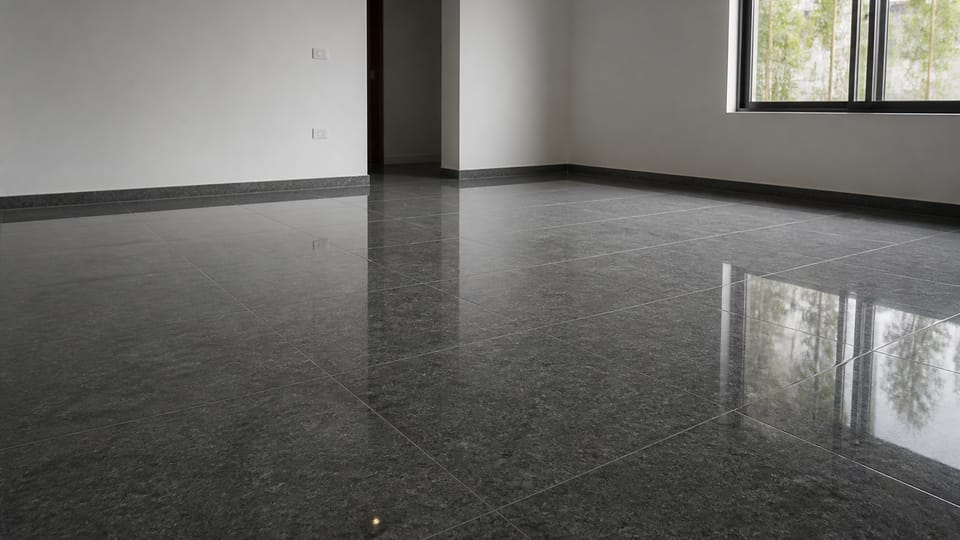
What does IS 14223 say about granite for flooring? IS 14223 (Part 1):2023 covers the physical properties and finish of polished natural granite and similar stones sold as granite. It asks for a fine polished top face, a glossmeter polish check, dimensions and tests such as water absorption, compressive strength and abrasion. It has no clause on floors, floor thickness, laying or slip resistance, so those come from the supplier and engineer.
On this page (9)
Granite is the stone people most often ask about for a house floor, and the search results are mostly supplier pages about colour, price and thickness. This page does something narrower: it says what the Indian Standard for polished granite, IS 14223 (Part 1):2023, actually asks for, what it leaves out, and what you can check yourself when slabs arrive. It names no colour, quarry or brand, ranks no granite and gives no price. It is also not a guide to choosing between granite, marble and tile for each room.
What does IS 14223 (Part 1):2023 cover?
Clause 1 says it “covers physical properties and finishing requirements of polished natural granite and similar natural stones such as granodiorite, syenites, diorite, gabbro, basalt, dolerite, rhyolite, trachyte, and andesite that are also commercially referred to as granite, and used for various purposes”. The Foreword says the revision widened the title and scope to include stones similar to granite and made clear that the standard is for natural stones only. In trade, “granite” means igneous rocks whatever their mineralogy, grain size or colour, and gneisses and migmatites are also traded as granite. So an artificial or engineered stone sold as “granite” is not covered, and the word on a quote does not tell you the rock.
IS 14223 is not a flooring standard. We found no clause on floors in it. The Foreword says the standard is to guide users and exporters about the quality parameters of polished granite, and notes granite’s suitability for carving and for ornamental, monumental and inscription uses, with a high polish expected on dimensional granite. NBCS 2026 lists it, with IS 1128 (limestone), IS 1130 (marble), IS 3316 (structural granite) and IS 3622 (sandstone), under stone flooring, but lists no laying code for stone flooring. The standard sits alongside, and does not replace, the supplier’s own specification for floor use.
What does it ask for?
| Subject | What the standard says |
|---|---|
| Imperfections (cl 3) | Hairline cracks and joints, flowers, moles, knots, and white and dark lines “are considered to be imperfections”. Granite free of imperfections is more in demand, but granite with imperfections “may also be utilised in the industry” |
| Deleterious minerals (cl 3) | Generally granite shall be free from minerals such as pyrite and marcasite that affect colour and polishing, but granite with those minerals “shall also quarried and processed”, so the standard is permissive |
| Shape and faces (cl 4) | Slabs “shall be rectangular or square and of specified dimensions”. “The bottom face may be rough but the top surface shall be fine polished and joint faces shall be dressed with the top surface without hollowness and spalling off” |
| Dimensions (cl 4) | Tolerances on length, breadth and thickness are set; we print none |
| Finish (cl 6) | Mirror finish without any hairline crack, with polish checked on a glossmeter and not less than 95 percent |
| Physical properties (cl 5, Table 1) | Limits are set for specific gravity, water absorption, compressive strength, tensile strength, shear strength, hardness, ultrasonic pulse velocity and resistance to wear by abrasion, tested by the IS methods the standard names. Compressive strength applies only at or above a stated thickness, and hardness is given on three scales. We print none of the limits |
| Marking (cl 7) | The maker’s mark and the BIS Standard Mark are optional (“may be marked”) |
| Sampling (cl 8) | Slabs of one quarry in a consignment form a lot; slabs are drawn at random and checked for general requirements, dimensions and finish, and a sub-sample is tested for the physical properties only if the lot passes |
The test names and the limits are for the supplier’s test report and your engineer. The standard cites IS 1706 for the wear test; NBCS 2026 lists a 2024 edition of IS 1706.
What does it not say?
- Colour or origin. No ranking, and no best granite. The Foreword’s black, red, grey and multi-coloured groups describe appearance and trade.
- Floor thickness. The standard says “specified dimensions” and sets tolerances on thickness (we print none); its only other thickness reference is that the compressive strength requirement applies only to slabs at or above a stated thickness. It gives no thickness for floor use. Thicknesses quoted by suppliers are market practice, not an IS 14223 requirement.
- Laying. No mortar bed, joint, grout or curing rule.
- Slip resistance. No requirement, and no finish classes other than polished.
- Flatness and colour variation. No tolerance on flatness or squareness, and no limit on colour variation between slabs.
- Radioactivity. We found no limit in it. We make no health claim about granite.
- Counter or floor. The standard does not distinguish a counter slab from a floor slab.
What should I check when slabs arrive?
This is practice, apart from the clauses named.
- Ask the supplier for the stone name, the standard it is sold to (IS 14223 Part 1:2023) and a test report for the lot that names the tests above.
- Approve a sample slab in writing, and compare every delivered slab with it.
- Look at the top face for the fine polish, hairline cracks, pits, cavities, chips and filled veins (clause 6 asks for no hairline crack), and at the joint faces for hollowness and spalling (clause 4).
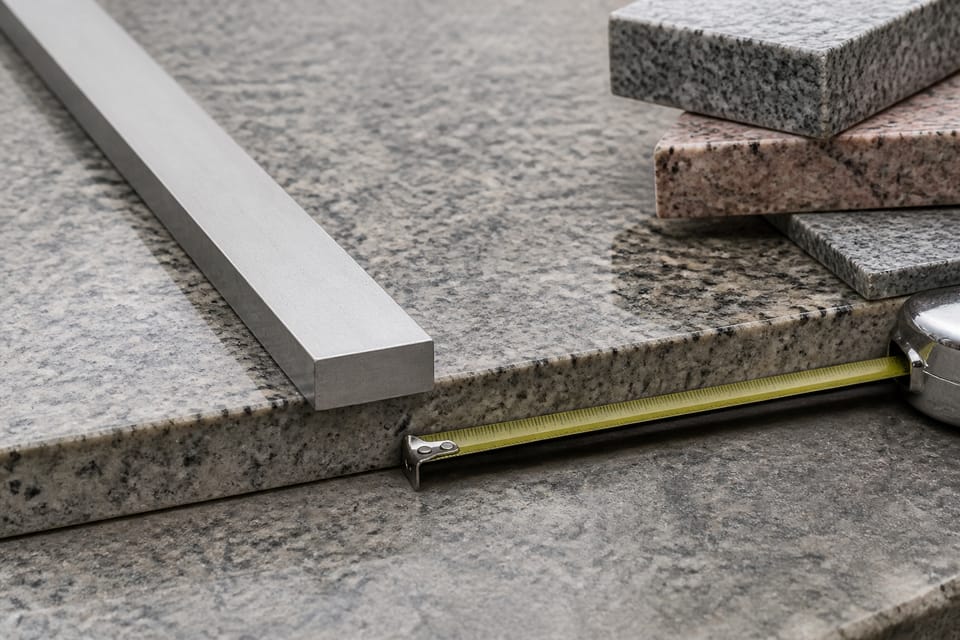
- Measure length, breadth and thickness at several points with a steel tape, check squareness, and lay a straightedge across a few slabs for flatness. Check against the tolerance the supplier states.
- Check colour across slabs from the same lot laid side by side. Mixed lots show up as patches.
- Reject cracked, chipped and stained slabs before laying. Check rust marks and stains on the back.
For the base under a wet-area floor, see bathroom waterproofing: steps, wall height and the ponding test. For movement joints in large floors, see expansion joints in a house: where walls and slabs need a gap.
What about polish, slip and cleaning?
This is practice. A high-gloss polished face is slippery when wet, so ask the supplier and your architect about the finish for bathrooms, balconies, ramps and entrances; IS 14223 sets no slip requirement and describes only the polished finish. Sealers help with stains but do not make stone stain-proof, and whether to seal is a supplier decision. Ask for the care instructions in writing, and avoid acid cleaners, which can dull a polish.
What mistakes should I avoid?
These are practice unless a clause is named.
- Taking a figure from the 1995 edition, or from a website, for the current limits. The 2023 edition replaced the 1995 one.
- Calling IS 14223 a flooring or laying standard.
- Accepting slabs with no sample approval and no test report.
- Mixing lots, so that colour and veining differ across the room.
- Choosing a mirror-polish face for wet areas without asking about slip.
- Using counter-grade slabs for floors without asking the supplier about thickness, size and edge.
- Treating an artificial or engineered stone as IS 14223 granite.
- Laying on a thin or uneven base, with hollow spots or no joint plan.
- Believing that sealer makes granite stain-proof or non-slip.
Frequently asked questions
What does IS 14223 say about granite?
It covers the physical properties and finish of polished natural granite and similar stones, with a polished top face, a glossmeter check, dimensions and tests for properties such as water absorption, compressive strength and abrasion.
What thickness of granite is used for flooring?
IS 14223 gives no floor thickness. Ask the supplier and your engineer, and get the thickness in the quote.
Is granite flooring slippery?
A mirror-polished granite face is slippery when wet. The standard sets no slip requirement; ask for a finish suited to wet areas.
Is granite the same as marble?
No. Marble is covered by its own standard, IS 1130, and a separate Part 2 of IS 14223 was published for marble and similar stones.
Does IS 14223 limit radioactivity?
We found no radioactivity limit in it.
Related guides
- Bathroom waterproofing: steps, wall height and the ponding test
- Expansion joints in a house: where walls and slabs need a gap
- Terrace leakage and waterproofing: methods, slope and ponding test
This guide is general information. Read the disclaimer. Your engineer, architect and supplier decide the stone, its thickness and its laying for your house.
Sources
- IS 14223 (Part 1):2023, Polished Building Stones, Specification, Part 1, Granite and Similar Stones (first revision): Foreword, clauses 1, 3, 4, 5, 6, 7 and 8, Table 1 and Table 2 (page images read). BIS lists it as in force, valid to 2028-12-31; the 1995 edition was withdrawn in January 2024. A Part 2 (marble and similar stones) was published in 2025 and was not read.
- SP 7:2026, National Building Construction Standards (NBCS) 2026, Part B Building Materials, the lists headed Stone Flooring and Stones (text layer read). From an unofficial archive.org copy.
General information only. It is not a structural design or professional advice. Ask a licensed structural engineer or architect to check your plans and site.