
Short answer
What grade and thickness does IS 15658 give for paver blocks? IS 15658 pairs each grade, from M30 to M55, with a traffic category and a minimum thickness, from 50 mm to 100 mm. The grade is a strength in N/mm2. The standard does not choose a grade for your driveway. Your engineer does that from the vehicles you expect and the base you build.
On this page (12)
- What grades does IS 15658 list?
- How does the standard define the traffic categories?
- What minimum thickness applies to a block?
- What size and shape tolerances does the standard set?
- What tests must a paver block pass?
- What are the rules on the materials?
- How many blocks fit in a square metre?
- Inline image
- What mistakes should I avoid?
- Frequently asked questions
- Related guides
- Sources
A paver block is sold by a grade, such as M35 or M50, and a thickness, such as 60 mm or 80 mm. A seller’s catalogue may print either or both. This page sets out what IS 15658:2021, the Indian standard for concrete paving blocks, lists for each: the grades, the traffic each grade is named for, the minimum thickness, the size tolerances and the physical tests. It also shows how to work out how many blocks fit in a square metre.
It does not choose a grade or thickness for your driveway or courtyard. That depends on the vehicles that will use it and on the base under the blocks. Your engineer decides it. For the laying steps and the IRC road code, see the paver blocks driveway page. The laying code for paver blocks is IS 16777, not IS 15658.
What grades does IS 15658 list?
Table 1 of the standard lists five grades. Each grade has a characteristic strength, shown as f_ck in N/mm2 (MPa) at 28 days, a traffic category and a minimum thickness.
| Grade | Strength f_ck (MPa) | Traffic category | Minimum thickness (mm) |
|---|---|---|---|
| M30 | 30 | Non-traffic | 50 |
| M35 | 35 | Light traffic | 60 |
| M40 | 40 | Medium traffic | 80 |
| M50 | 50 | Heavy traffic | 100 |
| M55 | 55 | Very heavy traffic | 100 |
Source: IS 15658:2021, Table 1, clause 4. The thickness column is a minimum. Table 2 note 2 says the thickness must also meet the Table 1 minimum for the grade.
The grade is not a guarantee for every block. Table 3 sets a test for each block and a test for the average of a batch, as described below.
How does the standard define the traffic categories?
The traffic categories come from the notes under Table 1. The 2021 text counted vehicles per day. Amendment No. 1 (April 2022) changed the equivalent million standard axle (MSA) bands in the same notes and added a line about M55 blocks.
| Category | Commercial vehicles a day (2021 text) | Equivalent MSA over 20 years (after Amendment 1) |
|---|---|---|
| Non-traffic | No vehicles | Not applicable |
| Light traffic | Up to 150 | 0.5 to 2.0 |
| Medium traffic | 150 to 450 | 2.0 to 10.0 |
| Heavy traffic | 450 to 1,500 | 10 to 20 |
| Very heavy traffic | More than 1,500 | 20 to 50 |
Sources: IS 15658:2021, Table 1 notes 1 to 5; Amendment No. 1 (April 2022) for the MSA bands. The vehicles-per-day counts were not changed by the amendment. Vehicles are counted as those over 30 kN laden weight.
Amendment No. 1 also says that “M 55 grade and 120 mm minimum thickness concrete paving blocks shall be used for more than 50 MSA”. The Table 1 row for M55 still shows 100 mm.
The last column of Table 1 gives examples. The examples overlap. The standard lists domestic drives, paths and patios under non-traffic. It lists office driveways and housing colonies under light traffic. So the example list alone does not tell you the category for your driveway. The category depends on the traffic you expect, and the engineer decides it.
What minimum thickness applies to a block?
The minimum thickness is the one in the Table 1 row for the grade. In the 2021 text the thicknesses are 50, 60, 80, 100 and 100 mm for the five grades. Table 2 allows a thickness from 50 mm to 120 mm, and says a block over 120 mm can be made by agreement between the maker and the buyer.
A thicker block is not a higher grade. A block of M30 at 60 mm still has the M30 strength and the M30 category. Do not read a higher thickness as proof of a higher grade, or the reverse.
What size and shape tolerances does the standard set?
Table 2 sets the allowed variation in size and shape. Thickness is the main split: blocks under 100 mm and blocks at 100 mm and above have different tolerances.
| Item | Limit under 100 mm thick | Limit at 100 mm and above |
|---|---|---|
| Length and width | Plus or minus 2 mm | Plus or minus 3 mm |
| Thickness | Plus or minus 3 mm | Plus or minus 4 mm |
| Squareness | Plus or minus 2 mm (the nominal is nil) | Plus or minus 3 mm (the nominal is nil) |
Source: IS 15658:2021, Table 2 items i to iii and ix, clause 7.2. Table 2 also sets these fixed limits for every block:
- The length to thickness ratio (aspect ratio) must not be more than 4.
- A block with a wearing layer must have a wearing layer at least 6 mm thick.
- The chamfer or arris on the top edge must be between 5 mm and 7 mm.
- The ratio of the wearing face area to the plan area must be at least 0.75.
The plan area is marked optional in Table 2. Its value is set by agreement between the maker and the buyer.
What tests must a paver block pass?
Table 3 of IS 15658 sets the physical requirements. Each has a limit for one block (individual) and a limit for the average of a batch.
| Test | Individual block | Average of a batch |
|---|---|---|
| Water absorption | No more than 7% | No more than 6% |
| Compressive strength | At least f_ck minus 3 MPa | f_ck plus 0.825 times the standard deviation, rounded to 0.5 MPa, or f_ck plus 3 MPa, whichever is greater |
| Abrasion resistance | Dry: no more than 20,000 mm3 per 5,000 mm2. Wet: no more than 22,000 mm3 | Dry: no more than 18,000 mm3. Wet: no more than 20,000 mm3 |
| Splitting tensile strength | 0.08 f_ck for M35 and below; 3.0 MPa for M40 and above | 0.085 f_ck for M35 and below; 3.6 MPa for M40 and above |
| Flexural strength | 0.10 f_ck | 0.11 f_ck |
Source: IS 15658:2021, Table 3, clause 7.3, and its Annexes C to G. Table 3 note 2 says that if the maker has no established standard deviation, the standard says the 5 MPa value may be assumed, and asks for 30 samples to set one. This page does not describe the test methods. The annexes do.
The paver test is not the same as the concrete cube test. The M number in IS 456 concrete is set by a cube test. A paver block grade is set by the tests in IS 15658 above.
What are the rules on the materials?
Two rules in IS 15658 are worth knowing when you compare blocks. The coarse aggregate size is normally 12.5 mm. It may go up to 20 mm only for single-layer blocks of 80 mm thickness or more, or for two-layer blocks whose backing layer is 80 mm or more (clause 5.4.1.2). The pigment in the block must not be more than 9% of the cement by weight (clause 5.5.2).
How many blocks fit in a square metre?
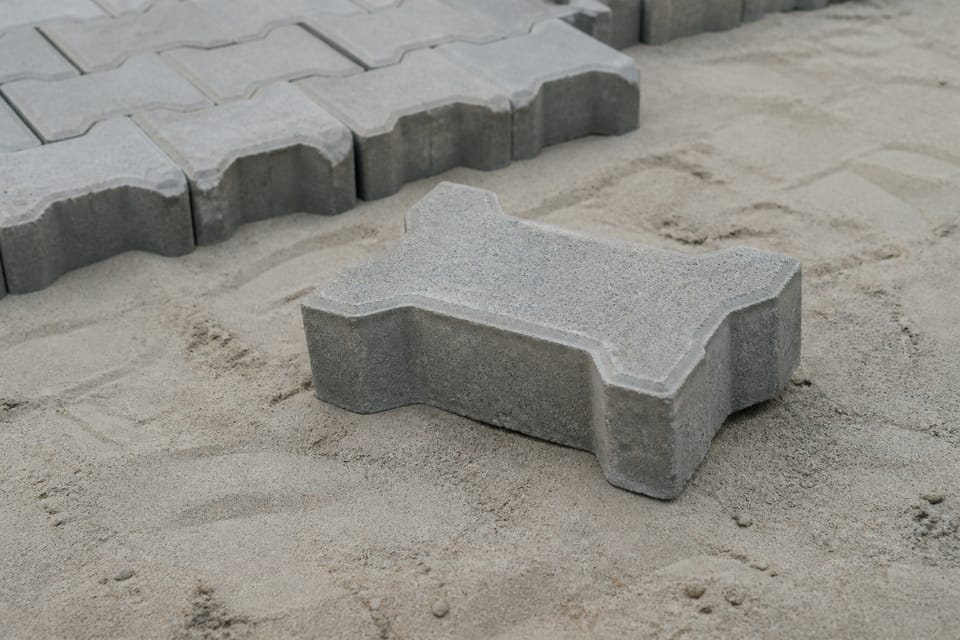
Neither IS 15658 nor IS 16777 gives a number of blocks per square metre. The count is simple arithmetic, and the joints are the part people forget.
The method is:
- Add the joint width to the length and to the width of the block. Both are in mm.
- Multiply the two results. This is the area of one block with its joint, in mm2.
- Divide 1,000,000 (the number of mm2 in a square metre) by that area.
Blocks per square metre = 1,000,000 / ((length + joint) x (width + joint))
The joint width comes from the laying code. IS 16777:2019 clause 4.4 says the gap between two paving blocks should be “preferably 3 mm and not more than 4 mm” and is to be filled with dry sand. Clause 8.9 says the 2 to 4 mm joint specification should be checked in the first few square metres of work.
| Step | Example input (assumed) | Result |
|---|---|---|
| Block length and width | 200 mm x 100 mm | Catalogue size, not a standard size |
| Joint width | 3 mm | Within IS 16777 clause 4.4 |
| Area with joint | 203 mm x 103 mm = 20,909 mm2 | |
| Blocks per m2 | 1,000,000 / 20,909 | 47.8 |
| Spare for cuts and breakage | 5% (assumed) | 51 blocks per m2 when rounded up |
This is an example, not a design. The block size and the 5% spare are assumptions. Use the size on your supplier’s data sheet. Cuts at the edges and breakage add to the count. The result is only as accurate as the size on the data sheet.
Inline image
What mistakes should I avoid?
These are practice points, not rules in the standard:
- Choosing by the colour or the shape. Two blocks can look the same and have different grades. Ask for the grade and the thickness in writing.
- Choosing by thickness alone. A thick block of a low grade is not the same as a thinner block of a higher grade for heavy vehicles. Check both against the traffic category.
- Counting blocks without the joint. Adding a 3 mm joint changes the count by about 2 blocks per square metre for a 200 mm x 100 mm block (50.0 to 47.8). Add cuts and breakage as well.
- Using the paver test as if it were a cube test. The two tests are different. The IS 15658 tests are in Table 3.
- Ordering without the test certificate. Ask the supplier for the test results for the batch you are buying.
Frequently asked questions
What grade of paver block is in IS 15658?
IS 15658 has five grades: M30, M35, M40, M50 and M55. Each is named for a strength in N/mm2 and is linked to a traffic category in Table 1. The grade you need for your paved area is set by your engineer.
Is a 60 mm paver block enough for a car?
Table 1 lists 60 mm as the minimum for M35 in the light-traffic category, which includes office driveways and housing colonies. Whether a 60 mm block suits your car and your base is a question for your engineer. The standard does not answer it for your site.
How many paver blocks do I need for one square metre?
Use the formula in the section above with the size on your supplier’s data sheet. Add the joint, and add a spare allowance for cuts. With a 200 mm x 100 mm block and a 3 mm joint, the arithmetic gives about 48 blocks per square metre before any spare.
Does IS 15658 tell me how to lay the blocks?
No. IS 15658 is the product standard. Amendment No. 1 refers to IS 16777 for laying practice for different traffic categories. The laying steps are in IS 16777 and in the paver blocks driveway page.
Related guides
- Paver blocks for a driveway: how they are laid and why they fail
- Parking tiles: what chequered cement tiles are and how they are laid
- Concrete grades M15 to M25: what the number means on your drawing
This guide is general information. Read the disclaimer. Your engineer decides the paver grade and thickness for your driveway or paved area.
Sources
- IS 15658:2021, Concrete Paving Blocks - Specification (First Revision). Clauses 1.1, 1.2, 5.4.1.2, 5.5.2, Table 1 with its Notes 1 to 5, Table 2 and Table 3 read from the page images. Edition read: January 2021.
- IS 15658:2021 Amendment No. 1 (April 2022), which changes the million standard axle bands in the Table 1 notes and adds the M55 line for more than 50 MSA.
- IS 16777:2019, Laying of Paver Blocks - Code of Practice. Clauses 4.2, 4.4 and 8.9 read. Covers laying; this page does not give laying steps.
General information only. It is not a structural design or professional advice. Ask a licensed structural engineer or architect to check your plans and site.