
Short answer
What does M20 or M25 mean in concrete? M stands for mix, and the number is the strength the concrete must reach: the compressive strength of a 150 mm cube at 28 days, in N/mm². M20 means 20 N/mm² and M25 means 25 N/mm². IS 456 allows a simple site mix only up to M20. For M25 and above, the mix must be designed. Your engineer's drawing sets the grade for each part of the house.

On this page (10)
Concrete on a drawing is written as M15, M20 or M25. The letter and number look like a code, and many owners do not know what they ask for when they order it. This page explains what the grade means, how the strength is tested, and when a site can mix concrete by a simple recipe. It does not give a mix ratio, a quantity or a rate for any grade. Those are on the cement, sand and aggregate page, and the choice of grade for each part of a building is the engineer’s job.
What does M20 mean?
The M stands for mix. The number is the strength the concrete must reach. IS 456:2000 says, in its note under Table 2, that “M refers to the mix and the number to the specified compressive strength of 150 mm cube at 28 days, expressed in N/mm2.” So M20 concrete is specified to reach 20 N/mm² on a 150 mm cube tested at 28 days, and M25 to reach 25 N/mm².
Table 2 of the code lists grades from M10 to M80. The grades from M10 to M20 are called ordinary concrete, M25 to M55 standard concrete, and M60 to M80 high strength concrete. Most house work is in the ordinary group (practice, not a code rule).
Why is 28 days used for the test?
28 days is the age at which the cube is crushed in the test. It is not the curing period. Curing is the wet care of the concrete after it is placed, and it is covered on the slab curing page. Mixing the two up is a common mistake.
What is the “5 percent” rule?
Concrete is tested in batches, and the results vary. Clause 6.1.1 of IS 456 defines the characteristic strength as “the strength of material below which not more than 5 percent of the test results are expected to fall.” So the grade is not the average result. It is a level that most results should reach. This is why a site cannot take a strength from one cube as proof of a grade.
Can a site mix M15 or M20 by a recipe?
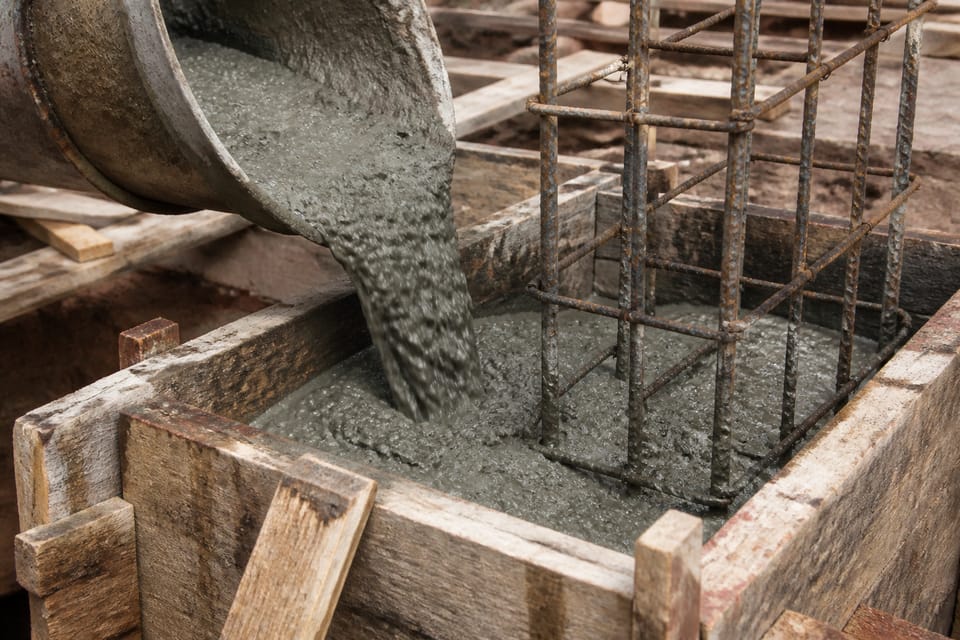
Sometimes. IS 456 prefers a designed mix. Clause 9.1.1 says that “Design mix concrete is preferred to nominal mix.” Clause 9.3 says a nominal mix is for “concrete of M 20 or lower.” A nominal mix is a set recipe by volume rather than a designed mix. Clause 9.1.1(b) allows it only where a design mix cannot be used for the work, with the engineer-in-charge’s permission.
Clause 9.3 limits nominal mix to M 20 or lower, so for M25 and above the mix must be designed. Clause 9.2.1 says the constructor “shall carry out the mix design,” and that the mix must be approved by the employer. Clause 9.2.2 says the mix is designed so the strength is at least the grade, with a target mean strength of the characteristic strength plus 1.65 times the standard deviation. You do not need the arithmetic. You need to know that the mix is designed and tested for that grade.
Which grade goes where?
Clause 6.1.2 of IS 456 says the minimum grade of concrete for plain and reinforced concrete is set by Table 5, which depends on the exposure. Clause 6.1.3 allows lower grades for simple work such as plain concrete, lean concrete and foundations for masonry walls. The grade for each member, such as a footing, beam, column or slab, is written on the drawing by the engineer. The grade is not a choice the owner or the mason makes on the day.
| Question | Where the answer comes from |
|---|---|
| Which grade is each member? | The structural drawing, set by the engineer |
| Can a site mix be used? | Clause 9.3: only for concrete of M20 or lower. Clause 9.1.1(b): only if a design mix cannot be used for the work, with the engineer-in-charge’s permission |
| How is the strength checked? | Cube tests on samples taken during the pour |
| What is the minimum grade? | Clause 6.1.2 and Table 5, by exposure |
What is a worked example?
Take a footing marked M20 on a drawing. The owner asks the mason for “M20.” The mason mixes the concrete by a volume recipe for that grade. This is a nominal mix. It is allowed for M20 under clause 9.3, and clause 9.1.1(b) allows it only if a design mix cannot be used and the engineer agrees. It gives no test result for the strength. Now take a column marked M25. A recipe is not allowed under clause 9.3, so the mix must be designed and the cubes tested.
What mistakes should I avoid?
These points are practice, not code rules.
- Assuming M25 is always better. A richer grade needs more cement and more careful control. The drawing sets the grade, and a higher grade does not help if the concrete is poorly placed or cured.
- Asking for “M20” with no mix or test. A site mix named by grade is a recipe, not a guarantee. Ask for the mix, the water quantity and the cube test results.
- Taking the 28 days as the curing time. The 28 days is the test age. The curing period is separate.
- Treating one cube as the strength of the whole member. The cube is an acceptance test. It does not measure the strength of every part of a member.
- Changing the grade without the engineer. A leaner grade to save cement, or a richer one without a drawing reason, should be checked first.
Frequently asked questions
Is M25 better than M20 for a house?
It is stronger, but it is not better in every case. The grade that is right for a member is the one on the drawing. Your engineer decides that.
What is M20 in cement bags?
This page does not give bag counts. The number of bags depends on the mix, and the cement, sand and aggregate page shows the bag count for each grade up to M20.
Can I use M15 for a house?
Only if the drawing says so, and the exposure and the member allow it. Clause 6.1.2 sets the minimum grade by exposure in Table 5, which this page does not reproduce. Ask your engineer.
Who tests the concrete on my site?
The strength is checked with cube tests on the concrete. Ask your engineer what tests are needed and who keeps the results.
Related guides
- Cement, sand and aggregate per cubic metre: M5 to M20
- Concrete for an isolated footing: a worked quantity example
- How many days to cure a concrete slab?
- Coarse aggregate for a house: what the size means and how it is chosen
- Concrete cube test: how cubes are made, tested and read
- Paver block grade and thickness: what IS 15658 lists
This guide is general information. Read the disclaimer. Your engineer decides the grade of concrete for every part of your house.
Sources
Change log
- : Added Related guides link to newly published article(s): paver-block-grades-and-thickness-what-is-15658-lists. No other text changed. Approved by the reviewing engineer (owner report, 2026-10-31).
- : Added Related guides link(s) to newly published article(s): Coarse aggregate for a house: what the size means and how it is chosen; Concrete cube test: how cubes are made, tested and read. No other text changed.
General information only. It is not a structural design or professional advice. Ask a licensed structural engineer or architect to check your plans and site.