
Short answer
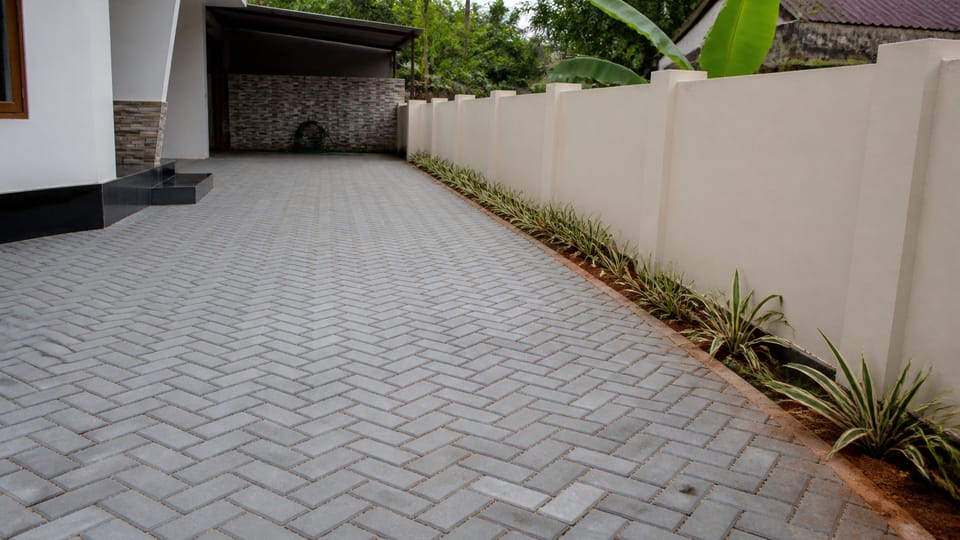
How are interlocking paver blocks laid for a driveway, and why do they fail? Paver blocks sit on a bed of sand over a prepared base, with sand in the joints and edges held firm. IRC SP 63 says the bedding sand should be 30 mm, plus or minus 5 mm, thick after compaction, and the joints should be filled before traffic is allowed. Blocks usually fail from loose joints, weak edges and poor drainage. The base depth for a driveway is not in the code. Your engineer sets it for your soil.
On this page (8)
A paved driveway or courtyard looks simple, but most failures come from the layers under the blocks and from the joints between them. This page explains how paver blocks are laid, what the Indian road code IRC SP 63 says about the main parts, and the usual reasons they fail. The code is written for public roads, footpaths and car parks. It does not give a base depth for a house driveway, and this page does not give one either. The engineer sets the base for your soil and your vehicles.
What are interlocking paver blocks?
Interlocking paver blocks are precast concrete blocks laid next to each other on a bed of sand. The blocks lock together and carry load through the joints and the sand. IRC SP 63 names the Indian product standard for these blocks as IS 15658. This page does not quote a grade or a strength from that standard, because the full text could not be checked.
The code’s block grades and examples are for public roads, footpaths and car parks. Clause 5.3 calls the Table 1 catalogue for commercial traffic “ad-hoc design catalogues based on international experience” (IRC SP 63, clause 5.3). The engineer should check any grade against the actual use of your driveway.
How are the layers laid?
| Layer | What the code says | What fails if it is wrong | Clause |
|---|---|---|---|
| Subgrade and base | Base and sub-base courses are built to MoRTH specifications. The code gives no separate compaction percentage. | The surface sinks or cracks under load. | 8.3 |
| Water table | The water table should be at least 600 mm below the subgrade. | Practice: water under the surface can soften the base. | 8.2 |
| Subgrade compaction | The subgrade is compacted in layers of 150 or 100 mm thickness, as IRC:36 and MoRTH specifications require. | Uneven settlement under the blocks. | 8.2 |
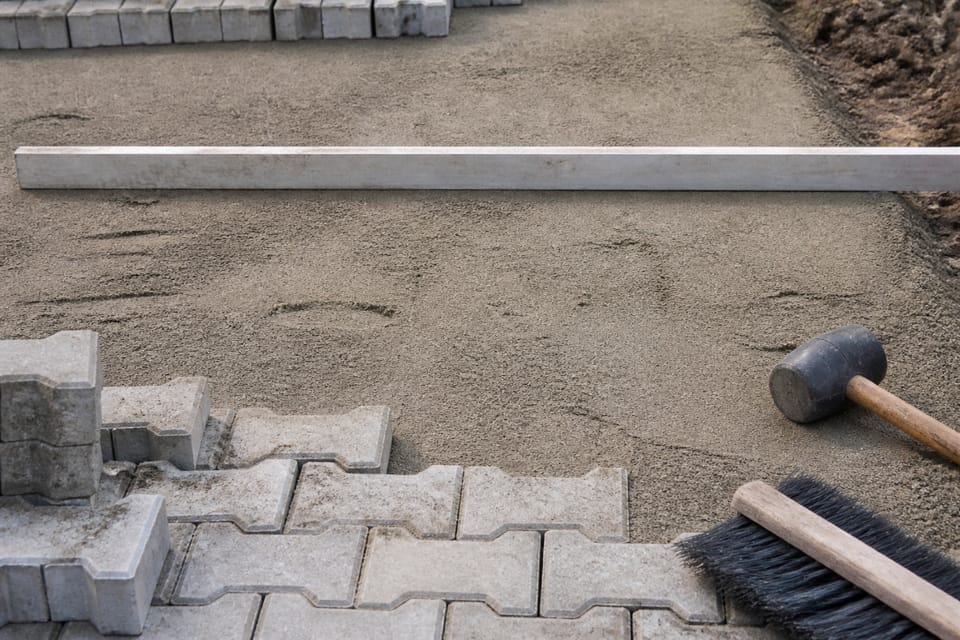
| Bedding sand | The sand bed after compaction should be 30 ± 5 mm thick. | Blocks rock or sit unevenly. | 5.2, 8.4 |
| Blocks and joints | The joint width range is 2 to 3 mm, with a nominal width of 3 mm. | Loose blocks and edges that break. | 8.8.6, Annexure I 1.3.5 |
| Edges | Blocks on trafficked pavements move sideways and forward. The edges must be held by kerbs or edge blocks, or by edge strips where there are no kerbs. | The whole field spreads and the outer blocks break away. | 4.6 |
Compaction is by a normal roller, preferably vibratory, or by a hand-held or plate vibrator where a roller cannot reach (Annexure I, clause 1.1.2).
How should the blocks be laid?
These steps follow the code’s method and the points it stresses. Steps 3 and 4 are practice where they go beyond a quoted clause:
- Prepare and compact the base. Set the base and sub-base to the depth the engineer chooses, and compact each layer.
- Spread the bedding sand. Bring the sand to a 30 ± 5 mm bed after compaction (clause 8.4). The code asks for a sand with not more than 3 per cent by weight of clay and silt (Annexure I, clause 1.2.4).
- Lay the blocks from a fixed line. Start from a straight edge or a kerb and work away from it. Keep the joints small and even.
- Fill the joints with dry sand. The code says dry sand and dry blocks are best for filling the joints (clause 8.8.4).
- Keep traffic off until the joints are full. The code says that until all the joints are completely filled, no traffic should be permitted over the pavement (clause 8.8.5).
- Check the sand after about a week. About a week after laying, inspect the surface for loss of sand at the joints, and put sand back wherever the level has dropped. The code says this inspection should continue for two to three months (clause 9.2).
Why do paver driveways fail?
The code gives the main failure mode. Unfilled or partly filled joints let the blocks deflect, which loosens them, can break the edges of the blocks and disturbs the bedding sand (clause 8.8.4). The other causes below are practice points, drawn from common faults rather than quoted clauses:
- Loose or empty joints. Sand not swept in and topped up.
- No edge restraint. Blocks move outward, and the outer rows break or drop.
- Water under the surface. Water that is not drained away softens the base and the sand. Surface repairs do not fix this.
- Poor levels. Uneven laying leaves high and low blocks, so each load pushes some blocks more than others.
- Weak base. A base that is not compacted in layers settles under the blocks.
What mistakes should I avoid?
These are practice points, not code rules:
- Laying blocks straight onto soil without a bed of sand.
- Leaving the joints open and driving on the surface the same day.
- Letting a roof downpipe or a tap discharge onto the paving edge.
- Using a block grade chosen from a seller’s table rather than the engineer’s check of the load.
- Repairing a sinking patch on the surface without fixing the base and water flow.
Frequently asked questions
How thick should the base be for a driveway?
IRC SP 63 does not give a base depth for a house driveway. Its worked base depths are for car parks and industrial yards (clauses 5.2 and 5.4), not house driveways. Ask your engineer to set the base for your soil and the vehicles that will use the driveway.
Can paver blocks carry a car on soil alone?
The code’s method is built on a base course, not on soil alone. Whether your soil can carry the driveway without a stronger base is for the engineer to decide. Read the soil test before building a house first.
Do I need a kerb or edge block?
The code says the edges must be held. It says kerbs or special edge blocks are used, and edge strips where there are no kerbs (clause 4.6). Ask your engineer which edge suits your driveway.
How do I stop the joints from emptying?
Fill the joints with dry sand, sweep the surface, and check the joints after about a week. Put sand back wherever it has dropped (clause 8.8.4 and the maintenance note).
These answers are practice guidance, not code quotes.
This guide is general information. Read the disclaimer. Your engineer decides the base and the grade for your driveway.
Related guides
- Soil test before building a house: what it is and why it matters
- Plinth protection: the sloping apron around your house
- Pre-monsoon checklist for your house and your building site
- Paver block grade and thickness: what IS 15658 lists
Sources
Change log
- : Added Related guides link to newly published article(s): paver-block-grades-and-thickness-what-is-15658-lists. No other text changed. Approved by the reviewing engineer (owner report, 2026-10-31).
General information only. It is not a structural design or professional advice. Ask a licensed structural engineer or architect to check your plans and site.