
Short answer
How is stone cladding fixed to an outside wall so it stays on? IS 4101 Part 1 (1967) fixes stone facing with metal cramps into the backing wall, dowels between slabs and mortar bedding, with support at storey levels and joints that allow movement. It names no thin glued stone and no steel-frame system. CPWD describes a dry system on a steel frame with stainless cramps. Your engineer decides the fixing.
On this page (10)
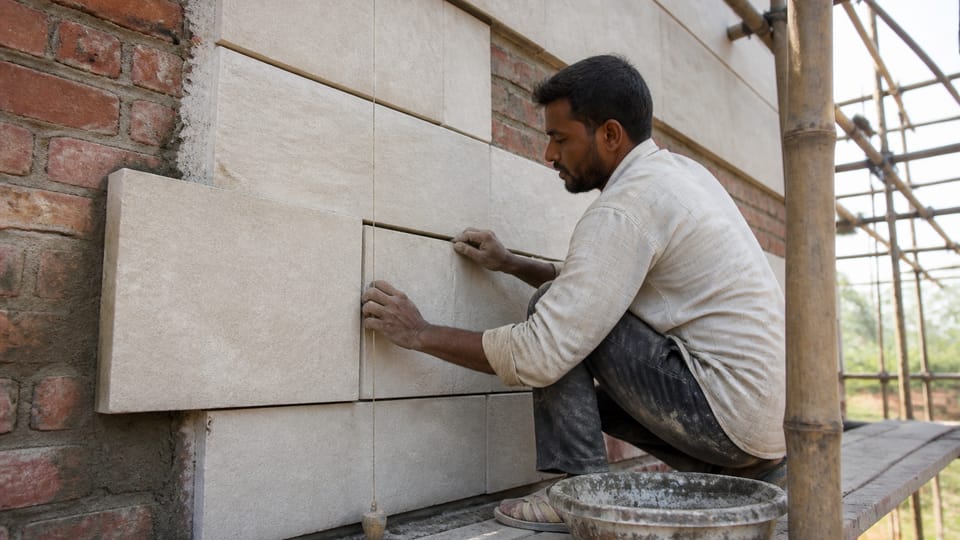
Stone on an outside wall looks solid, but it is a skin held to the wall by metal, mortar and weight, and it falls when any of those fails. The Indian code for stone facing, IS 4101 Part 1, is from 1967. It still sets out how slabs are held, supported and jointed, and it is silent on the thin glued stone that is common today. This page explains what the code and the CPWD specifications say, in plain words, and what they do not cover. It gives no thickness, cramp size, spacing, mortar mix or joint width, because those are for your engineer’s drawing. For outside tiles, see exterior wall tiles: how to fix them so they do not fall off.
Is it cladding, facing or veneer?
The word “cladding” is not in IS 4101 Part 1, whose title is “External Facings and Veneers: Stone Facing”. It defines stone facing as “stone dressed to the form of a thin slab, veneer or masonry unit and applied to the face of the wall”, and veneering as facing work “where the facing material is thin compared with exposed area of the facing unit”. “External cladding” is the title of Part 3, which covers wall tiling and mosaics. CPWD uses a thickness line to separate stone veneering from ashlar masonry; the number is not printed here.
NBCS 2026 (Part C Section 4) defines a veneered wall as one “in which the facing is attached to the backing but not so bonded as to result in a common action under load”, and says “the facing (veneer) shall be entirely ignored in calculations of strength and stability”. So stone fixed to a wall as a veneer does not make it stronger, and the wall behind must carry the wall and the stone. Only facing built bonded into the wall, a different construction, can be counted (IS 4101 Part 1 clause 5.1(b); NBCS 2.21(b), a faced wall).
What holds the stone on?
IS 4101 Part 1 describes these parts, and what each does:
| Part | What the code says |
|---|---|
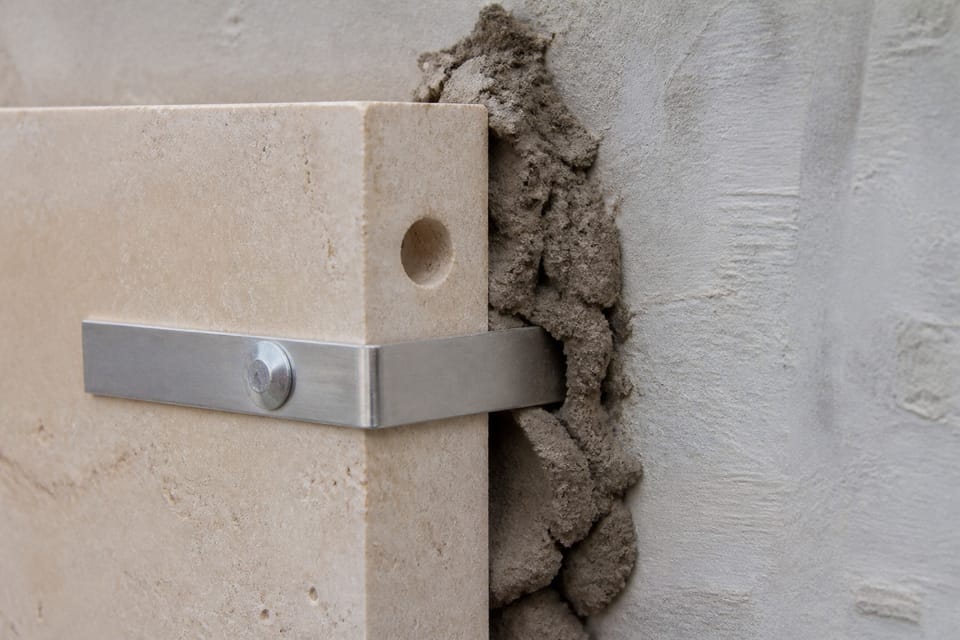
| Cramp | A thin piece of metal bent at each end, or a piece of stone, used to hold blocks of stone permanently in position (clause 2.1) |
| Dowel | A metal pin inserted in holes to hold adjacent facing units together (clause 2.2) |
| Mortar behind the slab | The stone is “well wetted before laying” and “no chips or fillings of any sort” are used (clause 7.1) |
| Shelf support | Where cramps only hold position, a continuous support at ground and storey levels and over openings (clause 5.3.1.1) |
| Staggered joints | Staggering vertical joints is preferred, “to reduce the danger of wholesale collapse” (clause 5.3.1.3) |
| Movement joints | Expansion joints in the structure or backing wall “shall also be carried through the facing”, except the extra close-spaced joints in parapets and copings (clause 5.4) |
Clause 5.3.1 says cramps work in two ways: they only hold units in position and pass the weight to the unit below, or they hold and also support, passing weight to the backing. Clause 5.3.1.2 warns that one faulty or missing cramp or imperfect unit “may result in collapse of many facings above and around the point of failure”, and says intermediate supports are essential. Clause 5.2.1 asks that the design allow for the pushing and pulling effect of wind, and clause 5.2.2 that the weight on the cramps be considered.
What metal may be used?
Clause 0.2 says stone facing needs “careful fixing techniques involving proper preparation, appropriate choice of fixing devices and weather-proof construction”. Clause 0.2.1 says cramps and dowels are commonly of copper alloys, and that other materials such as aluminium alloy or plastics may find use, but “galvanized mild steel, however, is not considered suitable for the fixtures”. Clause 4.3 asks for high resistance to corrosion under damp conditions and against the chemical action of mortar or concrete, and names copper alloys and stainless steel. CPWD 8.8.4.6 narrows this to copper alloyed with zinc or nickel, or stainless steel of grade 304, and adds that cramps carrying load “should be properly designed as per IS 4101 (Part 1)”.
How is water kept out?
IS 4101 Part 1 clause 5.5 says it is preferable to use joint sealing compounds where the facings are exposed to heavy rainfall and winds, and clause 4.6 says the manufacturer’s advice on such compounds is needed. Clause 5.6 says that, generally, apart from the joints, water seldom finds access through the stone unit. Clause 5.6.2 says string courses that throw water off reduce penetration at joints and at the facing unit. CPWD 8.8.5 repeats the sealing compound preference and asks that hollow groundings found by tapping the face stones be taken out and relaid. Part 1 has no clause on efflorescence, staining or cleaning.
What does the code not cover?
- IS 4101 Part 1 is a code for slabs fixed with cramps and dowels in mortar. It has no thin adhesive-fixed stone, no steel-frame dry cladding and no anchor design. The standard says only the simple methods feasible at the time are covered (clause 0.2.2).
- CPWD 2019 does describe a dry stone cladding system on a steel frame with stainless adjustable cramps, a weather sealant at the joints, and the cramp design by the manufacturer with the engineer-in-charge’s approval (8.12 to 8.14). Its details are contract-specific, so none are printed here.
- CPWD says 8 mm marble tiles fixed with special adhesive are not suitable for outside veneering exposed to rain and sun in large continuous stretches (clause 8.2, note 6).
- For thin glued stone, the adhesive maker’s data sheet and the supplier’s instructions apply. IS 15477:2019 covers adhesives for ceramic, mosaic and stone tiles; we did not find that it covers heavy cladding slabs.
- This page prints no thickness, spacing, sealer or cleaning method. The codes give some figures, and your engineer’s drawing sets them. No standard we read gives a cleaning method for stone facing, or defines “stone veneer” as a thin manufactured product.
What should I decide and ask? (practice)
This is practice, apart from the clauses named.
- Natural or manufactured stone, wet-fixed or dry-fixed: the engineer decides, from the wall, the height and the weight.
- Which walls: treat stone above windows, on a parapet or on a thin brick wall as an engineer question.
- Ask the contractor: how each stone is held and with what metal; what is behind the stone; where water that gets in will leave; where the movement joints are; and what the guarantee covers, in writing.
- Make a sample panel on site before the whole wall.
- Check: tap the stone for a hollow sound; joints filled and even; no white powder or rust streaks; fixing metal shown before it is covered; stone fixed only after the wall and plaster have cured. For damp problems, see damp walls: rising damp, seepage or condensation, and the fix.
What mistakes should I avoid? (practice)
- Stone on an unprepared, damp or uncured wall.
- Relying on dabs of mortar or adhesive alone, with no cramps or other fixing.
- No path for water to get out.
- Mixing metals, which can cause rust stains.
- Ignoring hollow spots.
- Sealing the stone too early.
- Heavy stone on a weak wall or parapet without an engineer.
Frequently asked questions
What is the difference between stone cladding and stone veneer?
IS 4101 Part 1 defines stone facing and veneering and does not use the word “cladding”; the word appears in the title of Part 3. The market sense of “stone veneer” as a thin manufactured product is not defined in a standard we read.
Can stone be fixed with adhesive alone outside?
IS 4101 Part 1 does not cover adhesive-fixed stone. Use the maker’s data sheet and ask your engineer.
Does stone cladding make the wall stronger?
Not when it is fixed as a veneer: NBCS 2026 says the veneer facing is ignored in strength calculations. IS 4101 Part 1 allows bonded facing to be counted, but that is a different construction.
Can galvanised steel be used for the fixings?
IS 4101 Part 1 clause 0.2.1 says galvanized mild steel is not considered suitable for the fixtures. Steel angle supports under the facing may be galvanised or painted (clause 4.4), and brass is preferred. The cramps and dowels are the fixings that must be corrosion-resistant metal.
Does stone cladding need movement joints?
IS 4101 Part 1 clause 5.4 asks that expansion joints in the structure or backing wall be carried through the facing.
Related guides
- Exterior wall tiles: how to fix them so they do not fall off
- Damp walls: rising damp, seepage or condensation, and the fix
- Expansion joints in a house: where walls and slabs need a gap
This guide is general information. Read the disclaimer. Your engineer decides how stone is fixed to your house.
Sources
- IS 4101 (Part 1):1967, Code of Practice for External Facings and Veneers, Part 1 Stone Facing: clauses 0.2, 0.2.1, 0.2.2, 2.1 to 2.4, 4.3, 4.4, 4.6, 5.1 to 5.6.2 and 7.1 (page images read; clause 2 definitions from the text layer). BIS lists it as in force, valid to 2030-09-10; the cover says reaffirmed 2000.
- CPWD Specifications 2019, Volume 1, Sub Head 8 (stone work), clauses 8.2 note 6, 8.8 to 8.8.5 and 8.12 to 8.14 (page images read). Copy hosted by Puducherry PWD. CPWD is a specification for the works it covers, not a BIS standard.
- SP 7:2026, National Building Construction Standards (NBCS) 2026, Part C Section 4, Masonry: clauses 2.21(b), 2.21(c), 5.5.1.3 and 5.5.1.4 (2.21 and 5.5.1.4 page images read; 5.5.1.3 not viewed). From an unofficial archive.org copy.
General information only. It is not a structural design or professional advice. Ask a licensed structural engineer or architect to check your plans and site.