
Short answer
What are the Proctor test and the core cutter test for soil compaction? The laboratory compaction test (IS 2720 Part 7 light, Part 8 heavy, called standard and modified Proctor) packs soil in a mould at several water contents and finds the maximum dry density (MDD) and the water content that gives it (OMC). The core cutter test (Part 29) measures the dry density actually achieved in a compacted fine-grained layer. The engineer sets the target; the standards give none.
On this page (9)
When a trench is backfilled or a plinth is filled, the question is not only what soil went in but how tightly it was packed. Two tests answer that: a laboratory test that finds how much a particular soil can be packed and at what water content, and a field test that measures what was actually achieved in a layer. This page explains both, the words that go with them, and what to ask for. It is not a backfilling method page. It gives no compaction percentage, no layer thickness and no machine, because no standard we read gives a target for house fill, and the engineer sets it.
What do “dry density” and “unit weight” mean?
IS 2809 is the glossary behind the soil test standards. Its entries, in plain terms:
| Term | What IS 2809 says |
|---|---|
| Unit weight | “Weight per unit volume of a soil mass” (2.343) |
| Dry unit weight, dry density | “The weight of oven dry soil (soil solids) per unit of total volume of soil mass” (2.343.1); “Dry Density ( Dry Unit Weight )” is “the weight of oven dry soil per unit volume of soil mass” (2.112) |
| Wet unit weight | “The weight (solids plus water) per unit of total volume of soil mass, irrespective of the degree of saturation” (2.343.5) |
| Density | Refers to unit weight, with the note that “in the field of soil mechanics the term is frequently used in place of unit weight” (2.104) |
| Compaction | “The densification of a soil by means of mechanical manipulation” (2.72) |
| Compaction curve | The curve showing the relationship between the dry unit weight (density) and the water content for a given compactive effort (2.73) |
| Optimum water content (OMC) | “The water content at which a soil can be compacted to the maximum dry unit weight by a given compactive effort” (2.213) |
IS 2809 has no entry for maximum dry density. The test standards define it by what the test reports: the dry density at the top of the curve. Wet and dry values differ by the water in the soil, which is why every field test also measures water content (IS 2720 Part 2). The words “bulk density” are used in some standards for the wet value and in other fields for the dry one, so always ask which is meant.
What does the laboratory compaction test do?
IS 2720 (Part 7):1980 covers the relation between water content and dry density using light compaction, and Part 8:1983 does the same with heavy compaction. They correspond to what is often called the standard and the modified Proctor test (NBCS 2026 uses those names; the standards do not). The Foreword (clause 0.2) says: “The purpose of a laboratory compaction test is to determine the proper amount of mixing water to be used, when compacting the soil in the field and the resulting degree of denseness which can be expected from compaction at optimum moisture content.” It adds that with the water-density relation known, better control of field compaction is possible because the optimum moisture content and the density to be obtained “can be checked by field control tests”.
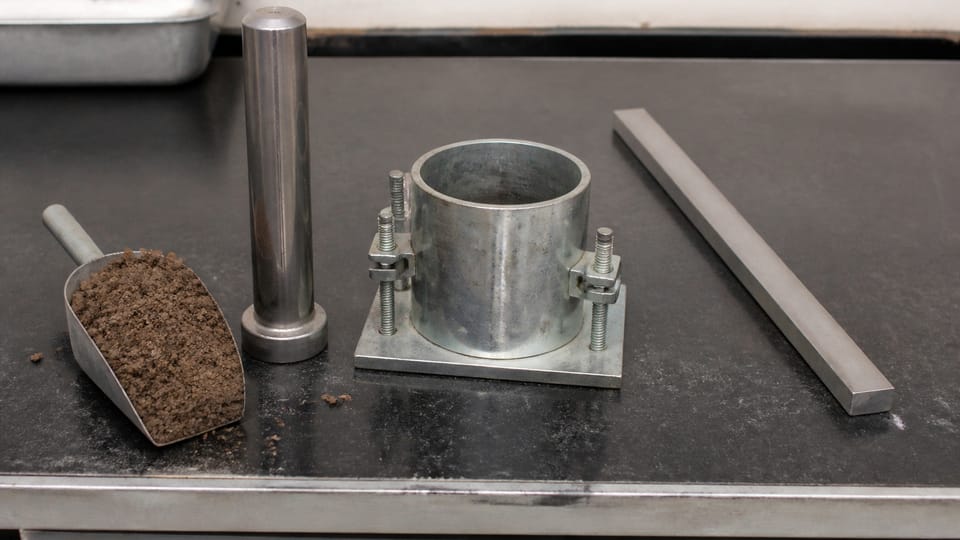
In outline, moist soil is compacted in layers in a standard mould with a rammer dropped from a fixed height, the top is levelled and the mould weighed, and a sample is taken for water content. The soil is then broken up, water is added and the steps repeat, at least five times, so that the range includes the optimum. The dry density is worked out from the wet density and the water content, and the points are plotted against water content; “a smooth curve shall be drawn through the resulting points and the position of the maximum on this curve shall be determined” (clause 6.3). The dry density at the maximum is reported as the maximum dry density, and the water content at that point as the optimum moisture content (7.2 and 7.3). We print no rammer, layer or mould detail: the heavy test packs more energy into the soil than the light one, so the two give different maximum values and optimum water contents, and a result is only meaningful with the test named.
The standards say where the test is weak (Part 7, Foreword). It is “satisfactory for cohesive soils but does not lend itself well to the study of the compaction characteristics of clean sands or gravels”, and for highly permeable soils such as clean gravels and coarse clean sands the result “may provide only a poor guide for specifications on field compaction” (Part 7, Foreword and the Note under 7.5). Where a large proportion of stone coarser than the stated size has been removed from the lab sample, Part 7 notes (Note 2) that there is no generally accepted method for comparing the laboratory result with field density.
What does the core cutter test do?
IS 2720 (Part 29):1975 “covers the method for the determination of the in-place density of fine-grained natural or compacted soils free from aggregates using a core-cutter” (clause 1.1). Its Foreword says the method is suitable for fine-grained soils free from aggregations, is “less accurate than the sand-replacement method” and is “not recommended, unless speed is essential or unless the soil is well compacted”. A note says the cutter “should not be used in stony soils”.
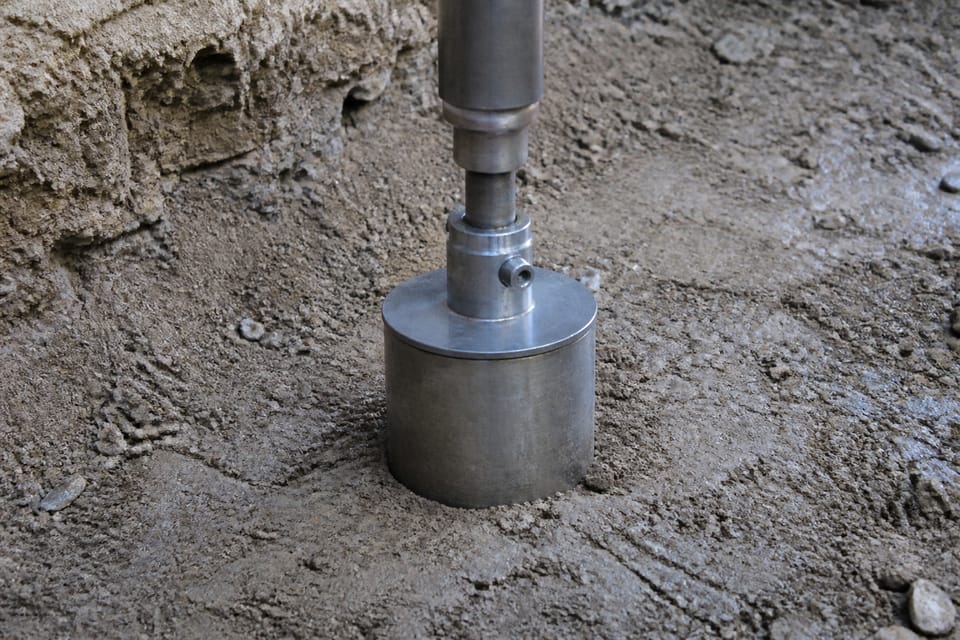
In outline, a small area of the layer is levelled, a steel cylinder with a sharp edge is rammed in with a dolly, dug out, trimmed flat at both ends and weighed, and a sample is taken for water content. The wet density is the weight of the soil divided by the volume of the cutter, and the dry density is worked out from it and the water content (clauses 4.1 and 4.2). The soil varies from point to point, so the standard says to make repeat determinations, at least three, and average them. Part 28, the sand replacement method, has a large-cylinder section for soils containing stones (its Foreword 0.3); we mention it by name only and read only its scope and Foreword.
How do the two fit together?
This is practice, apart from the Foreword quoted above.
- The laboratory test is run on a named soil and gives a reference: the maximum dry density and optimum moisture content for that soil under a stated compaction energy.
- The field test gives the dry density achieved in one layer at one spot.
- The engineer compares the field result with the laboratory reference, and the target, a stated share of the laboratory maximum, is the engineer’s decision. IS 2809 defines “degree of compaction” and “percent compaction” as that kind of ratio, and the test standards give no target. NBCS 2026 has no percentage target either. Its backfilling clause (Part C Section 2, 6.11.4) says the backfill shall be compacted in layers with the minimum water necessary for proper compaction, and its soil investigation list includes the light and heavy compaction tests (clause 3.5.7.1). A laboratory result for one soil does not apply to a different soil brought in later.
What should I ask for?
This is practice.
- The name of the fill soil and its source, and that the same soil is used throughout.
- The laboratory report with the curve, stating which test (light or heavy) was used and giving the maximum dry density and the optimum moisture content.
- The target, in writing, set by the engineer before filling starts.
- Where and in which layers the field tests will be taken: a spread of locations and layers, not one test at the top.
- That a layer that fails is re-compacted and retested before the next layer goes on.
- That every report is kept with your handover papers.
For the soil investigation that comes before the foundation, see soil test before building a house: what it is and why it matters. For why black cotton soil is a poor choice for fill, see black cotton soil: why houses crack and what the engineer checks.
What mistakes should I avoid?
These are practice unless a standard is named.
- Testing once at the top of the fill instead of layer by layer.
- Testing a lab sample that is not the soil actually used on site.
- Watering the fill heavily. Water helps only up to about the optimum, and wet clay stays soft.
- Taking “optimum moisture content” to mean more water is better. It is the water content at which that soil, at that compaction energy, packs densest.
- Using a core cutter in stony soil (Part 29 says it should not be used in stony soils, and covers fine-grained soils free from aggregates).
- Confusing the laboratory maximum dry density with the density achieved in the field: one is the reference, the other the result.
- Starting the floor base before the fill is tested and approved.
- Quoting a percentage from a website as the Indian rule. We found none in the standards.
Frequently asked questions
What is the difference between unit weight and dry density?
Unit weight is weight per unit volume of the soil mass. Dry density is the weight of the oven-dry soil solids per unit volume. The wet value includes the water.
What are MDD and OMC?
The maximum dry density is the dry density at the top of the compaction curve for a soil and a compaction energy, and the optimum moisture content is the water content at which it occurs.
What is the difference between standard and modified Proctor?
In India they are IS 2720 Part 7 (light compaction) and Part 8 (heavy compaction). Heavy compaction puts more energy into the soil, so the two give different results.
When is the core cutter test used?
For fine-grained compacted soil without stones, to check the density of a layer. IS 2720 Part 29 says it is less accurate than sand replacement.
What percentage of MDD must a house fill reach?
No standard we read gives one. The engineer or the project specification sets it.
Related guides
- Soil test before building a house: what it is and why it matters
- Black cotton soil: why houses crack and what the engineer checks
- Plinth protection: the sloping apron around your house
This guide is general information. Read the disclaimer. Your engineer and the testing laboratory decide the soil tests, the target and the layers for your house.
Sources
- IS 2720 (Part 7):1980, Methods of Test for Soils, Part 7, Determination of Water Content-Dry Density Relation Using Light Compaction (second revision, with Amendments 1 and 2): clauses 0.2, 1.1, 5.1.4, 6.3, 7.1 to 7.3, Note 2 under 5.3 and Note 7 after 7.5 (page images read). BIS lists it as not withdrawn, with a validity date of 2026-12-31, so check the BIS portal for a newer edition. IS 2720 (Part 8):1983, the same test with heavy compaction (second revision): clauses 0.2, 1.1 and 7.5 (page images read; formula page not viewed). BIS lists it as in force, valid to 2030-05-31.
- IS 2720 (Part 29):1975, Determination of Dry Density of Soils In-Place by the Core-Cutter Method (first revision): clauses 0.2, 1.1, 1.1.1, 2, 3.1 to 3.5, 4.1, 4.2 and 5 (page images read). BIS lists it as in force, valid to 2030-05-31. IS 2720 (Part 28):1974, the sand replacement method, was read in its text for clause 1.1 and Foreword 0.3 only.
- IS 2809:1972, Glossary of Terms and Symbols Relating to Soil Engineering (first revision): clauses 2.72, 2.73, 2.101, 2.104, 2.112, 2.213, 2.224 and 2.343 with 2.343.1 and 2.343.5 (page images read). BIS lists it as in force, valid to 2030-05-31.
- SP 7:2026, National Building Construction Standards (NBCS) 2026, Part C Section 2, Soils and Foundations: clauses 3.5.7.1 and 6.11.4 (page images read). From an unofficial archive.org copy.
General information only. It is not a structural design or professional advice. Ask a licensed structural engineer or architect to check your plans and site.