
Short answer
What is the standard penetration test, and what does the N value tell the engineer? The standard penetration test drives a split spoon sampler into the soil at the bottom of a borehole with a falling hammer, and counts the blows for the stretches after the first. That count is the N value, which the standard calls the penetration resistance. IS 2131 gives the method; the engineer uses the N value with other soil data. The 1981 edition was read here; a later edition, listed as in force, was not read.
On this page (10)
Before a foundation is designed, the engineer wants to know how the soil feels at depth. The standard penetration test is one way to find out, and it gives a sample as well as a count. This page explains how the test is run under IS 2131, what the N value is, and what an owner should ask for in the report.
The page gives no hammer mass, drop height, distance or count. The 1981 edition sets those, and a later edition that was not read here may differ, so the numbers are left to the standard and the soil engineer.
What is the test?
The test drives a hollow split spoon sampler into the soil at the bottom of a borehole. A hammer falls on the rods above the sampler, and the sampler is driven in stages. The sampler is split so that the soil inside can be taken out and kept as a sample (clauses 2.2 and 3.4.1).
The foreword says a standard procedure is necessary for dependable and reproducible samples (foreword 0.2). The equipment is set out in clauses 2.1 to 2.4.
How is the test run?
The steps in the standard are in outline below. The numbers are left to the standard.
- Drill the borehole. The borehole must be clean and of the diameter the standard sets for the sampler (clause 2.1.1). A casing may be used to keep the borehole open, but the casing is not driven below the level of the test (clause 3.1).
- Clean the bottom. The bottom of the borehole is cleaned up to the level of the test, so that the soil under the sampler is not mixed with the soil above (clause 3.2.3). Where the soil is below the water table, the water level in the borehole is kept up (clause 3.2.2).
- Lower the sampler. The sampler rests on the bottom of the borehole, and it is allowed to sink under its own weight first (clause 3.3.2 and 3.3.3).
- Seat the sampler. The hammer is dropped on the rods until the sampler is seated. The first stretch of drive may be considered a seating drive, and it is not counted.
- Count the blows. The blows for the next stretches are counted. The total of those blows is the penetration resistance (clause 3.3.3). If the sampler is driven less than 45 cm in total, the count is taken over the last 30 cm, and if less than 30 cm is penetrated the log records the blows and the depth penetrated. If the sampler sinks under its own weight in very soft soil, the standard allows the result to be recorded as zero (clause 3.3.3.1).
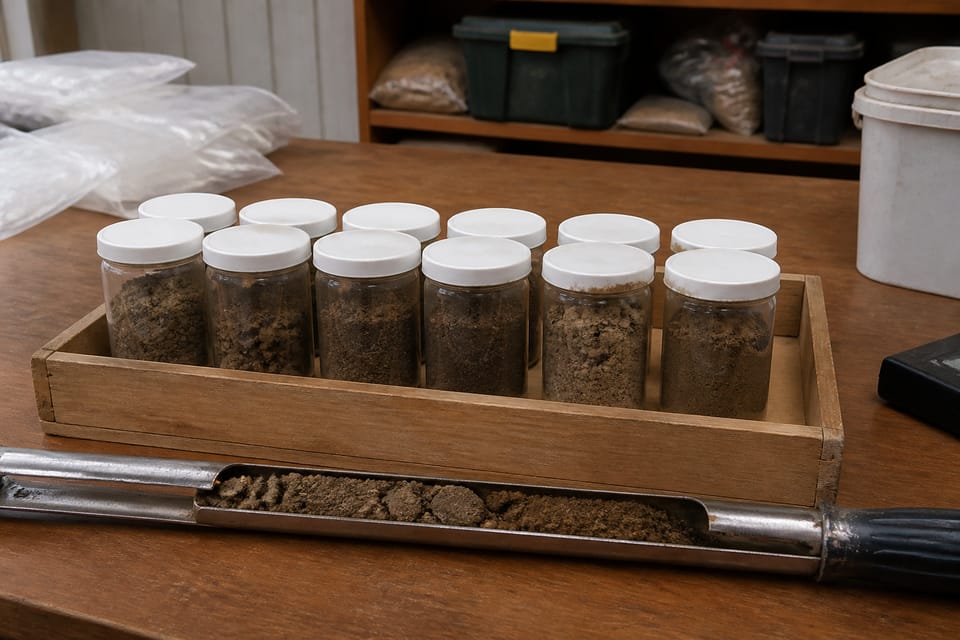
- Take the sample. The sampler is raised, opened and the soil put into sealed jars, with labels that record the origin, the job, the borehole number, the sample number, the depth, the penetration record, the length of recovery and the date (clauses 3.4.1 and 3.4.2).
What is the N value?
The N value is the number of blows that the standard calls the penetration resistance. It is the count for the stretches of penetration after the seating drive. Clause 3.3.3 calls the blow count the penetration resistance. The standard also uses N for the corrected value (clause 3.6 and Fig. 1), and the foreword refers to N values. The engineer and the report usually write the count as N.
The N value is a field measure. It tells the engineer how hard the soil is to drive a sampler into at that depth. It does not, by itself, give the bearing capacity of the soil. The engineer combines the N value with the sample, the water level and other soil data before deciding the foundation.
What does the report show?
A boring log for an SPT should show, for each level tested:
| Item in the log | What it records |
|---|---|
| Depth and water level | Where the test was done, and where the water was in the borehole |
| Penetration record | The blows for each stretch of penetration |
| N value | The penetration resistance, from the stretches counted |
| Soil description | What the sample looked like |
The standard asks that each sample be labelled with the job, the borehole, the sample number, the depth and the date (clause 3.4.2). A report without these is hard to check.
Inline image
What should an owner ask?
These questions are practice, not steps in the standard:
- Was the test done to the standard? Ask which edition of IS 2131 the lab followed, and whether the report says so.
- Where is the borehole, and what depth was tested? The test is for the level tested, not for every level of the house.
- Is there a water level in the log? The soil below the water table behaves differently, and the report should say where the water was.
- Can I see the samples and the log? Ask for the jars to be kept and the log given to the engineer.
- What does the engineer use the N value for? Ask the engineer how the value was used in the design.
What mistakes should I avoid?
These are practice points:
- Reading the N value as the bearing capacity. The engineer uses it with other data, and the design sets the safe pressure.
- Using one borehole for the whole plot. One test represents the soil near it.
- Using a report without the water level. The water level changes the reading.
- Using an old edition of the standard without checking. IS 2131 has a later edition; check the current one on BIS.
Frequently asked questions
Is the SPT the same as a soil test?
The SPT is one part of the soil investigation. It gives a sample and a count. The engineer also uses the plate load test, the lab tests on the sample and the site observations.
Does the N value give the safe bearing capacity of my plot?
No. The N value is one input. The engineer uses it with the sample, the water level and the design rules to decide the safe pressure. The soil report should show how it was used.
Is the 1981 edition still valid?
A later edition of IS 2131 is listed as in force and was not read for this page. Ask the lab which edition it follows and check the current status on the BIS portal.
Related guides
- Soil test before building a house: what it is and why it matters
- Safe bearing capacity of soil explained: SBC, ultimate and allowable
- Plate load test vs SPT vs cone test: which soil test tells what
This guide is general information. Read the disclaimer. Your soil lab and your structural engineer decide the tests, the report and the foundation for your house.
Sources
Change log
- : Added Related guides link to newly published article(s): plate-load-test-vs-spt-vs-cone-penetration-test-which-soil-test-tells-what. No other text changed. Approved by the reviewing engineer.
General information only. It is not a structural design or professional advice. Ask a licensed structural engineer or architect to check your plans and site.