
Short answer
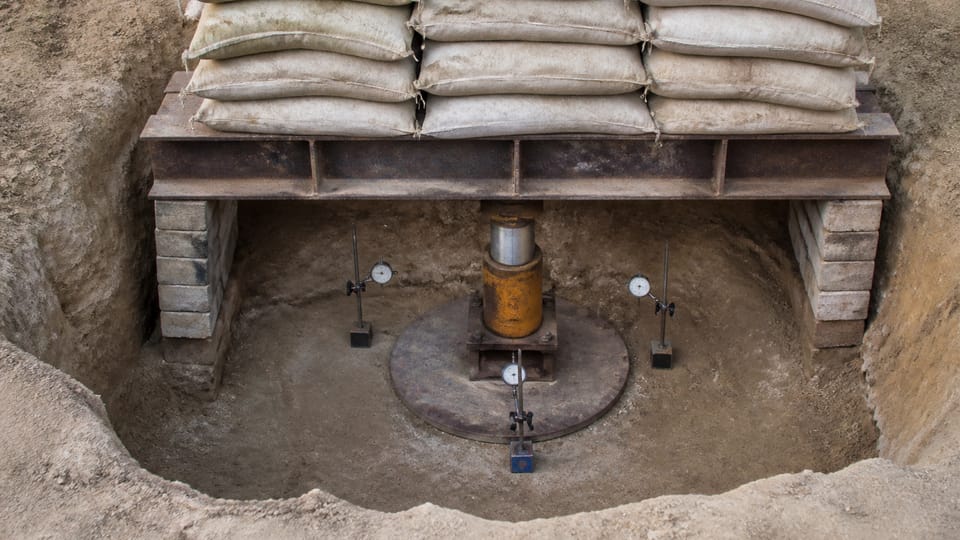
What is the difference between a plate load test, SPT and a cone test? A plate load test loads a steel plate at foundation level and records settlement, but it feels only shallow soil. SPT counts hammer blows in a borehole and brings up a sample. Cone tests, dynamic or static, give a continuous record of resistance with no sample. They measure different things, so one result should not be read directly against another. Your engineer chooses the tests.
On this page (11)
- What does “cone penetration test” mean?
- How do the four tests compare?
- What does each test tell me?
- Why can’t one test replace another?
- Can I convert one result into another?
- Which test does my house need?
- What should I ask the lab?
- What mistakes should I avoid?
- Frequently asked questions
- Related guides
- Sources
A soil report for your house may mention a plate load test, SPT, or a cone test, and a lab may offer you any of them. They are not four ways of getting one number. Each answers a different question, and each misses something. This page sets them side by side and explains what each one tells you, what the Indian codes warn about it, and why one result should not be read directly against another. It gives no conversions between tests, no bearing values and no prices. For how each test is done, see the plate load test and SPT guides.
What does “cone penetration test” mean?
It is not one test. The Indian codes have two, and road engineers use a third tool.
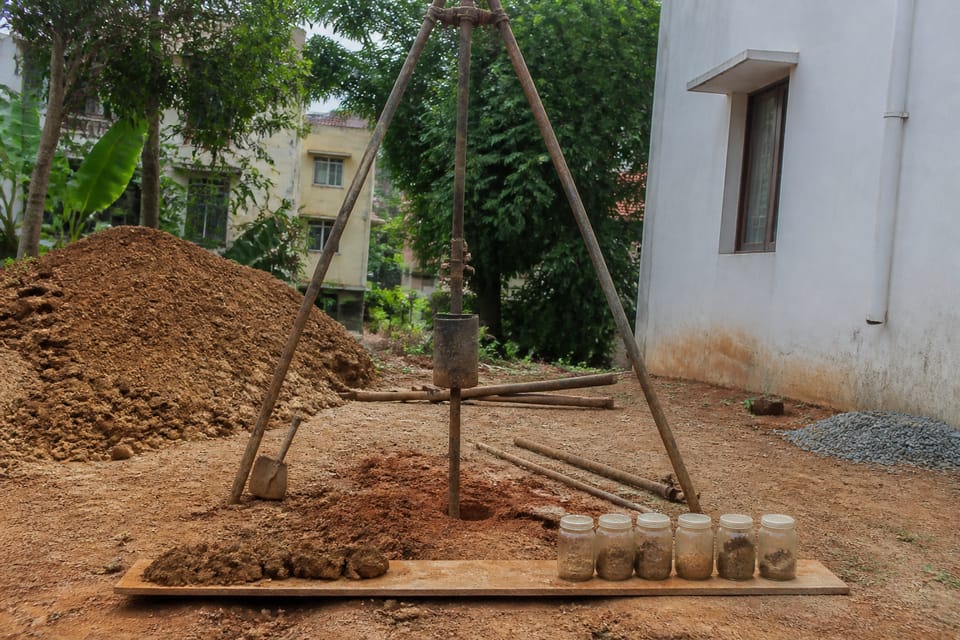
- Dynamic cone penetration test (DCPT). A cone is driven by a hammer, and blows are counted. It is covered by IS 4968 Part 1 and Part 2.
- Static cone penetration test (SCPT). A cone is pushed, not hammered. The rig records cone and friction resistance. It is covered by IS 4968 Part 3.
- Light DCP. This is a road tool. IRC:SP:72 describes it as a simple device for rapid strength evaluation of subgrade and other unbound pavement layers. It is reported in mm per blow. On our comparison it is a different test from IS 4968, so do not read a road DCP result as a foundation soil test.
So when someone says “cone test”, ask which one. IS 1892, the code for soil investigation, also lists a piezocone, a static cone that records water pressure. It gives no full procedure and points to international standards. Whether it suits a house is your engineer’s call.
How do the four tests compare?
The table is our own assembly from separate codes. No code gives this whole comparison. IS 1892 Annex B lists what each test measures, and the other rows are ours. The last row is the code’s wording on the ground, and it is not a rating.
| Point | Plate load test | SPT | Dynamic cone (DCPT) | Static cone (SCPT) |
|---|---|---|---|---|
| Code | IS 1888 | IS 2131 (2025 edition unread) | IS 4968 Parts 1, 2 | IS 4968 Part 3 |
| What it records | Load and settlement | Blows, as N | Blows with depth | Cone and friction resistance with depth |
| Where it is done | At proposed foundation level | Inside a borehole | From the ground down, no borehole | From the ground down, no borehole |
| Form of result | Load and settlement record | Readings at chosen depths | Continuous record | Readings with depth, at set intervals or continuous |
| Soil sample | No sample, but soil below is exposed and recorded afterwards | Yes, a disturbed sample, no longer in its natural state | No | No |
| What the code says on ground | Assumes reasonably uniform strata. Misleading if soil changes at shallow depth | To be done “in all types of soil deposits in a borehole” (an instruction, not a rating) | Gives “only” a “rough indication” of consistency or density | “most successful in soft or loose soils”. “unsuitable for gravelly soils” and filled earth |
What does each test tell me?
Plate load test. It tells how the ground at that level responds to load. IS 1892 uses it to determine load and settlement characteristics. Its limit is reach. IS 1888 says the results “reflect only the character of the soil located within a depth of less than twice the width of the bearing plate”, while a real foundation is usually bigger and stresses a thicker layer. So a soft layer lower down can stay unseen. IS 1888 says a satisfactory load test “should, therefore, include adequate soil exploration”. It also says the test does not give ultimate settlements, particularly in clay.
SPT. It tells how the soil resists a driven sampler, layer by layer, and it gives you a sample to look at. The result is a blow count, called N. The test needs a borehole, and it is a set of readings, not a continuous line. Your report should show N both uncorrected and corrected, as IS 1892 asks. N is an input to the engineer’s work. It is not a bearing value. Descriptions of N based on the 1981 edition may be out of date: BIS has withdrawn it and lists IS 2131:2025 in its place, which we could not read.
Dynamic cone. It gives a quick continuous picture, and IS 4968 Part 2 says it avoids a borehole. IS 4968 Part 1 says it helps a reconnaissance survey of wide areas, so that in-situ testing or sampling can be selective. IS 4968 Part 1 says its correlations are “qualitative rather than quantitative”, and the data “only provide a rough indication of the consistency or relative density of the soil”.
Static cone. It records two readings with depth: cone and friction resistance. IS 1892 calls the record continuous, and IS 4968 Part 3 reads at set intervals, or continuously if desired. IS 4968 says it can help where boring disturbs the in-situ density, meaning the density of the soil as it lies in the ground, a case that makes SPT unreliable, especially under water. It leaves no sample, and the code presents the results with a bore hole log. It does not suit fill. IS 4968 Part 3 warns of “erroneous values” from loose stones and brick bats in made-up ground.
Why can’t one test replace another?
Each sees something the others miss. IS 1892 says “no single method/approach can be suitable for all situations”, and tests are chosen “depending on the nature of the strata and project requirements”. In practice, a borehole with SPT shows the layers, a plate test loads one level, and cones fill in between borings. That pairing is practice, and your engineer decides.
The codes show this overlap in a few places:
- IS 1892 says soundings, which read resistance with a probe, “provide quick means to get continuous resistance”, but “samples cannot be collected”.
- IS 1892 says stones, gravels, boulders and stiff formations cannot be penetrated by a sounding device. A separate code, IS 10042, covers gravel-boulder ground and allows a dynamic cone test within a stone-size limit.
- NBCS 2026, the national building standard, says plate load results for the soil modulus “will be unreliable” in stratified deposits, and that static cone tests may be carried out.
Can I convert one result into another?
Not on this page, and not for your house without an engineer. N, cone resistance, cone blows and a plate curve are different quantities. IS 4968 Parts 1 and 2 say correlation between cone values and other tests may be developed for a given site by doing the tests side by side. Part 1 calls its correlations with bearing capacity and pile capacity “qualitative rather than quantitative”. Part 2 reports relationships for limited conditions, to be used with caution, and we do not reproduce them. Do not compare a number from one test with a number from another unless your engineer has a basis for it.
Bearing capacity is calculated. IS 1904 says the net safe bearing capacity for shallow foundations is calculated in accordance with IS 6403. IS 6403 methods can draw on shear tests, plate load results, SPT values and static cone resistance. IS 6403 adds that its calculation methods are “aids to design which cannot replace the critical role of engineering judgement”. See safe bearing capacity explained.
Which test does my house need?
Your structural or geotechnical engineer chooses, and the sources differ on how much a small house needs. Here is what they say:
- IS 1892 lists, for a lightly loaded single or double storeyed house, “At least one borehole/trial pit in the centre of the building”, with the note “Boreholes are preferred over trial pits”. This sits in a table of guidelines.
- NBCS says that for lightly loaded structures of not more than two storeys the tests “are optional, mainly depending on site conditions”. It also repeats the IS 1892 row.
- IS 1888 says that, for deciding safe bearing capacity, visual examination in trial pits with established soil data may be adequate for light or less important structures under normal conditions, and that laboratory or field tests are essential for unusual soil types and for all heavy and important structures.
- IS 1904 calls investigation an essential prerequisite for civil engineering works.
The codes do not spell out how these fit together. So do not read this as “no test needed”, and do not read it as “one borehole is enough”. See soil test before building a house.
Black cotton soil. IS 1904 says such clays shrink and swell with the seasons. None of these four field tests lists swelling as what it measures, on our reading of IS 1892. Free swell index and swelling pressure are lab tests in IS 1892, chosen to suit the ground. See black cotton soil.
A neighbour’s report. IS 1892 says data from nearby structures “may be utilized in planning the investigation”. NBCS goes further for lightly loaded structures of not more than two storeys: such local information may be used for foundation design. Your engineer decides whether it is enough for your plot.
What should I ask the lab?
These are practice points, not code rules.
- Which tests, why, and who chose them?
- How many points, where, and how deep compared with the planned footing?
- Which edition of the code was followed?
- Are the raw records in the report, such as bore logs, blow counts and curves?
- When was the water level measured, and in which season?
- Was any fill found, and how thick?
- Who signs the interpretation?
What mistakes should I avoid?
These are practice points, except where a code is named above.
- Asking which test is best, and not what the engineer needs to know.
- Trusting a plate result for soil below its reach.
- Comparing numbers across tests.
- Calling a road DCP on the surface a soil test for a house.
- Accepting a bearing figure with no stated method.
- Testing on fill or surface soil, not at the planned level.
- Ignoring the season and the water level.
Frequently asked questions
Is SPT better than a plate load test?
Neither is better in general. SPT shows layers and gives a sample. A plate test loads the soil directly, but over a shallow zone. In practice, many sites need more than one kind of information.
Is DCP the same as cone penetration test?
Not always. A DCPT under IS 4968 is a foundation sounding. A light DCP is a road tool. A static cone test is a third thing.
Can a DCP test give safe bearing capacity?
Not by itself. IS 4968 calls dynamic cone data a rough indication. Bearing capacity is calculated by the engineer.
Which tests give a soil sample?
SPT gives a disturbed sample. Cone tests give none. A plate test does not sample, but IS 1888 has the soil below the plate excavated and recorded afterwards.
Do these tests tell long-term settlement?
Not directly. IS 1888 says a plate test does not give ultimate settlements, particularly in clay. See foundation settlement.
Related guides
- Plate load test: how it is done and what the result tells you
- Standard penetration test (SPT) and the N value: how it is done
- Soil test before building a house: what it is and why it matters
This guide is general information. Read the disclaimer. A geotechnical or structural engineer chooses the tests for your plot and reads the results.
Sources
- IS 1892:2021, Subsurface investigation for foundations, Code of practice (second revision): foreword, clauses 3.1, 5.3, 5.6.2 with Table 2, 6, 6.1, 6.4, 6.7, 6.8, 6.9, 7.5.1, 8.1.2, 8.2, 9.2 and Annex B.
- IS 1888:1982, Method of load test on soils (second revision): foreword 0.2 and 0.3 and clauses 4.1 and 6.2. BIS validity shows to 2026-12-31.
- IS 2131:1981, Method for standard penetration test for soils: read for how N is defined. WITHDRAWN; BIS lists IS 2131:2025 in its place, which we could not read.
- IS 4968 (Part 1):1976, Method for subsurface sounding for soils, Dynamic method using 50 mm cone without bentonite slurry: foreword 0.2 and 0.2.1 and clause 1.1. BIS validity shows to 2026-12-31.
- IS 4968 (Part 2):1976, Dynamic method using cone and bentonite slurry: foreword 0.2 and 0.4.
- IS 4968 (Part 3):1976, Static cone penetration test: foreword 0.2 and clauses 1.1, 4.1 and 5.1.
- IS 10042:1981, Code of practice for site investigations for foundation in gravel-boulder deposit: clause 5.4. BIS validity shows to 2026-12-31.
- IS 6403:1981, Determination of bearing capacity of shallow foundations: foreword 0.2 and clauses 5.0, 5.2.2 and 5.2.3. BIS validity shows to 2026-12-31.
- IS 1904:2021, General requirements for design and construction of foundations in soils, Code of practice (fourth revision): clauses 6.1, 6.3.3, 7.5 and 18.
- SP 7:2026, National Building Construction Standards 2026, Part C Section 2: clauses 3.1.1, 3.1.2, 3.3.6.2, A-2.2 (unofficial archive.org copy).
- IRC:SP:72-2015, Guidelines for the design of flexible pavements for low volume rural roads: Appendix C, on the dynamic cone penetrometer for roads.
General information only. It is not a structural design or professional advice. Ask a licensed structural engineer or architect to check your plans and site.