
Short answer
What is the difference between a GI pipe and an MS pipe? Both are steel tubes. IS 1239 (Part 1) covers black tubes, with no surface treatment, and galvanised tubes, which carry a zinc coating to IS 4736. Light, medium and heavy are classes by wall thickness, marked yellow, blue and red. 'MS pipe' is a trade phrase: ask which standard and class, and whether it is black or galvanised.
On this page (10)
- What is the difference between GI and MS pipe?
- What does galvanising add?
- What are light, medium and heavy?
- What do the colour bands mean?
- What do NBCS 2026 and IS 2065 say about steel pipes in a house?
- What should I check on a delivered pipe?
- What mistakes should I avoid?
- Frequently asked questions
- Related guides
- Sources
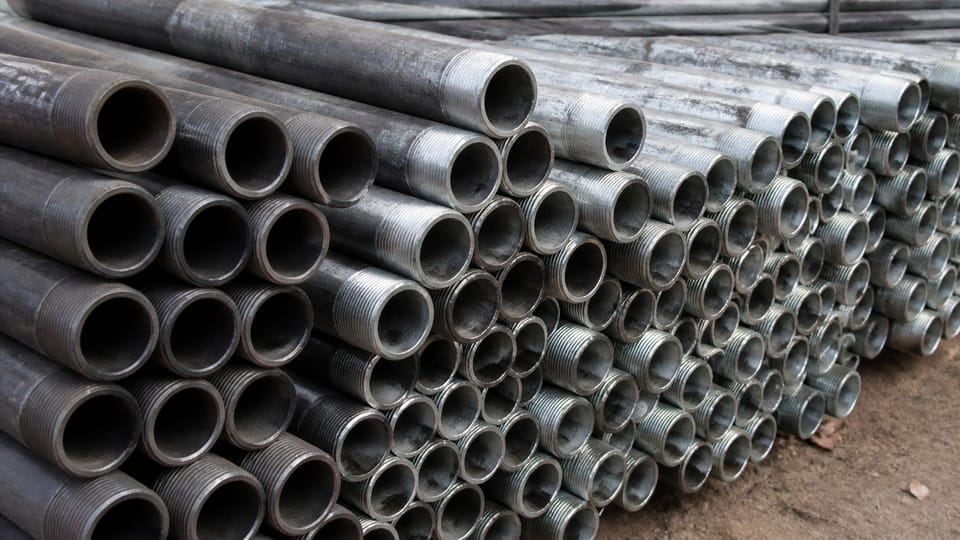
“GI pipe” and “MS pipe” are trade names used for steel pipes in plumbing, and shops use them loosely. In the Indian Standards both are steel tubes (IS 4736 and NBCS 2026 call the material mild steel), and the difference is the surface: a GI pipe is galvanised, with a zinc coat, and a black or “MS” pipe is not. This page explains what IS 1239 (Part 1) and IS 4736 say, what the light, medium and heavy classes and the colour bands mean, and what to check on a delivered pipe. It does not say whether you should use GI pipe in a house, and it gives no price, no brand and no pressure rating. For hot water, see CPVC vs UPVC pipes: which one to use for home plumbing.
What is the difference between GI and MS pipe?
| Word people use | What it can mean |
|---|---|
| GI pipe | An IS 1239 (Part 1) steel tube that is galvanised, with a zinc coat to IS 4736 |
| Black pipe, or MS pipe in the plumbing trade | An IS 1239 (Part 1) steel tube “as manufactured without any subsequent surface treatment” (clause 3.1) |
| MS pipe, said loosely | Possibly a structural tube (IS 1161) or a large water and sewage pipe (IS 3589), which are different products |
| GI sheet, GP sheet | Sheet, not pipe: see metal roof sheets: GI vs galvalume vs colour-coated |
No standard we read uses the term “MS pipe”, so ask the supplier for the standard, the class and the surface (black or galvanised).
IS 1239 (Part 1):2004 covers welded and seamless steel tubes, plain end or screwed end or screwed and socketed, for water, non-hazardous gas, air and steam, in nominal bores from small to large (clause 1.1 as amended). It says nothing about “potable” or drinking water.
What does galvanising add?
IS 1239 does not describe the coating itself. Clause 12.1 says: “Where tubes are required to be galvanized, the zinc coating on the tubes shall be in accordance with IS 4736”, and clause 12.2 says tubes that are to be screwed shall be galvanised before screwing. IS 4736 covers zinc coating applied by hot-dip galvanising on mild steel tubes. Its main points, in words:
- There is a minimum mass of zinc coating per square metre, determined on a test piece (clause 5.1). We do not print the figure: it was changed by amendments, and many websites still quote the old one.
- The coating is to be “reasonably smooth and free from such imperfections as flux, ash and dross inclusions, bare patches, black spots, pimples, lumpiness, runs, rust stains, bulky white deposits and blisters” (clause 5.2). Unless a passivation treatment is specified, “some white rust may be found on the tubes”.
- Uniformity is tested by repeated dips (clause 5.4, method IS 2633). For smaller tubes the coating must not crack on a bend test, and larger tubes get an adhesion test (clause 5.5).
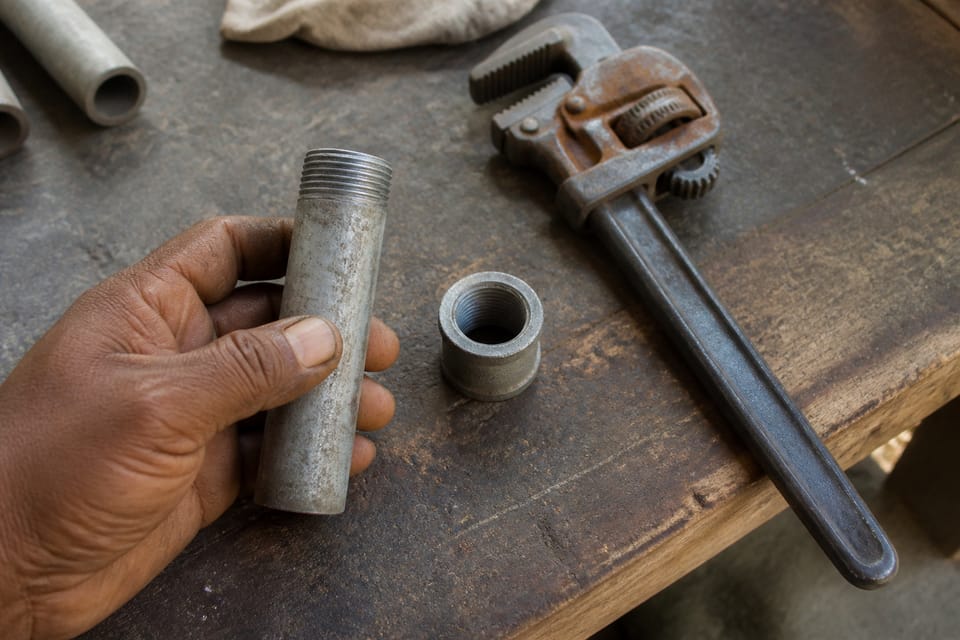
A screwed tube is galvanised before it is threaded (IS 1239 clause 12.2). Our reading, not a clause, is that the threading then cuts into the coat, so in practice cut ends, threads and scratches are where the steel shows: ask the plumber how threads are protected.
What are light, medium and heavy?
IS 1239 says tubes are designated by nominal bore and “further classified as light, medium and heavy depending on the wall thickness” (clause 4). The three classes differ in wall thickness and mass per metre (Tables 3 to 5), and the thickness and mass tables apply to both black and galvanised tubes (clause 8.1.1).
- For a given nominal bore the outside diameter is fixed by the thread dimensions of IS 554, so a thicker wall means a smaller actual bore (clause 3.2).
- Class is not the same as seamless or welded: light, medium and heavy tubes “shall be either welded or seamless as agreed to between the purchaser and the manufacturer” (clause 6.4).
- The tables for light tubes stop at a smaller bore than those for medium and heavy tubes. Medium and heavy tubes only are recommended for carrying steam (clause 1.2).
- The standard does not rank the classes for any use in a house. IS 2065:1983 says mild steel tubes used in a plumbing system “shall be of medium class” conforming to IS 1239 (Part 1) (clause 6.2.5, which cites the 1979 edition). CPWD’s water supply specification also asks for medium grade galvanised pipes (clause 18.3.11.1). That is a rule of IS 2065 and a CPWD specification, not a statement about every use.
What do the colour bands mean?
IS 1239 clause 17 says each tube is marked with “manufacturer’s name or trade-mark, IS No. that is, IS 1239 (Part 1) and class of tubes, that is, L, M, and H, for light, medium and heavy class”. It also says the classes “shall be distinguished by colour bands” applied before the tubes leave the works: light yellow, medium blue and heavy red. A white band at each end is for steam services unless agreed otherwise. The yellow, blue and red bands mark the class only, and say nothing about the zinc coat. The Standard Mark is optional: the tubes “may also be marked” with it (clause 17.5).
What do NBCS 2026 and IS 2065 say about steel pipes in a house?
NBCS 2026 lists “galvanized mild steel tubes” among the materials for water pipes (4.6.2), and says the material chosen “shall be resistant to corrosion, both inside and outside or shall be suitably protected against corrosion” (4.6.2.1). On hot water, clause 4.14.6.1 says: “Under no circumstances shall ungalvanized (black) mild steel pipes and fittings, such as sockets, bushes, etc, be used in any part of domestic hot water installation, including the cold feed pipe and the vent pipe.” It adds that each installation “shall be restricted to one type of metal only”, and that “when water supplied is known to have appreciable salt content, galvanized iron vessels and pipes shall not be used”.
That clause is about domestic hot water installations. It is not a rule that black pipe may never carry cold water, and it does not rate galvanised pipe or set limits for it. Ask the engineer or plumber which pipe suits each line.
IS 2065 clause 8.1.11 says piping shall not be buried in walls or solid floors; where unavoidable it may be buried for short distances with adequate protection and no buried joints: see plumbing work during house construction: stages and inspection points.
What should I check on a delivered pipe?
This is practice, unless a clause is named.
- The pipe is marked with the maker’s name, “IS 1239 (Part 1)” and the class letter (clause 17.1), and the band matches the class. The marking is the check; a colour alone is not.
- The galvanising looks continuous, without bare or rust patches, and the threaded ends are clean with no damaged threads.
- Take a sample length and measure the outside diameter and wall thickness against the supplier’s table for that class.
- Fittings (sockets, elbows, tees) are IS 1239 (Part 2) and match the pipe in class, make and thread.
- Test before covering, with the joints visible, as the plumbing stages page describes.
What mistakes should I avoid?
These are practice, not code rules.
- Treating GI as rust-proof and leaving cut threads and joints unprotected.
- Buying by colour band or a “heavy” label without reading the marking.
- Mixing classes or makes between the pipe and the fittings.
- Asking for “MS pipe” without saying black pipe, structural tube or fencing tube.
- Using a steel pipe on a hot-water line because a supplier says it is fine, with no standard behind it.
- Treating GI pipe and GI sheet as the same product.
- Covering the line before the pressure test, or burying joints.
Frequently asked questions
Is GI pipe the same steel as MS pipe?
In IS 1239 both are mild steel tubes of the same standard. A galvanised tube also has a zinc coating to IS 4736.
Are light, medium and heavy GI pipes different steel?
No. The classes differ in wall thickness and mass per metre for a given nominal bore.
What do the yellow, blue and red bands mean?
IS 1239 clause 17.2: light tubes yellow, medium blue, heavy red. The bands mark the class only.
Does GI pipe rust?
The zinc coat protects the steel, and IS 4736 recognises that some white rust (a zinc corrosion product) may be found unless the tubes are passivated. In practice, cut ends and threads leave steel exposed, which is why the plumber’s protection of threads matters.
Can black pipe be used for hot water?
NBCS 2026 4.14.6.1 says ungalvanised black mild steel pipes shall not be used in any part of a domestic hot water installation. It does not rate galvanised pipe for it.
Related guides
- CPVC vs UPVC pipes: which one to use for home plumbing
- Plumbing work during house construction: stages and inspection points
- Metal roof sheets: GI vs galvalume vs colour-coated, and TCT and BMT
- MS vs SS vs GI grills and railings: what SS 304 and SS 202 mean
This guide is general information. Read the disclaimer. Your plumber and engineer decide the pipes for your house.
Sources
- IS 1239 (Part 1):2004, Steel Tubes, Tubulars and Other Wrought Steel Fittings, Part 1 Steel Tubes (sixth revision), with Amendments 1 to 6: clauses 1.1, 1.2, 3.1, 3.2, 4, 6.4, 8.1.1, 12 and 17 (page images read). BIS lists it as in force, valid to 2029-06-30.
- IS 4736:1986, Hot-Dip Zinc Coatings on Mild Steel Tubes (first revision), with Amendments 2 to 4 (Amendment 1 was withdrawn): clauses 1.1, 5.1, 5.2, 5.4 and 5.5 (page images read). BIS lists it as in force, valid to 2031-03-27.
- SP 7:2026, National Building Construction Standards (NBCS) 2026, Part E Plumbing Services, Section 1 Water Supply: clauses 4.6.2 and 4.14.6.1 (page images read). From an unofficial archive.org copy.
- IS 2065:1983, Code of Practice for Water Supply in Buildings, clause 6.2.5 (page image read); CPWD Specifications 2019 Vol 2, clause 18.3.11.1 (page image read; practice for government works).
Change log
- : Added Related guides link to newly published article(s): ms-vs-ss-vs-gi-grills-and-railings-what-each-metal-is-and-what-ss-304-and-ss-202-mean. No other text changed. Approved by the reviewing engineer.
General information only. It is not a structural design or professional advice. Ask a licensed structural engineer or architect to check your plans and site.