
Short answer
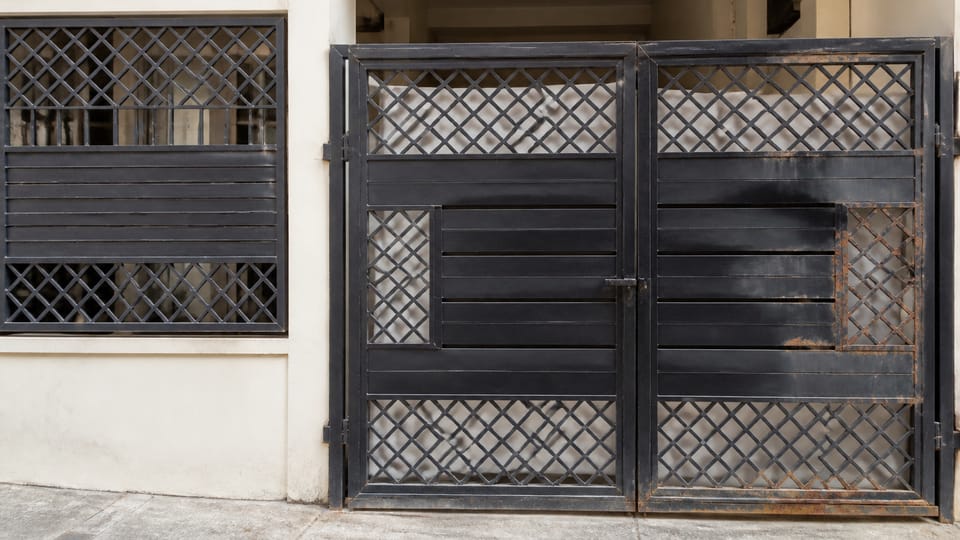
How do I paint a rusty MS grill or gate? IS 1477 asks you to remove grease, then rust and loose scale, and to prime straight afterwards, because paint over rust lets rusting continue. Then comes the finish, with the surface dry and no dew or monsoon. IS 2074:2023 says its red oxide-zinc chrome primer is not recommended on household articles such as grills because of chrome toxicity, so ask the painter which primer, and why.
On this page (11)
- What order does the code give?
- What does the code say about edges, welds and drying?
- Which primer? A caution in IS 2074
- Enamel: interior or exterior?
- What if the metal is galvanised?
- When the old paint is already failing
- What should I ask the painter? (practice)
- What mistakes should I avoid? (practice, except where a clause is named)
- Frequently asked questions
- Related guides
- Sources
A steel grill, gate or railing is usually painted again and again. IS 1477 (Part 1, clause 8.1) says the effective life of the coating depends very largely on how thoroughly the surface has been prepared. This page follows the order the Indian code for painting ferrous metals (IS 1477) gives, flags a caution in the primer standard (IS 2074), and lists what to ask. It gives no coat count, drying time, thinner ratio, film thickness, price or brand: those come from the maker’s data sheet, which the painter should show you. For walls, see painting exterior walls: preparation, primer and coats.
What order does the code give?
IS 1477 is a 1971 code that BIS still lists as in force. It names paint standards in their 1962 editions, so read it for the method, not for product names. In the order the code gives:
| Step | What the code says |
|---|---|
| Degrease | Paint on greasy or oily steel “will lack proper adhesion” and the film will fail; even minute traces are removed with a solvent or alkali degreaser (Part 1, clause 6.1) |
| Remove rust and scale | “Derusting and descaling are the essential preparations required prior to the application of any type of coating on iron and steel” (Part 1, clause 6.2) |
| Prime without delay | After cleaning, the surface is “immediately painted”; the first primer coat goes on “within the shortest possible interval”, particularly in humid coastal areas (Part 1, clause 9.1; Part 2, clause 3.1) |
| Undercoat | A coat of undercoating “is recommended where a high class finish is required” (Part 2, clause 5.2) |
| Finish | The coat that “comes in direct contact with the weather” (Part 2, clause 5.3) |
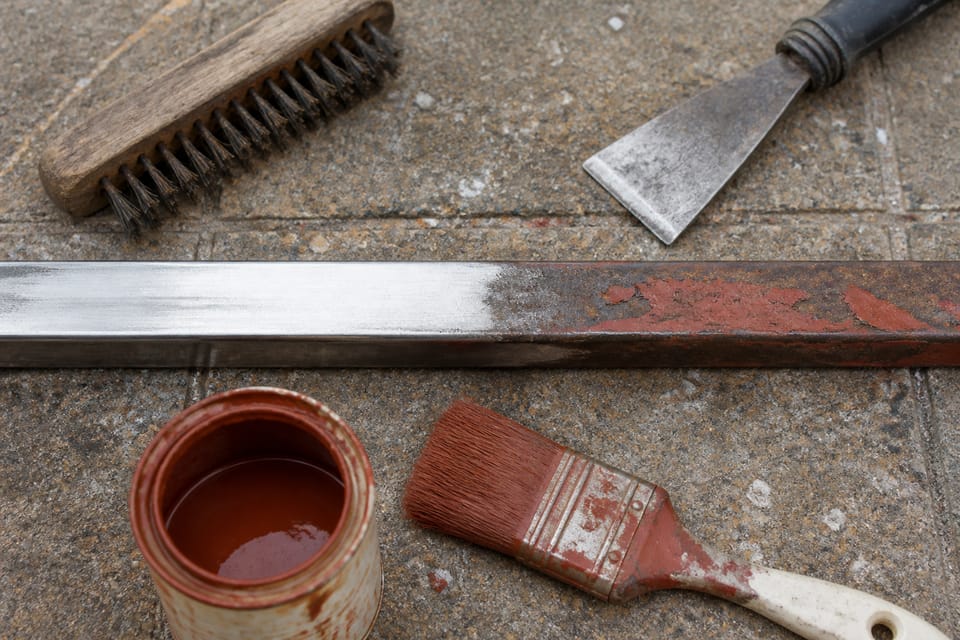
On rust, clause 6.2 is blunt: “If paint is applied on the layers of rust or loose mill scale, rusting continues almost to the same extent as if there was no paint,” and heavy layers of paint make further corrosion hard to detect. The code lists scraping, chipping, wire-brushing, abrasive paper, flame cleaning and sand- or shot-blasting as ways to clean. It adds that hand work cannot remove firmly adhering mill scale, so the surface “will not give optimum protection against rust at a later date”; it calls blasting “the most thorough system of cleaning steel” (clause 6.2.4).
What does the code say about edges, welds and drying?
- Edges and hidden faces: “Buried or hidden faces should be protected from corrosion by priming and applying a further coat of protective paint. Sharp edges shall be slightly rounded to avoid paint receding from them” (Part 1, clause 4.1.2).
- Welds: weld flux is removed before painting (Part 1, clause 7.1.2), and accessible flux and splatter are removed by power tools (Part 2, clause 6.1.2.1).
- Dry surface and weather: the surface must be “dry, free from moisture”, because moisture gets trapped in the film; in coastal and humid areas it is “generally not safe to paint exterior steel work early in the morning due to the settlement of dew”; and “painting during monsoon shall be avoided even indoors” (Part 2, clauses 5.8 and 5.8.1).
- Brush the primer: the first primer coat goes on by spray or brush, “preferably the latter”, working the paint into the fine dents and giving a continuous film without “holidays”, meaning missed spots (Part 2, clause 6.2.1.1). A note to clause 4.3 gives technologists’ opinion that only a brush can work the paint into the minute depressions.
- Thinners and makers: do not add thinner because the paint looks thick; if the viscosity needs adjusting, use the maker’s thinner (clause 5.7.1). It is “safer to use” primer, filler, undercoat and finish from the same maker (clause 5.4).
- Hollow sections and cut ends: the code has no clause on the inside of hollow sections or on cut ends. Treat that as a question for your painter, not a rule.
Which primer? A caution in IS 2074
IS 1477 Part 2, clause 4.1, calls primers “anti-corrosive primers” and says they may be lead-based or lead-free. It says lead-free primers are used for spray and (clause 4.3) that primers with lead pigments “shall not be applied by spray”. It names red lead, zinc chrome and red oxide-zinc chrome primers, and says zinc-rich primer may be used by the maker’s recommendation. The red lead standard it names (IS 102:1962) has since been withdrawn.
For red oxide-zinc chrome primer, IS 2074:2023 says two things that sit uneasily together:
- Clause 1.1.2 (it names “household articles such as grills”, not gates): “This paint is not recommended to be used on household articles such as grills, shutters, metal furniture, LPG cylinder, etc, due to toxicity of chrome primer. It is recommended that proper precaution to be taken during application.”
- Its Foreword says the primer “is extensively used for protection of grills, gates, window frames (metal), etc, in houses and buildings”.
We do not resolve this. Ask your painter which primer will be used, ask to see the tin and the maker’s data sheet, and note that IS 2074 clause 6.2.1(g) asks for a cautionary note on the tin, including that the dried film “may be harmful, if eaten or chewed”. We did not read the standards for other steel primers, such as red oxide or zinc phosphate primers, so this page does not say which to choose.
Enamel: interior or exterior?
IS 133:2023 is titled and scoped as enamel, interior, undercoating and finishing, and it does not name outdoor use. IS 1477 Part 2 lists other enamel standards for exteriors. BIS lists IS 2932:2025, air drying enamel paint for architectural and industrial applications, as in force and the older exterior enamel standard as withdrawn; we could not read IS 2932:2025, so this page does not describe it. The practical point is to ask the maker, in writing, that the enamel is meant for exterior steel.
What if the metal is galvanised?
IS 1477 is for ferrous metals, and a GI pipe or galvanised panel is different. IS 2524 (Part 1):1968 says new galvanised steel “should be degreased before painting”; even then the paint may adhere satisfactorily only if the surface is chemically treated or weathered, or if the recommended priming paints are used (clause 6.3.1). So do not assume the primer for plain steel suits GI: ask the maker which primer does. For what galvanising is, see metal roof sheets: GI vs galvalume vs colour-coated, and TCT and BMT.
When the old paint is already failing
IS 1477 Part 2 treats repainting by condition, not by a calendar. If rust shows in a few spots, the film is cut down to the metal, the top coats feathered, and the primer and finish built up again (clause 7.5.1.5). If rusting is severe or general, the whole film is scraped to the base metal and painted afresh (clause 7.5.1.6). It says removing old paint by chipping and scraping is “the best” method (clause 7.6.3), and that paint removers, if proper care is not taken, “may do more harm than good” (clause 7.6.1). No standard we read gives a repaint interval or a best colour.
What should I ask the painter? (practice)
This is practice, apart from the clauses named.
- How will the rust be removed, and how far? Loose rust, scale and flaking paint should be gone before any primer goes on.
- Which primer and which enamel, from the same maker, and for exterior steel? Show the tins and the data sheets.
- How many coats and what drying gap, per the data sheet? Ask for it in writing.
- How are welds, edges, hinges and the bottom of the gate treated?
- Is any part galvanised, and what primer is used on it?
- Who gives the guarantee, and what does it cover?
- How will old paint, dust and scrapings be handled? Ask the painter to take care with dust and scrapings from old paint, and ask the local authority about disposal.
What mistakes should I avoid? (practice, except where a clause is named)
- Painting over rust, loose scale or flaking paint (Part 1, clause 6.2).
- Putting enamel straight on bare steel with no primer.
- Painting a wet surface, in early-morning dew or in the monsoon (Part 2, clauses 5.8 and 5.8.1).
- Skipping edges, welds, hinges, the gate bottom and post bases.
- Using wall emulsion on metal.
- Applying one thick coat to save time.
- Painting over bars so thin or rusted through that they need a welder’s repair first.
Frequently asked questions
Do I have to remove all the rust before painting?
IS 1477 calls derusting and descaling essential, and says hand cleaning cannot remove firmly adhering mill scale. Remove loose rust and flaking paint at least, and ask the painter about the rest.
Can I paint enamel directly on a rusty grill?
The code says paint over rust lets rusting continue, and its schedule puts an anti-corrosive primer under the finish.
Is red oxide-zinc chrome primer recommended on a grill?
IS 2074:2023 clause 1.1.2 says it is not recommended on household articles such as grills because of chrome toxicity, yet its Foreword says it is extensively used on grills and gates. Ask the painter which primer and read the tin.
Why does paint peel off a GI pipe?
IS 2524 says paint on new galvanised steel may stick only if the surface is treated or weathered, or the recommended primer is used. Ask the maker.
When should I repaint?
IS 1477 Part 2 says by condition: repaint when the film breaks down. It gives no number of years.
Related guides
- Painting exterior walls: preparation, primer and coats
- Why wall paint peels, bubbles or flakes, and how to fix it
- Metal roof sheets: GI vs galvalume vs colour-coated, and TCT and BMT
- MS vs SS vs GI grills and railings: what SS 304 and SS 202 mean
- How painting area is measured: IS 1200 door, window and grill factors
This guide is general information. Read the disclaimer. Your painter and engineer decide the paint system for your gate.
Sources
- IS 1477 (Part 1):1971, Code of Practice for Painting of Ferrous Metals in Buildings, Part 1 Pretreatment (first revision): clauses 4.1.2, 6.1, 6.2, 6.2.1, 7.1.2 and 9.1 (page images read for 4.1.2, 6.2, 6.2.1 and 9.1; 6.1 and 7.1.2 text). BIS lists it as in force, valid to 2030-09-10.
- IS 1477 (Part 2):1971, same code, Part 2 Painting (first revision): clauses 3.1, 4.1, 4.3, 5.2, 5.3, 5.4, 5.7.1, 5.8, 5.8.1, 6.1.2.1, 6.2.1.1 and 7.5.1.5 to 7.6.3 (page images read except 3.1, 5.3 and 5.4, which are text). It names IS 102, IS 104 and IS 2074 in their 1962 editions. BIS lists it as in force, valid to 2030-09-10.
- IS 2074:2023, Ready Mixed Paint, Air Drying, Red Oxide-Zinc Chrome, Priming, Specification (fourth revision): Foreword and clauses 1.1.1, 1.1.2 and 6.2.1(g) (page images read). BIS lists it as in force, valid to 2028-04-30.
- IS 133:2023, Enamel, Interior, Undercoating and Finishing, Specification (sixth revision): clause 1 (page image read). BIS lists it as in force, valid to 2028-08-31.
- IS 2524 (Part 1):1968, Code of Practice for Painting of Non-Ferrous Metals in Buildings, Part 1 Pretreatment: clause 6.3.1 (page image read). BIS lists it as in force, valid to 2030-09-10.
Change log
- : Added Related guides link to newly published article(s): ms-vs-ss-vs-gi-grills-and-railings-what-each-metal-is-and-what-ss-304-and-ss-202-mean. No other text changed. Approved by the reviewing engineer.
- : Added Related guides link to newly published article(s): how-painting-area-is-measured-for-doors-windows-and-grills-is-1200-part-15-coefficients. No other text changed. Approved by the reviewing engineer.
General information only. It is not a structural design or professional advice. Ask a licensed structural engineer or architect to check your plans and site.