
Short answer
What are the types of doors used in an Indian house? There is no fixed count. Sorted by how the shutter is built: timber panelled, flush (solid core, or cellular, hollow and tubular core), ledged and battened plank doors, moulded HDF panelled, solid panel foam uPVC, GRP and steel. Rolling shutters and collapsible gates are closures, not doors. Each has its own Indian Standard. This page ranks none of them.
On this page (9)
Sellers and websites use many door names, and a list of “types” often mixes how a door is built with how it opens. This page sorts doors by how the shutter is built, because that is what the Indian Standards do. It names the standard for each, says what the standard itself says, and leaves out prices, sizes and any “best door”. For why timber doors jam in the rains, see doors jamming in the monsoon.
What are the main types, and which standard covers each?
| Type | What it is, in the standard’s words or ours | Indian Standard |
|---|---|---|
| Panelled and glazed (timber) | A timber frame of stiles and rails with panels of timber, plywood, blockboard, glass and other materials | IS 1003 (Part 1):2003 |
| Flush, solid core | A flat shutter with a solid core and plywood (or cross-band and face veneer) face panels | IS 2202 (Part 1):2023 (plywood faces); Part 2:2022 (other faces) |
| Flush, cellular, hollow or tubular core | A flat shutter with a cellular, hollow or tubular core and plywood face panels | IS 2191 (Part 1):2022 (plywood faces); Part 2:2022 (other faces) |
| Ledged, braced and battened | Ledged, braced and battened timber door shutters (in plain words, a door of boards held by ledges and braces) | IS 6198:1992 |
| Moulded HDF panelled | Pre-primed high density fibreboard panels with deep moulded designs | IS 15380:2023 |
| Solid panel foam uPVC | A shutter with a rigid uPVC foam panel | IS 15931:2012 |
| GRP (glass fibre reinforced plastic) | A panel type shutter in glass fibre reinforced plastic | IS 14856:2000 |
| Steel doors | Doors from rolled steel sections | IS 1038:1983 |
| Metal rolling shutters and grills | A metal curtain that rolls up | IS 6248:1979 |
| Collapsible gates | A folding grill gate | IS 10521:1983 |
None of these standards has a clause that says “a flush door is…”. The descriptions above come from their scope and construction clauses. IS 10428 is the standard for door terms. Its 1983 edition has been withdrawn and the 2022 edition is “Windows and Pedestrian Doors Vocabulary”. We could not read the 2022 text, so we do not say what it defines.
What are the timber door types?
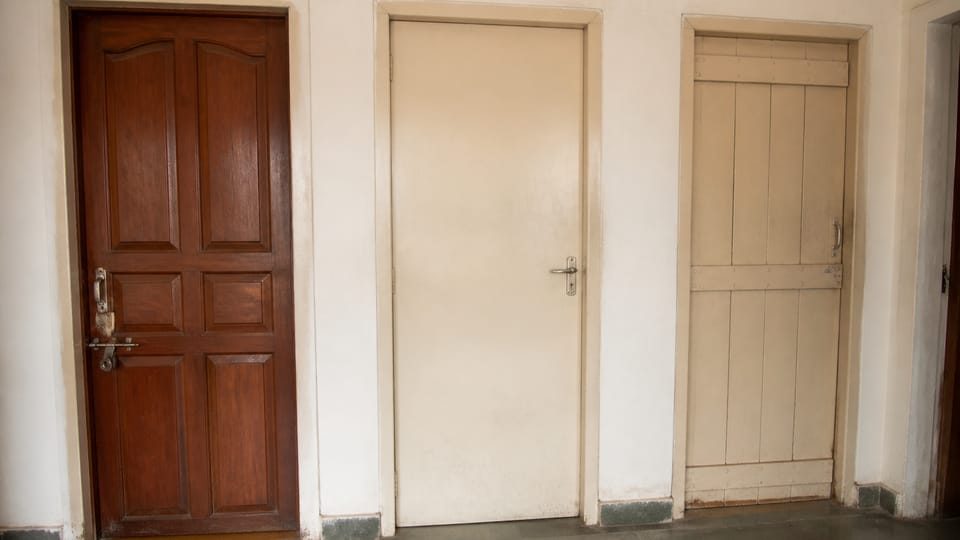
Panelled and glazed. IS 1003 (Part 1) covers timber door shutters “used in domestic buildings, offices, schools, hospitals, etc.”, single or multi-panelled, with or without glazing. Its construction clause describes a timber frame of stiles and rails, with panel inserts of timber, plywood, blockboard and similar boards, wire gauze or glass, fixed by grooves in the stiles and rails, or by beading, or both. The standard does not cover shutters for industrial and special buildings such as workshops and garages.
Flush. A flush shutter is flat on both faces. The Indian Standards split flush doors by core, and then by face material. IS 2202 is the “solid core” standard, and IS 2191 is the standard for cellular, hollow and tubular cores. Each has a Part 1 for plywood face panels and a Part 2 for particle board, HDF, MDF and fibre hardboard faces.
Both standards give two grades of shutter. IS 2202 says the BWP (boiling water proof) grade is “recommended for use at humid and dry locations”, and the MR (moisture resistance) grade is “recommended for use at dry locations only”. IS 2191 says its BWP grade “may be used in both humid and dry locations” and its MR grade “may be used in dry locations only”. In IS 2202 (Part 1) the listed core types are blockboard, particle board and medium density fibre board; the standard does not describe a single solid timber slab.
Ledged, braced and battened. IS 6198 covers ledged, braced and battened timber door shutters. In plain words, that is a door of boards held together by ledges and braces. Its foreword says they are frequently used where appearance is not the main criterion, “for example” temporary sheds, warehouses, stores and low cost housing.
What are the moulded, uPVC and GRP doors?
Moulded HDF panelled. IS 15380:2023 defines the HDF panel as “pre-primed, high density fibreboard, with deep moulded designs on the panel”. The number of panels and the design are “as agreed to between the purchaser and the manufacturer”. The standard says “panelled” and uses “skin” only for the moulded face board; “skin door” is the usual seller’s name.
Solid panel foam uPVC. IS 15931 covers solid panel foam uPVC door shutters used in residential buildings, offices, schools, hospitals and similar places, “for use in internal locations only where security is not of prime importance”. It does not cover large industrial shutters. Framed uPVC doors and windows are a different product, and the profile standard for those is IS 17953; we did not read its text.
GRP. IS 14856 is titled “Glass Fibre Reinforced Plastic (GRP) Panel Type Door Shutters for Internal Use”. Its foreword says it was evolved for internal use, “particularly for use in bathrooms/toilets and kitchens”. This page gives no bathroom-door advice. The title says GRP; the same standard also uses the abbreviation FRP in its text and figures.
What about steel doors, rolling shutters and collapsible gates?
Steel doors. IS 1038 covers steel doors, windows, ventilators and fixed-lights made from rolled steel sections, but not those for industrial buildings.
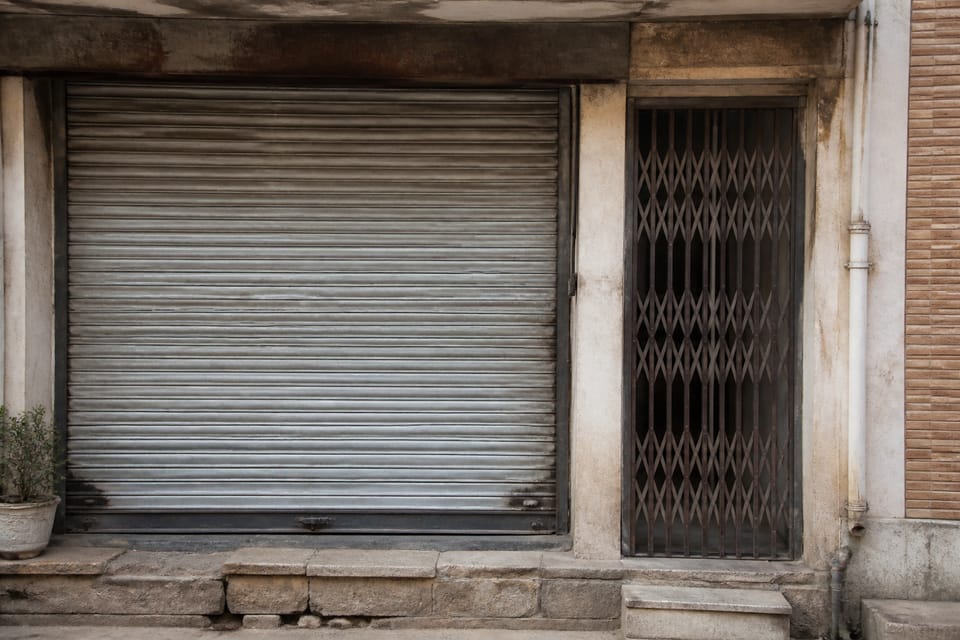
Rolling shutters and grills. IS 6248 covers metal rolling shutters and rolling grills “for normal use”. Its foreword says rolling shutters are largely provided at the entrances of shops, garages and godowns, and elsewhere, “for affording protection and safety”.
Collapsible gates. IS 10521 covers collapsible gates. Its foreword says they are provided where visibility and width of movement are needed along with security. The standard groups them by fixing position: under the lintel, outside the opening, inside the opening, or on movable top and bottom channels.
In practice, rolling shutters and collapsible gates close an opening. They are not a substitute for a door when you need privacy, weather protection or quiet. IS 3614:2021 is the standard for fire doors and doorsets, which is a separate subject.
How do I choose a door type?
The standards do not rank door types, and this page does not either. The choice depends on the place, the exposure and the frame. This is practice:
- Ask which core a flush door has, and which standard and grade it is made to.
- Read “waterproof”, “termite proof” and “fire rated” on a quote as claims to check, and ask for the IS number or a test report.
- Remember the frame. A good shutter on an unseasoned timber frame still jams. See termites in a finished house for timber damage.
- Check the shutter at the site for warp, joints and edge finish before payment. See the snag list.
What mistakes should I avoid?
These are practice, not code rules.
- Calling every smooth door “flush” and assuming the core is solid.
- Trusting a catalogue photo over the shutter itself.
- Using a timber or board door in a wet place with its bottom edge and lock cut-outs unsealed.
- In practice, treating a rolling shutter or a grill gate as a security door. Security also depends on the lock and the frame.
- Quoting an old IS edition from a seller’s page.
Frequently asked questions
How many types of doors are there?
There is no fixed count. Sorted by how the shutter is built, the standards cover timber panelled, flush, battened, moulded HDF, uPVC foam, GRP and steel shutters. Other lists add opening styles such as sliding and folding.
What is the difference between a flush door and a panelled door?
A flush door is flat on both faces, with a core. A panelled door has a timber frame of stiles and rails with panels. IS 2202 and IS 2191 cover flush doors, and IS 1003 (Part 1) covers panelled doors.
Is a moulded door a solid wood door?
IS 15380 defines the panel as moulded high density fibreboard. It does not describe a solid wood door.
Are uPVC and GRP doors waterproof?
The standards do not use that word. IS 15931 limits uPVC foam shutters to internal locations where security is not of prime importance. IS 14856 is for internal use.
Which IS code is for a flush door?
IS 2202 for solid core flush door shutters, and IS 2191 for cellular, hollow and tubular core flush door shutters. Older editions (1983, 1999) are withdrawn.
Related guides
- Doors jamming in the monsoon: why it happens
- Windows leaking in rain: frame, sill and drip
- Snag list for a new house: what to check before final payment
This guide is general information. Read the disclaimer. Your architect or engineer decides the doors for your house.
Sources
- IS 1003 (Part 1):2003, Timber Panelled and Glazed Shutters, Part 1 Door shutters (fourth revision, with Amendments 1 and 2): scope 1.1, 1.2 and clause 6.1. BIS lists it as not withdrawn.
- IS 2202 (Part 1):2023, Wooden Flush Door Shutters (Solid Core Type), Part 1 Plywood Face Panels (scope and clause 4.1); IS 2191 (Part 1):2022, Wooden Flush Door Shutters (Cellular, Hollow and Tubular Core Type), Part 1 Plywood Face Panels (scope and clause 4.1). Part 2 of each (other face panels, 2022) is named by its BIS title only.
- IS 6198:1992, Ledged, Braced and Battened Timber Door Shutters: scope and foreword.
- IS 15380:2023, Moulded High Density Fibre (HDF) Panelled Door Shutters (first revision): scope and clause 3.1.
- IS 15931:2012, Solid Panel Foam UPVC Door Shutters: clauses 1.1 to 1.3. IS 14856:2000, Glass Fibre Reinforced Plastic (GRP) Panel Type Door Shutters for Internal Use: title, scope and foreword.
- IS 6248:1979, Metal Rolling Shutters and Rolling Grills (clause 1.1 and foreword 0.2); IS 10521:1983, Collapsible Gates (clause 3.1 and foreword 0.2); IS 1038:1983, Steel Doors, Windows and Ventilators (clauses 1.1 and 1.2).
General information only. It is not a structural design or professional advice. Ask a licensed structural engineer or architect to check your plans and site.