
Short answer
What does IS 17953 say about uPVC windows and doors? IS 17953:2023 is a specification for the extruded uPVC profile used to make windows and doors. It covers the material, appearance, dimensions, mass, tests such as weld strength, impact and weathering, and marking. It says nothing on installation, glazing, hardware, steel reinforcement or the assembled window, so ask the supplier for the marking, the test reports and a cut section.
On this page (9)
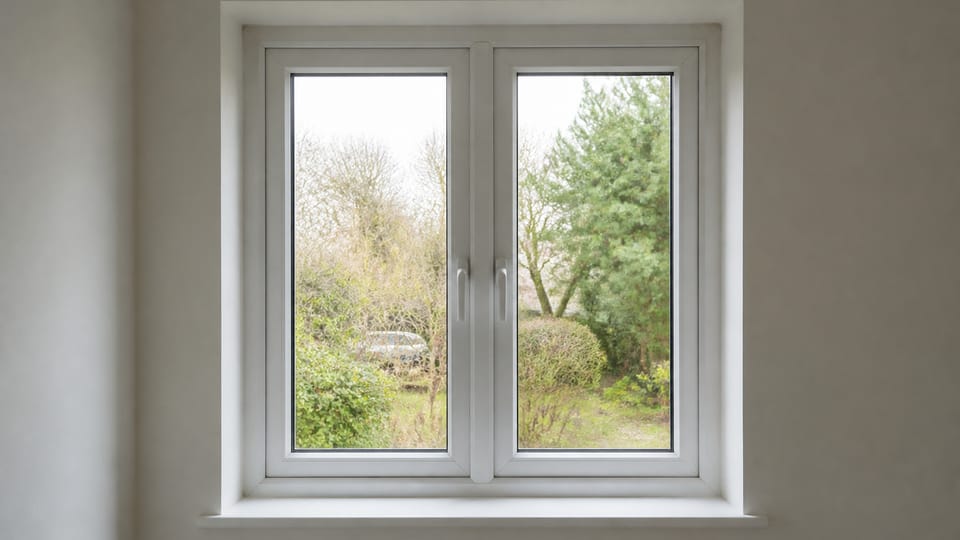
A quote that says “uPVC windows” can mean very different things, and the one Indian standard for the product covers less than most owners assume. IS 17953:2023 is a standard for the extruded uPVC profile, the hollow section a window is made from. It is not a standard for a finished window. This page says what the standard covers, what it does not, and what you can check on site. It gives no price, no brand and no “uPVC or aluminium or wood” verdict, since the standards we read give none. For leaks at a fitted window, see windows leaking in rain: frame, sill and drip, and where to start.
What does IS 17953 cover?
Clause 1 says the standard “specifies the requirements for uncoated unplasticized polyvinyl chloride (uPVC) profiles and light coloured surfaces intended to be used for fabrication of windows, doors and their framing components”. A note in clause 3 says the word “window” is used in the standard for both windows and doors.
| Subject | What the standard says, in outline |
|---|---|
| Definitions (3.1) | A profile is a “continuously extruded section of uPVC”. A main profile “has a load bearing function in the door and window” and can be the outer frame, sash, transom or mullion. An auxiliary profile has “a reduced load bearing function” and can be a glazing bead, packer, frame extension or sill profile |
| Material (5.1) | The material “shall consist substantially of unplasticized polyvinyl chloride”, with only additives needed to make a sound and durable profile. Lead and cadmium compounds are not to be used as additives, except that recycled window-profile material containing them may sit in the inner layer of a co-extruded profile |
| Recycled material | Own reprocessed material and recycled uPVC are allowed only in stated places; non-recyclable material is not permitted. A profile that uses recycled material is marked r-uPVC |
| Appearance (5.2) | The colour is uniform on all visible surfaces; surfaces are smooth and free from pitting, impurities and cavities; edges are clean and burr-free. Extrusion lines are allowed unless visually intrusive. Colour limits are set for the light base colour, and clause 6.1 sets how the surface is viewed in inspection |
| Dimensions (5.3, 5.4) | The manufacturer declares the nominal shape. Depth, width and visible wall thickness have tolerances, and the mass per metre is not to be less than a stated share of the declared mass |
| Tests | Type tests on the material and the profile, and acceptance tests on each lot, including weldability. Named tests include softening point, impact, heat ageing, heat reversion and artificial weathering with a colour-fastness check |
| Welded corners (5.8) | Welded corners and T joints are tested in tensile bending and compression bending |
| Marking (8.1) | Each profile is marked at least once in every metre, in a position not visible when the window is closed |
We print no limit, no tolerance and no test value. Those are for the supplier’s test report and your engineer.
What does IS 17953 not cover?
By its scope and by what it does not mention:
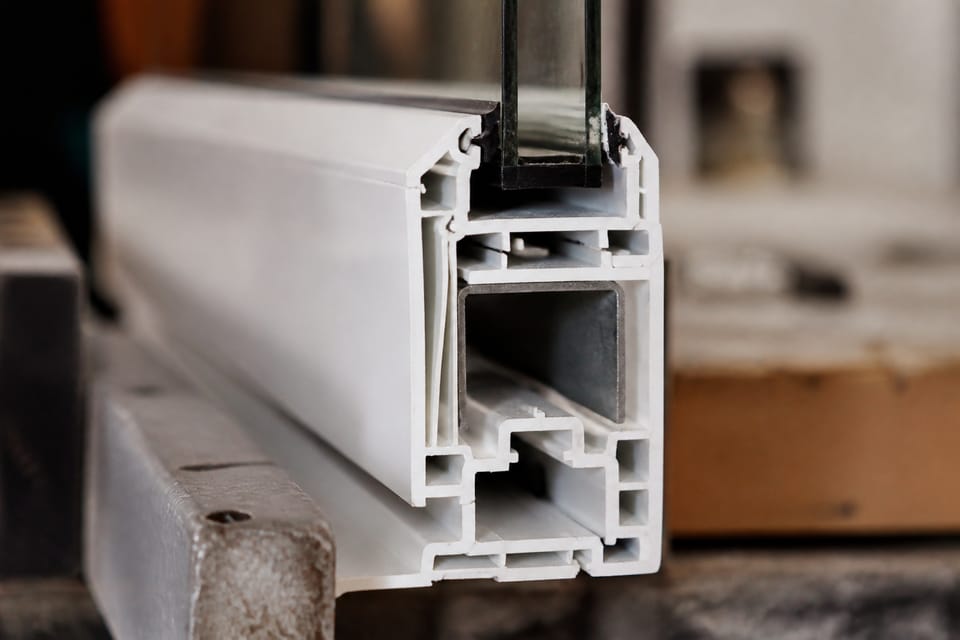
- Steel reinforcement. The standard has no requirement for steel inside the profile and says nothing about steel reinforcement, and it has no grades or classes of profile. (It has a table of impact thresholds banded by wall thickness, which we do not print.) We searched its text for steel and found only test equipment and a filling block used in a joint test. NBCS 2026, Part C Section 8, clause 8.2.3.3 says that PVC “which is internally reinforced with steel or aluminium to give it the required strength and stiffness may also be used”. The two are not in conflict, but IS 17953 is silent: whether a window needs steel, and where, is for the supplier to state and the engineer or architect to accept.
- Installation and fixing of the frame in the wall opening.
- Glazing, hardware and gaskets as supplied with the window.
- The assembled window or door, including air, water and wind performance. NBCS 2026 Table 29 names IS 18648:2024 for classification and performance of doors, windows and sliders; we did not read it.
- Laminated or painted surfaces. The standard is for uncoated profiles.
NBCS 2026 Table 29 cites IS 17953:2023 for the frame or profile specification of a uPVC glazed system. The standard is for the profile, and a quote for a whole window should say what covers the rest.
What must the profile be marked with?
Clause 8.1 says each profile shall be legibly and indelibly marked in an unobtrusive position not visible when the window or door is closed, at least once in every 1 m along its length, with the maker’s name or trade mark, a profile identification code for the declared shape and dimensions, a lot or batch number for traceability, and, where recycled material is used, “r-uPVC”. Clause 8.2 says each profile and its packaging “may also be suitably marked with the standard mark”, so the BIS Standard Mark is optional under the standard, and the standard number is not a required marking item. Use of the mark is governed by the BIS Act and its rules. For how a mark, a Quality Control Order and a standard relate, see IS codes for house construction: which standard covers what; we have not checked whether uPVC profiles are on a compulsory certification list, so check the BIS list before relying on a mark.
Because the marking sits where it is hidden once the window is shut, it is checked on loose profile or an offcut before fixing, not on the finished window.
What about the door shutter standard?
IS 15931:2012 is a different product: solid panel foam uPVC door shutters. Its scope covers shutters for use in internal locations “where security is not of prime importance”, and excludes large industrial door shutters. It describes a shutter with a mild steel tube frame covered in uPVC sheet and a foam uPVC panel. It is not a profile standard, and it does not make an outside uPVC door covered by a standard.
What should I ask the supplier, and check on site?
This is practice, apart from the clauses named.
- Ask the quote to name the profile standard, IS 17953, and the supplier’s test report for the profile lot, and say what covers the glass, the hardware and the fixing.
- Ask to see an offcut or a cut corner. Check the marking in 8.1 (maker, profile code, lot number), that the colour is uniform and the surface smooth, and that the edges are clean (5.2).
- If a profile has steel inside, ask for the steel’s size and finish in writing and look at the cut end. The standard does not set it.
- Ask whether any recycled material is used and whether it is marked r-uPVC.
- Check the welded corners for gaps, burrs or cracks.
- Ask for the glazing in writing: the glass thickness and type, and whether toughened or laminated glass is used in doors and low windows.
- Check drainage slots are present and not blocked by sealant or plaster, and that the frame is fixed with screws or anchors through the frame, not held by foam or sealant alone. The gap around the frame is for the fabricator and architect to set.
- Agree who fixes the frame and when, so the opening, the plaster and the sill are done to suit. Ask your engineer or architect.
- Check that shutters close without dragging, that the handles and hinges match the system and are not loose, and that the glass does not rattle.
IS 1081 does not apply to uPVC: the leakage page explains. A uPVC window follows its maker’s fixing instructions.
What mistakes should I avoid?
These are practice unless a clause is named.
- Accepting “uPVC windows” in a quote with no standard, profile marking or test report.
- Assuming the standard guarantees the whole window. It covers the profile only.
- Assuming steel is required or not required by IS 17953. It says nothing either way.
- Treating the uPVC pipe standards as the window standard. They are different products: see CPVC vs UPVC pipes: which one to use for home plumbing.
- Glass with no stated thickness or type.
- Blocking the drainage slots with sealant, plaster or paint.
- Fixing the frame with foam or sealant only.
- Taking “never fades”, “fireproof” or “fully soundproof” claims as fact. The standard has a weathering type test with a colour-fastness check; ask what test report covers your formulation and colour. Sound and fire behaviour depend on the whole window, and we found no figure in the standard.
- Using IS 15931 as proof that an outside uPVC door is covered.
Frequently asked questions
Is there an Indian Standard for uPVC windows?
Yes for the profile: IS 17953:2023. NBCS 2026 cites it for uPVC frames in glazed systems. It does not cover the assembled window.
Does a uPVC window need steel inside?
IS 17953 gives no steel requirement. NBCS 2026 says uPVC internally reinforced with steel or aluminium may also be used. Ask the supplier what is in each profile and look at a cut end.
Must the profile carry the standard number?
Not under IS 17953 clause 8.1, which requires the maker’s name, a profile code and a lot number. Clause 8.2 allows the standard mark. Ask for the test report.
Do uPVC windows turn yellow?
The standard has an artificial weathering type test with a colour-fastness check, on the material and on visible surfaces. We do not print the limit; ask what weathering test report covers the formulation and the colour you are buying.
Is uPVC fireproof or soundproof?
We found no fire or sound claim in IS 17953. Sound depends on the glass, the seals and the gaps around the frame, not the frame alone.
Related guides
- Windows leaking in rain: frame, sill and drip, and where to start
- Cross ventilation in a house: how window placement moves air
- IS codes for house construction: which standard covers what
This guide is general information. Read the disclaimer. Your architect, engineer and the window supplier decide the window design and fixing for your house.
Sources
- IS 17953:2023, uPVC Profiles for Windows and Doors, Specification: clauses 1, 3.1, 4, 5.1 to 5.4, 5.6 to 5.8, 5.10, 6.1, 7, 8.1 and 8.2 (page images read). BIS lists it as in force, valid to 2028-04-30.
- IS 15931:2012, Solid Panel Foam UPVC Door Shutters, Specification: clauses 1.1 to 1.3, 4.3, 5.2 and 12 (text layer read; page images not viewed). BIS lists it as in force, valid to 2027-07-31.
- SP 7:2026, National Building Construction Standards (NBCS) 2026, Part C Section 8, Glass and Glazing: Table 29 and clause 8.2.3.3 (text layer read; page not imaged). From an unofficial archive.org copy.
General information only. It is not a structural design or professional advice. Ask a licensed structural engineer or architect to check your plans and site.