
Short answer
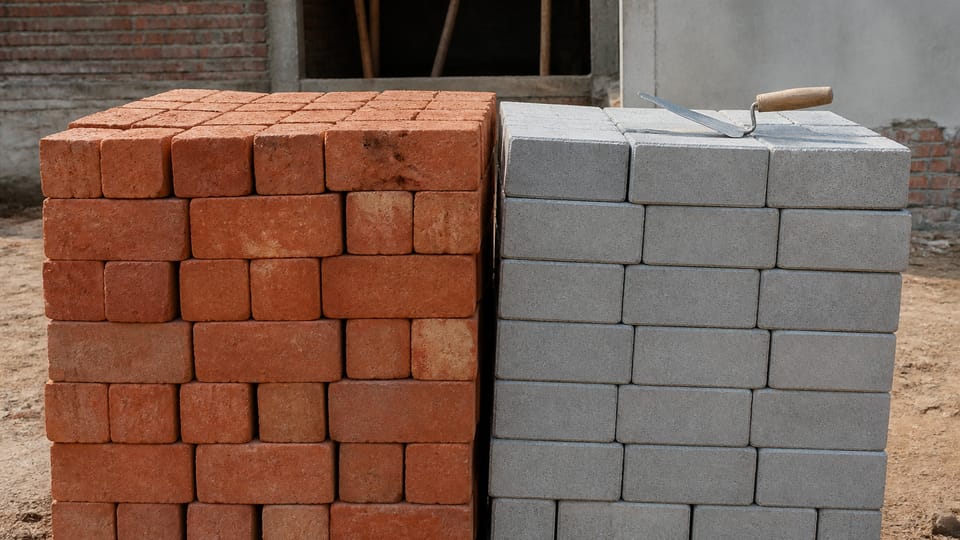
What is the difference between cement bricks and red bricks? No Indian Standard defines the trade term cement brick; the nearest title is IS 16720 for fly ash-cement bricks, made from fly ash, cement and aggregate, moulded and cured, not fired. A grey solid concrete unit sold as a cement brick may instead be a solid concrete block under IS 2185 (Part 1). A red brick is a burnt clay brick under IS 1077. Ask the supplier for the standard and class.
On this page (9)
“Cement brick” is a trade word, not a term we found defined in the Indian Standards. In shops and on sites it can mean a fly ash-cement brick, a solid concrete block or a sand-cement brick, and each is a different product with a different standard. This page says what each is, how the fly ash-cement brick differs from the red burnt clay brick, and what to ask for. It gives no price, no brand and no verdict on which is better: both can be used in walls when they meet their standards and suit the design, and the engineer chooses. It prints no strength comparison.
What does “cement brick” mean?
A search of the BIS standards database for the titles “cement brick” and “concrete brick” finds only one standard with such a title: IS 16720, “Pulverized Fuel Ash-Cement Bricks”. There is no standard with “concrete brick” in its title. So the word usually means one of these:
| Product | Standard | What it is |
|---|---|---|
| Fly ash-cement brick | IS 16720:2018 | Made from “pulverized fuel ash in major quantity, cement and other ingredients”, mixed, moulded, demoulded when sufficiently hardened and then cured; not fired |
| Solid concrete block | IS 2185 (Part 1):2005 | A concrete masonry unit “which has solid material not less than 75 percent of the total volume of the block”; a grey unit sold in brick-like shapes may be this |
| Fly ash-lime brick | IS 12894:2002 | Made from fly ash and lime, a different product from the cement one; see fly ash brick quality: what IS 12894 requires and how to check a load |
| Red brick | IS 1077 | A common burnt clay building brick, fired; the 2025 edition is in force and we read the 1992 edition |
Whether a unit is a brick or a block is a matter of size, in the standards: IS 2185 defines a block as a unit with at least one dimension greater than the corresponding dimension of a brick (as in IS 3952), and IS 16720 defines a brick as “a masonry unit not exceeding 300 mm in length, 150 mm in width or 100 mm in height”. Write “IS 2185 Part 1” in full: Part 3 of that standard is for AAC.
What is a fly ash-cement brick under IS 16720?
IS 16720:2018 is in force, valid to 2028-04-30, and has two amendments. It covers the “classification, dimensions, manufacture, physical requirements, sampling and criteria of conformity” of these bricks. Its foreword says they “are suitable for use in masonry construction just like common burnt clay bricks”.
What the standard prints:
- Materials and making. The brick is made by mixing cement, pulverized fuel ash, aggregate and water, with chemical admixtures if required, and the brick has a minimum fly ash content stated as a share of its mass (clause 7.1). It may be compacted in moulds by a hydraulic or vibratory press, protected until sufficiently hardened, and cured as per IS 456 or by mist curing, or by steam curing (clauses 7.3 and 7.4). It is not fired. The cement may be any of several types named in clause 6.3, and the fly ash is to IS 3812.
- Sizes. Modular 190 x 90 x 90 mm and 190 x 90 x 40 mm; non-modular 230 x 110 x 70 mm and 230 x 110 x 30 mm (clause 4.1), with other sizes by agreement and smaller bricks for bonding. The 1992 edition of the clay brick standard (IS 1077) lists the same four sizes; the 2025 edition was not read.
- Solid. The brick is solid, with or without a frog (clause 4.3).
- Classes. Five classes, designated 5, 7.5, 10, 12.5 and 15, by “Average 28-Day Wet Compressive Strength, Min”, where the class number is the minimum average strength in N/mm2 (Table 1).
- Requirements. General quality (sound, free from visible cracks, uniform in shape and colour, with smooth rectangular faces and sharp corners), dimensions, density, compressive strength, drying shrinkage and water absorption (clause 8). We do not print the limits.
- No efflorescence clause. IS 16720 as published has no efflorescence requirement, while IS 1077 and IS 12894 do. That is a difference in the standards, not a verdict on the bricks.
- Marking. Each brick is marked with an indication of the source of manufacture, in the frog where there is one. The maker “may also use the Standard Mark” (clause 12). The BIS list of products under compulsory certification (Scheme I), read on 2026-10-29, has no entry for bricks or blocks.
- Use. Apart from the foreword sentence, the standard says nothing on load-bearing use, plastering or wetting before laying. Do not take such rules from a website.
How does it differ from a red brick?
| Item | Fly ash-cement brick (IS 16720) | Red brick (IS 1077:1992 read) |
|---|---|---|
| Raw material | Fly ash, cement, aggregate, water | “Suitable soils” |
| Making | Mixed, pressed or vibrated, demoulded, cured; not fired | Moulded by hand or machine, then burnt |
| Classes | 5, 7.5, 10, 12.5, 15 | 3.5, 5, 7.5, 10, 12.5, 15, 17.5, 20, 25, 30, 35 |
| Class meaning | Minimum average 28-day wet compressive strength, in N/mm2 | Minimum average compressive strength, in N/mm2 |
| Sizes | 190 x 90 x 90, 190 x 90 x 40, 230 x 110 x 70, 230 x 110 x 30 mm | The same four sizes in the 1992 edition |
| Efflorescence | No requirement | A rating limit |
| Mark | Source of manufacture; Standard Mark “may” | Source of manufacture; Standard Mark “may” |
Both standards name water absorption as a requirement, but the limits and the class at which they change differ, and IS 1077 has a newer edition, so we do not print or compare them. The same class number in two standards does not make two bricks equivalent, since other requirements (efflorescence, absorption, density) differ. Ask the engineer.
What if the “cement brick” is a solid concrete block?
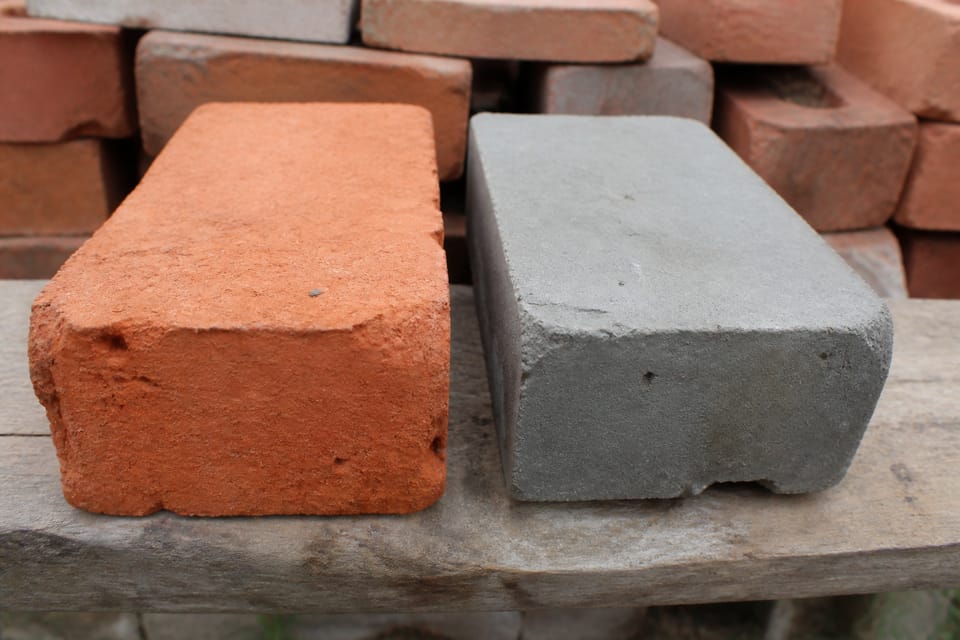
IS 2185 (Part 1) covers solid and hollow concrete blocks. Its solid block is “not less than 75 percent” solid by volume. A solid load-bearing concrete block in grade C has a minimum block density and minimum average compressive strength set by the standard (clause 5.2); we do not print them. It is a block and not a brick, by size, and it follows a different masonry code (IS 2572). See solid concrete blocks vs bricks: where cement blocks suit a house for those blocks. The sizes of bricks and blocks are in brick and block sizes in India: red, fly ash and AAC.
What should I ask for and check?
This is practice, unless a clause is named.
- Ask the supplier which standard the unit is made to (IS 16720, IS 12894, IS 1077 or IS 2185 Part 1) and which class, and get it written on the quote and the delivery note.
- Ask for the maker’s test report for the lot. The standard’s tests are for compressive strength, density, drying shrinkage and water absorption (IS 16720 clause 8).
- Confirm it is a solid brick and not a hollow block or a paving unit, which are other products.
- Look for the maker’s mark on each brick (IS 16720 clause 12) and check the edges, corners and size across a row against the engineer’s size.
- For a large order, ask the engineer to draw a sample as the standard’s sampling clause says, and keep the first delivered bricks for comparison.
- Ask how old the lot is, and do not use bricks fresh from the press without the engineer’s say (practice). IS 16720 puts curing in the manufacture clause (7.4: as per IS 456 13.5, mist curing or steam curing) and defines the class at 28 days (Table 1); it sets no curing period and we found no rule on age at delivery or use.
- Wetting before laying: IS 16720 says nothing. Follow the engineer and the supplier; do not copy a rule for clay bricks or for blocks. For the wall itself, see curing a brick wall: how long, and how, per IS 2212.
- Use the mortar and the plaster mix the engineer specifies, and do not mix different brick types in one wall without the engineer’s approval.
What mistakes should I avoid?
These are practice, not code rules.
- Assuming any grey brick is IS 16720, or that colour tells you the strength.
- Accepting a “cement brick” with no standard or class on the note.
- Using hollow blocks or paving units as wall bricks.
- No sample or test for a large order.
- Using bricks that are too fresh.
- Skipping the curing of the wall because the bricks were “already cured”.
- Taking a rule from a website for wetting, plastering or strength.
Frequently asked questions
Are cement bricks stronger than red bricks?
The standards do not rank them. Both have class numbers, which are minimum average compressive strengths in N/mm2 under each standard. Compare class numbers on the delivery note, not the word on the brick.
Is a fly ash brick the same as a cement brick?
Not always. IS 16720 covers fly ash-cement bricks. A fly ash-lime brick is IS 12894, and a burnt clay fly ash brick is IS 13757. “Cement brick” can also mean a solid concrete block.
Do cement bricks need curing?
IS 16720 puts curing in the manufacture clause (7.4), with no period stated. The wall also needs curing, as the engineer specifies.
Do I need to soak them before laying?
IS 16720 says nothing about wetting. Ask the engineer and the supplier.
Is the Standard Mark compulsory on bricks?
No: the standards say the maker “may” use it, and the BIS compulsory certification list read on 2026-10-29 has no entry for bricks or blocks.
Related guides
- Solid concrete blocks vs bricks: where cement blocks suit a house
- Brick and block sizes in India: red, fly ash and AAC
- Fly ash brick quality: what IS 12894 requires and how to check a load
This guide is general information. Read the disclaimer. Your engineer chooses the bricks or blocks for your walls.
Sources
- IS 16720:2018, Pulverized Fuel Ash-Cement Bricks, Specification: foreword, clauses 1, 3.1, 4.1, 4.3, 5 and Table 1, 6, 7, 8, 11 and 12 (page images read), with Amendments 1 (2022) and 2 (2023). BIS lists it as in force, valid to 2028-04-30.
- IS 1077:1992, Common Burnt Clay Building Bricks, Specification (fifth revision): clauses 1.1, 5, 6.1, 7.2, 7.3, 9 and Table 1 (page images read). BIS lists IS 1077:2025 as in force and the 1992 edition as withdrawn; the 2025 edition was not readable.
- IS 2185 (Part 1):2005, Concrete Masonry Units, Hollow and Solid Concrete Blocks (third revision): clauses 3.1, 3.10 and 5.2 (page images read). BIS lists it as in force, valid to 2030-08-01.
- BIS standards database and BIS list of products under compulsory certification, Scheme I, read on 2026-10-29: title searches for "cement brick" and "concrete brick", and a search of the list for bricks and blocks.
General information only. It is not a structural design or professional advice. Ask a licensed structural engineer or architect to check your plans and site.