
Short answer
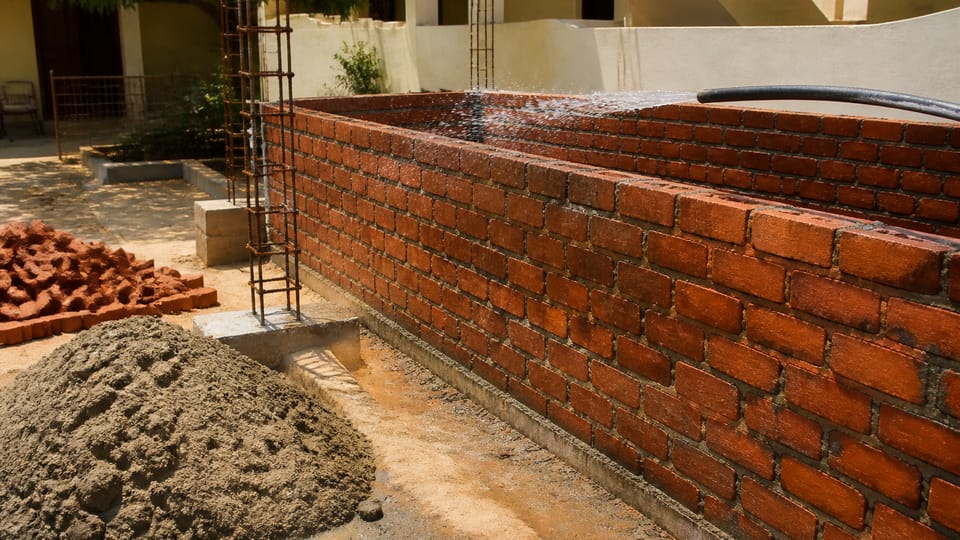
How long should a new brick wall be kept wet? The Indian brickwork code says the brickwork should be kept constantly wet for at least seven days in hot and dry weather (clause 11.10), and that brickwork should be kept wet for seven days from 24 hours after each course is laid (clause 12.3(m)). The CBRI guidance says masonry walls should be cured for seven days. In rain, new work should be covered. The mason keeps the wall damp and protected, and marks the date of each day's work.
On this page (9)
A new brick wall needs time and water to gain its strength. Mortar that dries too fast in the sun does not set properly, and it can crumble. Curing is the work of keeping the wall damp, and protecting it, for the first days after it is built. This guide sets out what the Indian brickwork code and the CBRI guidance say, what to ask the mason, and what to check. It gives no water quantities. The mason and the engineer decide the method for the site.
What does the brickwork code say?
IS 2212 is the Indian code of practice for brickwork. Its curing rule is in clause 11.10. It says that “In hot and dry weather, the mortar is likely to dry up before it has attained its final set and may crumble. This shall be prevented by keeping the brickwork constantly wet for at least seven days, except in the case of brickwork with mud mortar for which no such curing is required.”
So the seven-day rule applies in hot and dry weather. Brickwork laid with mud mortar needs no curing under this clause.
A second clause sets a different trigger. Item (m) of the inspection list in clause 12.3 says: “Care shall be taken to ensure that the brickwork is kept wet for seven days commencing from 24 hours after the course is laid.” This is not limited to hot weather, and it counts the seven days from 24 hours after each course is laid. The two clauses are different. Ask your engineer which one the drawings and the contract use, and do not mix them.
What about rain?
In rain, the code asks for protection rather than wetting. Clause 11.9.2 says “In inclement weather, newly built work shall be covered with gunny bags or tarpaulin so as to prevent the mortar from being washed away.” Cover the top of the wall at the end of each day, and keep it covered until the work is ready for the next course.
What does the CBRI guidance say?
The CSIR Central Building Research Institute publishes a booklet called Good Construction Practices (2017). It is guidance, not the code. It says “Masonry walls should be cured for 7 days,” and that the mason should mark the date at the end of each day’s work so that the curing can be checked. The same booklet says that “Masonry units should be watered for about 4 hours before laying.” So the bricks themselves are damped before they are laid, and the wall is kept damp after.
What about plaster and pointing?
The CPWD specifications for plaster and pointing use the same seven-day rule. For pointing, CPWD says “The pointing shall be kept wet for seven days. During this period it shall be suitably protected from all damages.” (clause 13.13.5). For plaster, the plaster must be kept wet for at least seven days, and the dates on which it was done must be marked so that the curing can be checked (clause 13.1.6). Our guide to plaster curing covers the plaster in more detail.
How do I keep the wall damp?
This section is practice. The sources read do not give a method for brick masonry beyond keeping the wall constantly wet and protected.
- Keep the wall damp, not flooded, with a fine spray or a wet cloth over the top, and keep it damp through the hottest part of the day.
- Protect the wall from the sun and the drying wind, with a cover or a wet sack, while it is curing.
- Cover the top of the wall in rain, as the code asks.
- Mark the date of each day’s work on the wall, so that the seven days can be counted.
- Do not lay the next course on a wall that is still dry and dusty. Wet the surface first, as the mason would do with the bricks.
What mistakes should I avoid?
This section is practice.
- Leaving a new wall to dry in the sun for the first days.
- Wetting only the top while the lower courses dry out.
- Leaving the wall uncovered in rain, so that the fresh mortar is washed out of the joints.
- Not marking the date of each day’s work, so that no one can tell when the seven days end.
- Assuming that a longer period is always better. Ask the engineer what the drawings and the contract ask for.
Frequently asked questions
Does lime mortar need a different curing time?
The CPWD Volume 2 text read for this guide has no lime-mortar masonry curing clause. Its 2009 foreword (item 8.3) says that “Specifications of lime mortar which is not in use now a days have been deleted.” Ask your engineer what the mortar in your wall needs.
Some contracts say ten days. Is that right?
We did not verify a ten-day figure from a standard. The brickwork code says seven days, and the CBRI booklet says seven days. Ask your engineer whether the contract asks for more.
Do the bricks need wetting before they are laid?
The CBRI booklet says masonry units should be watered for about four hours before laying. Ask the mason how the bricks will be wet on your site.
Related guides
This guide is general information. Read the disclaimer. Your engineer and mason decide the curing for your house.
Sources
- IS 2212:1991, Brick works: code of practice (first revision). Clauses 11.9.2 and 11.10, and item (m) of clause 12.3, read from the page images of a scanned copy. Current per the BIS record (valid to 2029-09-30).
- CSIR-CBRI, Good Construction Practices (2017), government institute booklet: masonry curing, the watering of masonry units, and the checklist. Guidance, not the code.
- CPWD Specifications 2009, Volume 2, clauses 13.1.6 (plaster curing) and 13.13.5 (pointing curing), read from the text layer. Volume 1, which holds the brickwork chapter, was not readable.
General information only. It is not a structural design or professional advice. Ask a licensed structural engineer or architect to check your plans and site.