
Short answer
How is the efflorescence test on bricks done, and what do the ratings mean? A lab stands the end of a brick in distilled water, lets it dry, adds the same water again and lets it dry, then rates the white salts as nil, slight, moderate, heavy or serious (IS 3495 Part 3). The test shows a brick's own liability to salts. It does not predict a wall. The pass limit is in IS 1077, and the figures we could read are from the 1992 edition.
On this page (11)
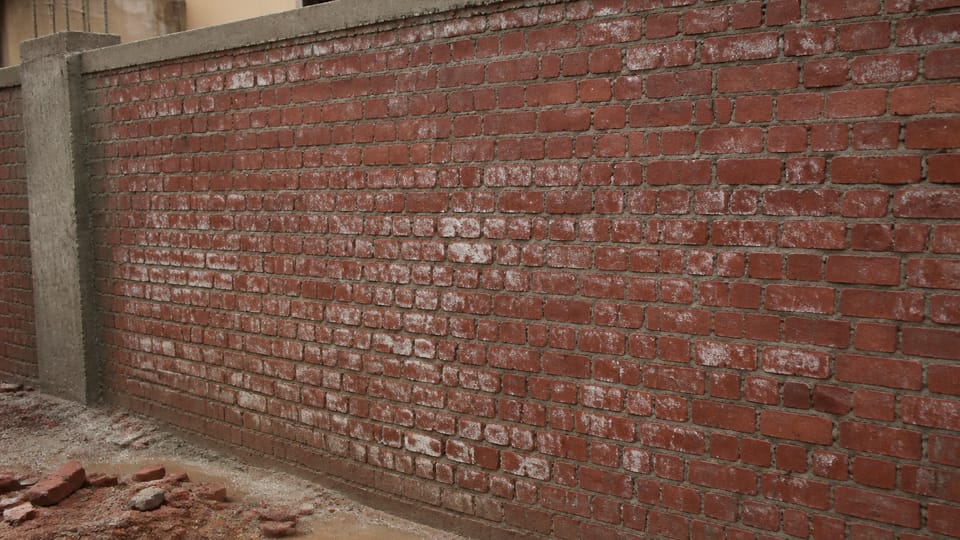
White powder on a new brick wall worries most owners. The question for a buyer of bricks is different: do these bricks carry salts that will come out? Indian Standards answer that with a lab test and a five-step scale. This page explains the test and the scale. It is about the test only. For cleaning a wall, see exposed brick walls and damp walls. It gives no prices and names no brands.
What is efflorescence?
IS 2212, the Indian code for brick work, says that when bricks containing soluble salts are used, the salts are dissolved out if water passes into the brickwork. They are then “deposited in the form of fine crystals on the face of the brickwork”. The code adds that efflorescence is common on new construction, because the water used in building leaves the salts on the face. It says that “continued efflorescence” would indicate that water from leaks or similar sources is finding its way into the brickwork, and that the entry of water shall be located and stopped.
CPWD’s 2019 specification describes it as “a powdery incrustment of salts left by evaporation”. It adds that salts can also lie below the surface, which it calls crypto efflorescence. So salts can be present without showing on the surface.
How is the test done?
IS 3495 Part 3 (2019) is the method. It gives these steps:
- The number of bricks tested is chosen according to the sampling standard IS 5454. Part 3 itself does not give a number.
- Brush off any adhering dirt that might be mistaken for efflorescence. This step is new in the 2019 revision.
- Stand one end of the brick in a shallow flat dish of distilled water, with the water 25 mm deep. The dish is glass, porcelain or glazed stoneware.
- Keep the arrangement in a warm, well-ventilated room at 27 ± 2 °C, until the bricks have absorbed all the water and the surplus has evaporated. Cover the dish with a glass cylinder, so that evaporation is not excessive.
- When the bricks look dry, add a similar quantity of water and let it be absorbed and evaporate again.
- Examine the bricks for efflorescence after the second evaporation, and report the result.
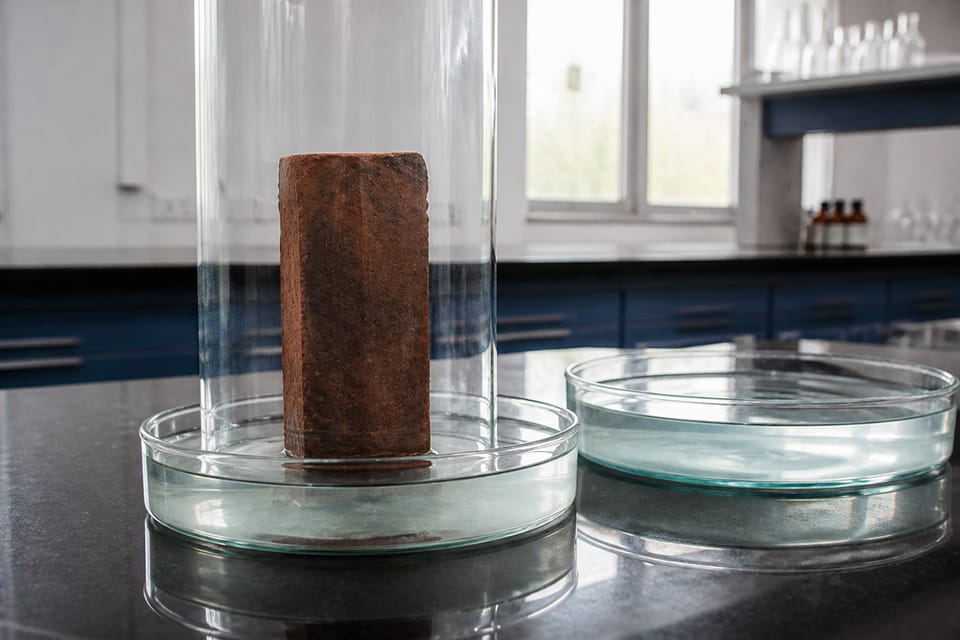
CPWD’s Appendix D describes the same idea with slightly different figures: 2.5 cm of water, and a warm, ventilated room at 18 to 30 °C. So follow the lab’s report, and ask which standard and year it used.
What do nil, slight, moderate, heavy and serious mean?
IS 3495 Part 3 says liability to efflorescence is reported as one of five words, with these definitions:
| Rating | IS 3495 Part 3 definition |
|---|---|
| Nil | “When there is no perceptible deposit of efflorescence.” |
| Slight | “When not more than 10 percent of the exposed area of the brick is covered with a thin deposit of salts.” |
| Moderate | “When there is a heavier deposit than under ‘slight’ and covering up to 50 percent of the exposed area of the brick surface but unaccompanied by powdering or flaking of the surface.” |
| Heavy | “When there is a heavy deposit of salts covering 50 percent or more of the exposed area of the brick surface but unaccompanied by powdering or flaking of the surface.” |
| Serious | “When there is a heavy deposit of salts accompanied by powdering and/or flaking of the exposed surfaces.” |
Two points follow from the wording. First, “serious” has no percentage. It is defined by powdering or flaking of the surface. Second, exactly 50 percent falls in both “moderate” (up to 50) and “heavy” (50 or more). That overlap is in the standard itself. The scale is a way to describe the result. Part 3 says nothing about whether a rating passes or fails.
What is the pass limit?
The limit is in IS 1077, the brick specification, not in IS 3495. IS 1077:1992 clause 7.3 says the rating shall not be more than “moderate” up to class 12.5 and “slight” for higher classes. That is the edition we could read. BIS lists it as withdrawn, and IS 1077:2025 is the current edition, which we could not read. Ask your engineer or supplier what the current edition says.
CPWD’s 2019 specification asks for common burnt clay bricks to be “not more than moderate”. Its own text is not consistent on how many bricks may fail: Appendix D says a lot passes if 4 of 5 bricks are not beyond “moderate”, while its sampling table allows no failing bricks for the smaller lots. So ask the lab which rule it applied.
What does the test not tell you?
The lab test shows how much salt a brick brings out when it is wetted and dried under set conditions. It does not predict how a wall will behave in rain. IS 2212 says continued efflorescence on a built wall points to water getting in. We found no source that says a particular rating means a particular wall will or will not show salt.
If white salts appear on a finished wall, IS 2212 says they should be scrubbed out dry with brushes when the structure dries up. They are not to be washed, as the solution will be absorbed into the brickwork again. It says cleaning with acids shall not be done, as new salts are formed, except in one narrow case given in a note to the clause. Ask your engineer before using any acid. The exposed brick page covers this in detail.
What about the home “soak and look” test?
Some web pages suggest standing a brick in a bowl of water and looking for white powder. As practice, treat that as a rough hint at most. It is not the IS test: it does not use distilled water, the stated depth, the room conditions, two wetting cycles or the rating scale. Tap water carries its own salts.
What should I ask the lab?
This is practice, not a standard.
- Which standard and year did you use (IS 3495 Part 3 and its year)?
- Was distilled water used, and were there two wet and dry cycles?
- What was the rating for each brick, not only for the lot?
- How was the sample taken, and did it come from my batch?
- Which acceptance rule did you apply?
What mistakes should I avoid?
These are practice, not code rules.
- Treating a home soak test as a certificate.
- Using tap water, or judging the result while the bricks are still wet.
- Calling dirt efflorescence, because the dirt was not brushed off first.
- Reading “serious” as a percentage, or “heavy” as the worst grade.
- Quoting a limit from memory without checking which edition of IS 1077 applies.
- Washing a wall, or using acid without an engineer’s advice (see IS 2212).
- Treating repeated salts on a wall as cosmetic when IS 2212 says they point to water getting in.
Frequently asked questions
Which IS code covers the efflorescence test?
IS 3495 (Part 3):2019 gives the method. IS 1077 gives the limit for common clay bricks.
What percentage of area is slight, moderate and heavy?
Slight is not more than 10 percent of the exposed area, with a thin deposit. Moderate is a heavier deposit covering up to 50 percent, with no powdering or flaking. Heavy is a heavy deposit on 50 percent or more, with no powdering or flaking. Serious is a heavy deposit with powdering or flaking.
Is efflorescence harmful?
IS 2212 says some salts, such as magnesium sulphate, have a disintegrating effect and make the brick face crumble to dust. It advises sealing off the entry of water if the salts are of the harmful type. Continued efflorescence on a wall can be a sign of water moving through it.
Does the test apply to fly ash bricks?
IS 12894:2002, for pulverized fuel ash-lime bricks, refers to IS 3495 (Part 3) for the efflorescence rating (clause 7.3). Clay-fly ash and other bricks have their own specifications. See fly ash brick quality.
Can I remove efflorescence with water or acid?
IS 2212 says to scrub it out dry and not to wash it. It also says acid cleaning shall not be done, except in one narrow case given in a note. Ask your engineer before any treatment.
Related guides
- Exposed brick walls: pointing and keeping water out
- Damp walls: rising damp, seepage or condensation
- Fly ash brick quality: what IS 12894 requires and how to check
This guide is general information. Read the disclaimer. Your engineer decides which bricks and tests suit your walls.
Sources
- IS 3495 (Part 3):2019, Burnt Clay Building Bricks: Methods of Tests, Part 3 Determination of Efflorescence (fourth revision): clauses 1, 3.3, 4.1, 4.2, 4.3 and the foreword. The standard defines no efflorescence and gives no pass limit.
- IS 1077:1992, Common Burnt Clay Building Bricks: Specification (fifth revision), clause 7.3. BIS shows this edition withdrawn and IS 1077:2025 as current; the 2025 text could not be found, so the limit here is a 1992 value.
- IS 2212:1991, Brick Works: Code of Practice (first revision), clauses 13.5.1 to 13.5.4. Read from OCR text, so the wording should be checked against a print.
- IS 12894:2002, Pulverized Fuel Ash-Lime Bricks: Specification, clause 7.3 (efflorescence rating).
- CPWD Specifications 2019 Vol 1, Appendix D (efflorescence test), clause 6.1.3.6 and Table 6.4. A government works specification, used as a second reading.
General information only. It is not a structural design or professional advice. Ask a licensed structural engineer or architect to check your plans and site.