
Short answer
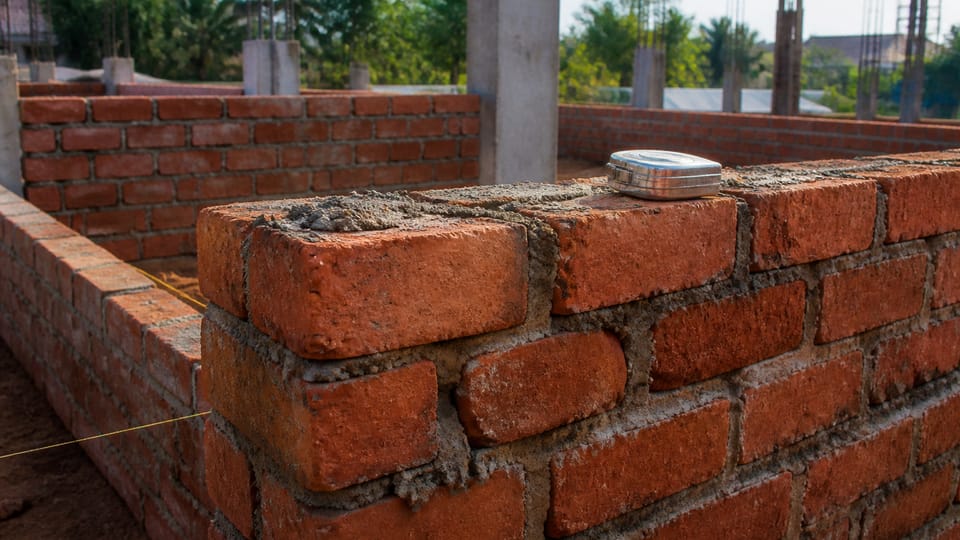
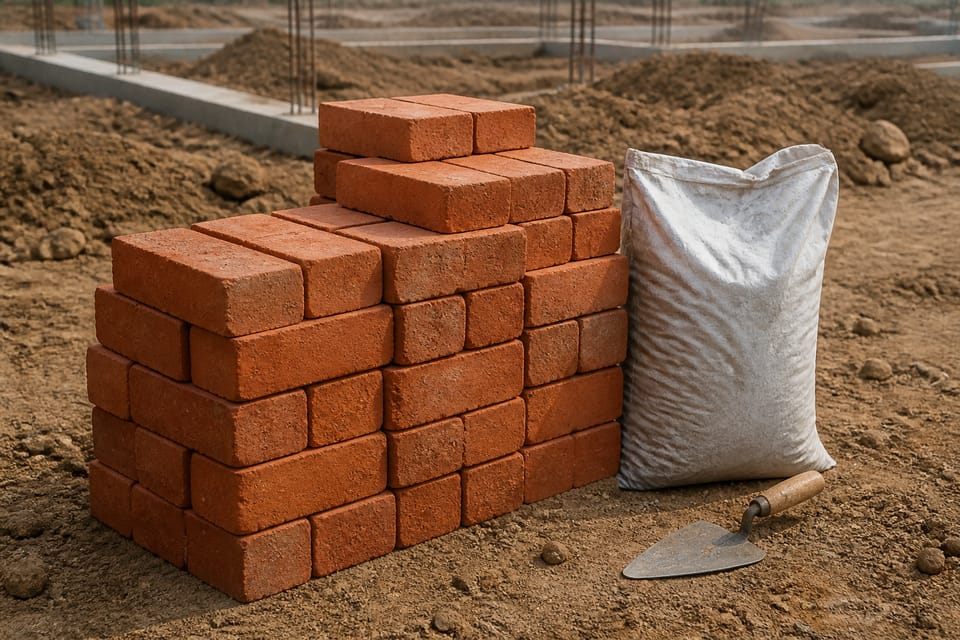
How many bricks are needed for 1 cubic metre of brickwork? About 434 traditional bricks (230 × 110 × 70 mm) or 500 modular bricks (190 × 90 × 90 mm) for 1 cubic metre of brickwork, with the 10 mm mortar joint assumed on this page. These counts exclude wastage. A thicker joint means fewer bricks. Ask your mason which brick size you are buying.
On this page (9)
Need quantities? Brick and mortar quantity calculator
A mason or a supplier may ask how many bricks a cubic metre of wall needs. The answer depends on two things: the size of the brick and the thickness of the mortar joint around it. This page gives the method, the count for the two common sizes, and a worked example. It does not give prices, and it does not replace the drawing or the advice of your engineer.
How many bricks are in 1 cubic metre?
Each brick is laid with mortar around it, so the space one brick takes up is larger than the brick. Divide 1 cubic metre by that space to get the count.
| Brick | Actual size (mm) | Size with 10 mm joints (mm) | Bricks per cubic metre of brickwork |
|---|---|---|---|
| Traditional clay brick | 230 × 110 × 70 | 240 × 120 × 80 | about 434 |
| Modular clay brick | 190 × 90 × 90 | 200 × 100 × 100 | 500 |
The count is for brickwork, not for solid brick. The mortar takes about 23 percent of the volume of the wall, so the count is lower than the number you would get by dividing by the brick alone.
Why does the count assume a 10 mm joint?
The joint is the layer of mortar between bricks. The joint size is not a free choice, and the standards say so:
- IS 2212:1991 gives a 1 cm allowance for mortar joints with modular bricks in its nominal wall thickness. For traditional bricks the same clause gives an allowance in inches.
- IS 2212 says no bed joint shall be thicker than 12 mm (clause 6.4.1). That is the upper limit.
- The handbook SP 20 takes the normal bed joint as 10 mm and notes that a thicker joint weakens the wall.
This page uses 10 mm for both sizes, because that is the joint the handbook uses for its normal figure. The standard gives the allowance for modular bricks as 1 cm, and this page applies the same 10 mm to traditional bricks. This is our assumption, not a separate rule.
The brick sizes are from IS 1077:1992, which gives 190 × 90 × 90 mm for the modular brick (clause 6.1.1) and 230 × 110 × 70 mm for the non-modular clay brick (clause 6.1.2). IS 1077 has since been revised to a 2025 edition, which we have not read. Check the size of the brick you will buy before you use these counts.
How do I work out the number for my wall?
Use this method:
- Take the volume of the wall in cubic metres: length × height × thickness.
- Take the nominal size of one brick with its joints: length × width × height, in metres.
- Divide the volume by the nominal size of one brick.
- Add wastage only as a separate step, and say what allowance you chose.
Using the traditional brick: 1 ÷ (0.240 × 0.120 × 0.080) = 1 ÷ 0.002304 = 434.03 bricks. The count is 434 bricks, and whole bricks must be ordered by rounding up, so order 435.
Using the modular brick: 1 ÷ (0.200 × 0.100 × 0.100) = 1 ÷ 0.002 = 500 bricks exactly.
Worked example (example, not a design)
The table below takes a wall of 1 cubic metre, which is the same as 1 m long, 1 m high and 1 m thick. The wastage column is an example assumption, not a rule.
| Item | Traditional brick | Modular brick |
|---|---|---|
| Wall volume | 1.000 m³ | 1.000 m³ |
| Bricks, no wastage | about 434 | 500 |
| Whole bricks to order (rounded up) | 435 | 500 |
| Bricks with 5 percent wastage (example assumption) | 456 | 525 |
The brick quantity calculator runs the same arithmetic for any wall, with the wall length, height, thickness and openings as inputs.
What mistakes should I avoid?
These are arithmetic and practice points, not code rules.
- Dividing by the brick size alone. Using 230 × 110 × 70 mm gives about 565 bricks per cubic metre, which is about 30 percent too many, because the joints are left out.
- Using one count for both bricks. A modular brick and a traditional brick are different sizes and give different counts.
- Counting wastage twice. Wastage is the buyer’s choice. Keep the physical count separate from it.
- Ignoring the joint. A thicker joint means fewer bricks, and a thinner one means more.
- Treating a web figure as a code figure. Many pages give 500 bricks per cubic metre without naming the brick. Check the size first.
Frequently asked questions
Is 500 bricks per cubic metre always right?
No. 500 is the count for the modular brick (190 × 90 × 90 mm) with a 10 mm joint. A traditional brick of 230 × 110 × 70 mm gives about 434.
Does the wall thickness change the count per cubic metre?
No. The count per cubic metre is the same for any thickness, because the volume is already 1 cubic metre. The thickness changes the number of bricks in a wall of a given area. See the 100 sq ft page for that.
How many bricks do I need for a 100 sq ft wall?
That depends on the wall thickness as well as the brick. The 100 sq ft page works through 9 inch and 4.5 inch walls with the same assumptions.
How much mortar goes into 1 cubic metre of brickwork?
About 23 percent of the wall volume is mortar, given the 10 mm joint. The mix of cement and sand depends on the mortar ratio. See the mortar ratio page for the choice of ratio. This page does not give the bag count.
Does a fly ash brick change the count?
Only if its size is different. Check the size on the brick or the supplier’s data sheet, then divide as shown above. The brick and block sizes page lists the common sizes.
Related guides
- How many bricks for 100 sq ft of wall? Assumptions shown
- Brick and block sizes in India: red, fly ash and AAC
- Mortar ratio for brick walls: 1:4, 1:5 or 1:6?
This guide is general information. Read the disclaimer. Your engineer decides the wall thickness, the brick and the mortar for your house.
Work out your quantities
- Brick and mortar quantity calculator: Estimate the number of bricks and the cement and sand for mortar for a wall, from its length, height and thickness.
Sources
- IS 2212:1991, Brick Work - Code of Practice (First Revision), clauses 3.1 (nominal thickness of a wall, 1 cm allowance for modular bricks) and 6.4.1 (bed joints not thicker than 12 mm). The BIS record shows this edition in force.
- IS 1077:1992, Common Burnt Clay Building Bricks - Specification (Fifth Revision), clauses 6.1.1 (modular size 190 × 90 × 90 mm) and 6.1.2 (230 × 110 × 70 mm). IS 1077:2025 (Sixth Revision) is the current edition; its size clause has not been read.
- SP 20 (S&T):1991, Handbook on Masonry Design and Construction (First Revision), section 6.3, which takes the normal bed joint as 10 mm.
General information only. It is not a structural design or professional advice. Ask a licensed structural engineer or architect to check your plans and site.