
Short answer
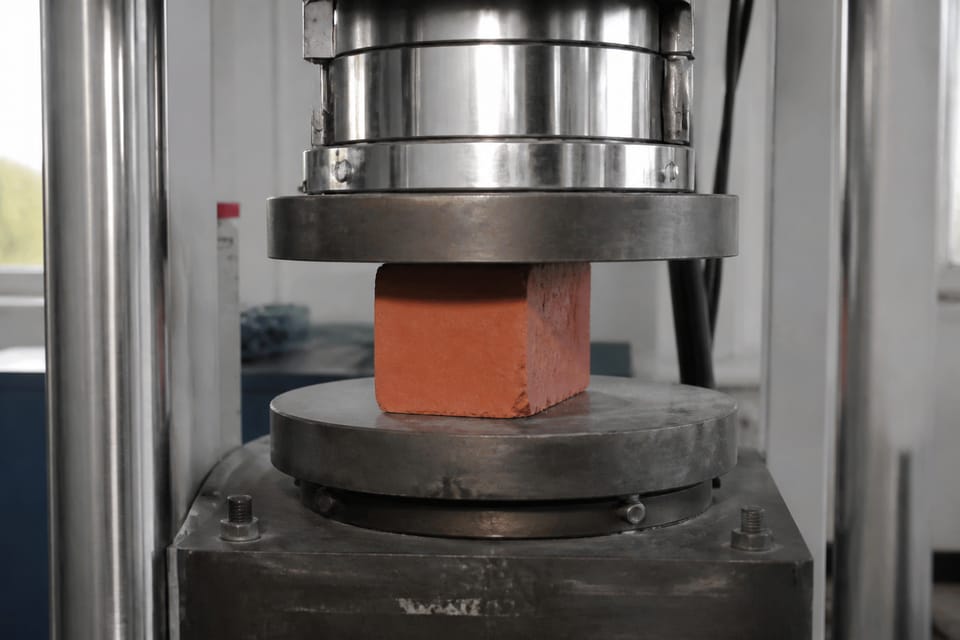
What tests are done on bricks, and what do the class numbers mean? A lab tests a sample of bricks for compressive strength, water absorption, efflorescence and size (IS 3495 gives the methods, IS 1077 the limits). A brick's class number is its minimum average strength in N/mm2. The limits in this page are from IS 1077:1992, which BIS has replaced with a 2025 edition that we could not read. Ask for a lab report on bricks from your own batch.
On this page (13)
- Which standards cover brick tests?
- What are the four tests?
- What do the class numbers mean?
- How is water absorption tested?
- What is efflorescence, and how is it rated?
- How is the size checked?
- What can I check by eye?
- How are bricks sampled?
- What should I do as an owner?
- What mistakes should I avoid?
- Frequently asked questions
- Related guides
- Sources
A brick is sold by the thousand, and the strength of a house wall depends on the lot you get, not on the name on the invoice. This page explains the four tests a lab runs on clay bricks, what the class numbers mean, the limits in the edition we could read, and what you can sensibly check yourself. It gives no prices and names no brands. For fly ash bricks, see fly ash brick quality. For sizes, see brick and block sizes in India.
Which standards cover brick tests?
Two standards work together, and they are easy to mix up.
- IS 3495 says how to test. Parts 1 to 4 (2019) are the methods for compressive strength, water absorption, efflorescence and warpage. They set no pass limits. IS 1077:1992 refers to the 1992 methods, which the 2019 parts replace.
- IS 1077 says what is required: the classes, the general quality, the size checks, and the limits on absorption and efflorescence.
An important caution: BIS lists IS 1077:1992 as withdrawn and IS 1077:2025 as the current edition. We could not read the 2025 text. Every limit below is from the 1992 edition. Ask your engineer or supplier which edition applies, and whether the numbers have changed.
What are the four tests?
| Test | Method | What it checks | IS 1077:1992 requirement |
|---|---|---|---|
| Compressive strength | IS 3495 Part 1 | How much load a brick takes before it crushes | The class: minimum average strength |
| Water absorption | IS 3495 Part 2 | How much water a dried brick takes in over 24 hours | Not more than 20 percent by weight up to class 12.5, and 15 percent for higher classes |
| Efflorescence | IS 3495 Part 3 | How much white salt shows on the surface after wetting and drying | Rating not more than “moderate” up to class 12.5, and “slight” for higher classes |
| Warpage | IS 3495 Part 4 | How far a face is from flat | The 1992 text has no warpage limit that we found |
Size is checked separately, as described below. A lab does these tests on a sample of whole bricks, not on a brick at your site.
What do the class numbers mean?
IS 1077:1992 groups bricks into eleven classes by “average compressive strength”: 3.5, 5, 7.5, 10, 12.5, 15, 17.5, 20, 25, 30 and 35. The class number is the minimum average strength in N/mm2 of the lot’s sample. A higher class is a stronger brick. A class is a minimum, not a measure of how good the brick is in other ways.
The standard also limits the weakest individual brick. As amended in 2008, no individual brick may fall below the class minimum by more than 15 percent. If the lot fails, it is checked against the next lower class. This is a 1992 value, and CPWD’s specification for government works uses a different figure, 20 percent. Ask your engineer which class your wall needs. See red brick vs fly ash brick vs AAC block for how the classes compare.
How is water absorption tested?
The lab dries the bricks, weighs them, soaks them in water for 24 hours, wipes them, weighs them again and works out the percentage gained. It needs an oven and a precise balance. A soak and weigh in the kitchen does not follow the standard method, so do not treat it as the test.
What is efflorescence, and how is it rated?
Efflorescence is a white deposit of salts on the surface of a brick. IS 3495 Part 3 reports it in five steps: nil, slight, moderate, heavy and serious. Serious means a heavy deposit with powdering or flaking of the surface. IS 1077:1992 allows up to “moderate” for lower classes and only “slight” for higher classes. White patches on a finished wall are a sign of salts and damp, but they are not the standard test. See exposed brick walls for dealing with them on a wall.
How is the size checked?
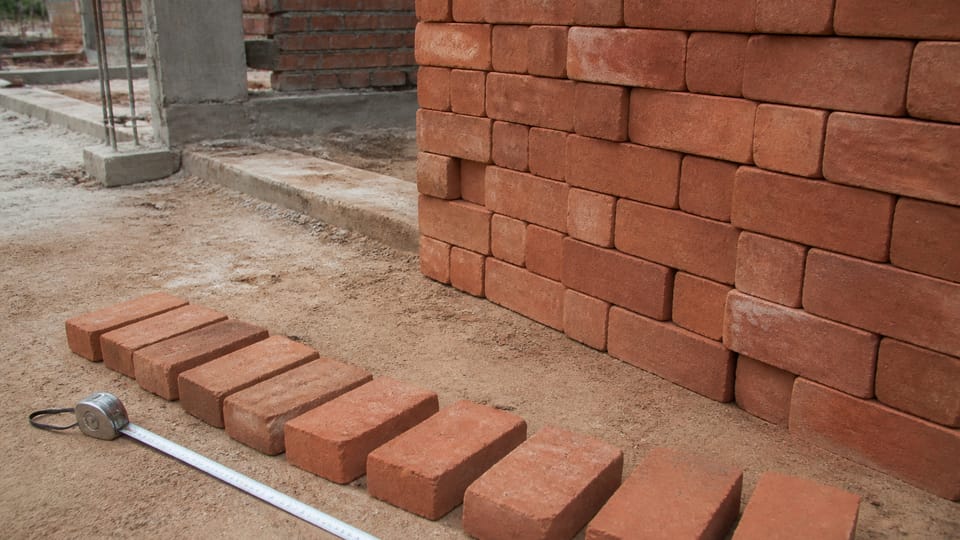
IS 1077 does not measure one brick at a time. It asks for twenty whole bricks, chosen at random, laid in a straight row in contact with each other, and the whole row measured with a steel tape “sufficiently long to measure the whole row at one stretch”. Measuring in steps with a short rule “shall not be permitted”. As practice, this is one check an owner can do on site. The size and tolerance figures are in the standard, and the sizes page lists the sizes. We do not repeat them here.
What can I check by eye?
IS 1077:1992 says bricks shall be free from cracks and flaws and nodules of free lime, with smooth rectangular faces, sharp corners and a uniform colour. Each brick should be marked with an indication of its source of manufacture, in the frog where there is one.
CPWD’s 2019 specification adds that the bricks should “emit clear ringing sound when struck”. That is CPWD wording, for its own works. IS 1077:1992 has no sound test and no drop test. We found no standard that treats a drop from shoulder height, a fingernail scratch or breaking a brick open as a quality test. As practice, treat them as rough hints at most. A ring or a drop does not give a class, so a doubtful brick is a reason to ask for a lab test.
How are bricks sampled?
IS 1077 sends sampling to IS 5454, the sampling standard. CPWD’s version says bricks are taken at random, and from a stack the stack is divided into real or imaginary sections, a number of bricks is drawn from each section, and bricks in the upper layers are removed so that units can be taken from inside the stack. For small lots, the 1978 edition of IS 5454 leaves the sampling to agreement between the buyer and the supplier. A newer 2024 edition is in force, and we did not read it.
What should I do as an owner?
This is practice, not a code rule.
- Ask the supplier for a lab report on bricks from the batch you will actually receive, with the class, the strength, the absorption, the efflorescence rating and the sizes.
- Have the sample taken from several places in the stack, not only the top layer, and not chosen by the seller.
- Keep a few bricks from each delivery as a sealed sample, so that a later problem can be traced.
- Check the class on the report against the class your engineer specified.
- Test before the bricks are in the wall.
What mistakes should I avoid?
These are practice, not code rules.
- Accepting bricks on the seller’s word or on a ring test.
- Reading “first class” or “second class” as an Indian Standard class. IS 1077:1992 uses numbered classes only.
- Taking class 3.5 as “enough for a house” without asking the engineer.
- Testing one brick, or the best-looking ones, and judging the whole lot.
- Mixing up IS 3495 (the method) and IS 1077 (the requirement).
- Using the 1992 numbers without noting that a newer edition exists.
Frequently asked questions
Is the drop test or ring test a standard test?
No. IS 1077:1992 and IS 3495 contain neither. CPWD’s specification asks for a clear ringing sound as one property of the brick, but it gives no method and no pass rule.
What is the minimum strength of a brick?
It depends on the class. IS 1077:1992 starts at class 3.5 (3.5 N/mm2). The class your wall needs is the engineer’s decision.
What is the water absorption limit of a brick?
In IS 1077:1992, not more than 20 percent up to class 12.5 and 15 percent for higher classes. This is a 1992 figure. CPWD uses 20 percent for all classes.
Can I test a brick myself?
You can check size, shape, cracks and markings. Strength, absorption and efflorescence need a laboratory.
Which standard is current?
IS 1077:2025 is the edition BIS lists as current. IS 3495 Parts 1 to 4 (2019) are the current methods.
Related guides
- Red brick vs fly ash brick vs AAC block
- Fly ash brick quality: what IS 12894 requires and how to check
- Brick and block sizes in India
This guide is general information. Read the disclaimer. Your engineer decides the brick class for your walls.
Sources
- IS 3495 (Parts 1 to 4):2019, Burnt Clay Building Bricks: Methods of Tests: Part 1 Compressive Strength, Part 2 Water Absorption, Part 3 Efflorescence, Part 4 Warpage (fourth revisions; scope, and Part 3 clause 4.3 for the efflorescence ratings). These give methods only, no pass limits.
- IS 1077:1992, Common Burnt Clay Building Bricks: Specification (fifth revision, with Amendment 1 of 2008): clauses 4.1 and Table 1, 5.1 to 5.3, 6.2.1, 7.1, 7.1.1, 7.2, 7.3, 8.1, 9.1 (page images read). BIS shows this edition withdrawn in June 2026 and IS 1077:2025 (sixth revision) published on 2025-09-01; the 2025 text could not be found, so every limit here is a 1992 value and may differ in the 2025 edition.
- CPWD Specifications 2019 Vol 1, clauses 6.1.2 (classification and the ringing-sound sentence), 6.1.3 (tests and sampling), 6.1.3.5. A specification for government works, used here as a second reading. Copy hosted by Puducherry PWD.
General information only. It is not a structural design or professional advice. Ask a licensed structural engineer or architect to check your plans and site.