
Short answer
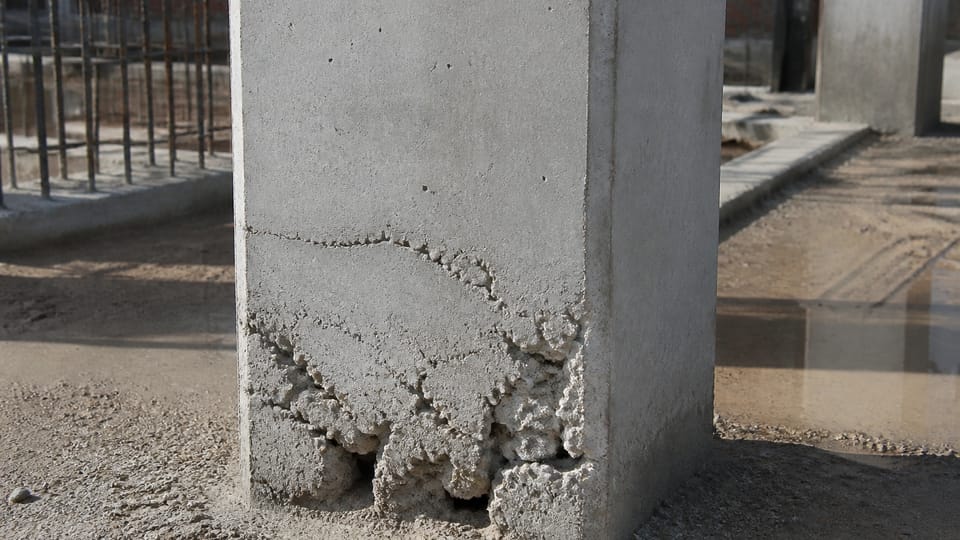
What is the difference between honeycombing, segregation and bleeding in concrete? Segregation is the mix separating into its parts, bleeding is mixing water rising to the surface of fresh concrete, and honeycombing is the voids left in hardened concrete where mortar failed to fill the spaces between stones. IS 456 says honeycombed concrete is liable to be rejected unless the engineer-in-charge accepts suitable remedial measures.
On this page (9)
When the shuttering comes off a column and a patch of stones shows with no mortar between them, the first question is always the same: is it serious? The second is what to call it. Honeycombing, segregation, bleeding, laitance and bug holes are used as if they meant one thing, but they are different problems with different causes, and only some of them are defects in the hardened concrete. This page defines each using the glossary of the Indian concrete standards, says what IS 456 says about defective concrete, and says plainly that no code we read gives a repair method for a cast-in-place house member: the engineer decides. It gives no free-fall height, no vibration time and no repair recipe. For how to use the vibrator, see compacting concrete with a needle vibrator: method and mistakes.
What does each word mean?
The definitions below are from IS 6461 (Part 7):1973, the glossary part on mixing, laying and compaction. That edition is withdrawn and replaced by a 2024 edition we could not read, so treat the wording as the older text.
| Word | Glossary wording | What it means for an owner |
|---|---|---|
| Honeycomb | “Voids left in concrete due to failure of the mortar to effectively fill the spaces among coarse aggregate particles” (2.194) | A defect in hardened concrete, seen after the shuttering is removed: stones with open spaces between them |
| Rock pocket | “A porous, mortar-deficient portion of hardened concrete consisting primarily of coarse aggregate and open voids, caused by leakage of mortar from formwork separation (segregation) during placement, or insufficient consolidation” (2.267) | A honeycomb in a pocket. The glossary names two causes: mortar leaking from the formwork, and insufficient consolidation |
| Segregation | “The differential concentration of the components of mixed concrete, resulting in nonuniform proportions in the mass” (2.288) | A process in the fresh mix: stones and mortar separate. It can lead to honeycombing |
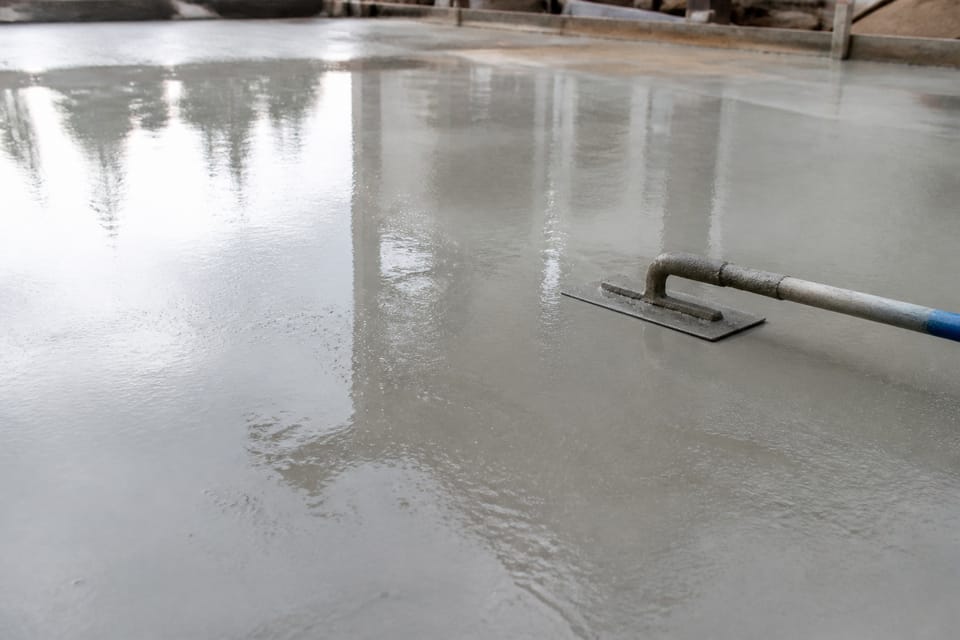
| Bleeding | “The autogenous flow of mixing water within, or its emergence from newly placed concrete or mortar; caused by the settlement of the solid materials within the mass or drainage of mixing water; also called water gain” (2.35) | Water rising to the top of a fresh slab or sliding up a wall face |
| Laitance | “A layer of weak and nondurable material containing cement and fines from aggregates, brought by bleeding water to the top of overwet concrete, the amount of which is generally increased by overworking or overmanipulating concrete at the surface by improper finishing or by job traffic” (2.203) | A weak, powdery skin on the top of a slab |
| Sand streak | “Streak in surface of formed concrete caused by bleeding” (2.281) | A line of sand showing on a formed face |
| Cold joint | “A joint or discontinuity formed when a concrete surface hardens before the next batch is placed against it, characterized by poor bond unless necessary procedures are observed” (2.77) | A line where one pour met hardened concrete. See construction joints in concrete: where a pour stops and restarts |
Segregation and honeycombing are not the same: segregation is the cause in the fresh mix, and honeycombing is what is left in the hardened concrete. Bleeding and laitance are linked by the glossary, which says bleeding water brings the weak layer to the top. “Bug holes” is not a defined term in the glossary Part we read. The glossary Part 5 on formwork (1972) defines a blowhole as a small hole in a concrete face caused by an air pocket, which is the nearest.
Why does it happen?
IS 456 does not list causes of honeycombing. It names what to do to prevent it:
- Mix and placing: clause 8.2.7 asks for “adequate compaction without segregation” through suitable workability and appropriate placing and compacting equipment and procedures. Clause 13.2 says methods of placing “should be such as to preclude segregation”. Clause 10.3 says that if concrete segregates after unloading from the mixer, it should be remixed.
- Compaction: clause 13.3 says concrete “should be thoroughly compacted and fully worked around the reinforcement, around embedded fixtures and into corners of the formwork”. Clause 13.3.1 asks for mechanical vibrators and says “over vibration and under vibration of concrete are harmful and should be avoided”, and the glossary defines overvibration as causing segregation and excessive bleeding.
- Steel: clause 12.6 says the reinforcement should be placed and tied so that concrete can be placed “without segregation of the mix” and so that an immersion vibrator can be used.
- Formwork: clause 11.1 says the formwork shall prevent “loss of slurry from the concrete”.
- Water: clause 8.2.7 says overworking the surface and adding water/cement to help finishing should be avoided, and the resulting laitance has impaired strength and durability. See water-cement ratio: why extra water weakens concrete.
In plain words, which is practice and not a clause: too little compaction, steel packed so close that the concrete cannot get through, concrete dropped from a height or pushed along, formwork joints that leak slurry, too much water, and a wrong mix or stone size for the member.
What does IS 456 say about defective concrete?
Clause 16.6 says concrete “is liable to be rejected if it is porous or honey-combed, its placing has been interrupted without providing a proper construction joint, the reinforcement has been displaced beyond the tolerances specified, or construction tolerances have not been met”. It adds that “the hardened concrete may be accepted after carrying out suitable remedial measures to the satisfaction of the engineer-in-charge”. Clause 17.2 says that immediately after stripping the formwork, all concrete “shall be carefully inspected and any defective work or small defects either removed or made good before concrete has thoroughly hardened”. Where there is doubt about the grade of concrete, for example from poor workmanship, clause 17.3 allows compressive strength tests of cores (clause 17.4) and/or a load test (clause 17.6). Clause 17.4.1 leaves the core points and number to the engineer-in-charge.
The code gives no repair method for a house, no limit on how much honeycombing is acceptable, and no definition of “small defects”. NBCS 2026 has a table of defects and remedies for factory precast units, with a list of remedial steps, but that is for precast concrete and it is not a method for a cast-in-place house member. Whether a honeycomb in a column is cosmetic or serious depends on its depth, its position and what it exposes; that is the engineer’s call.
What should I do if I see one? (practice)
This is practice, apart from the clauses named.
- Photograph it with a coin or a tape in the picture, mark the area, and note the date and the pour.
- Do not plaster over it, patch it or paint it before the engineer has seen it. Hiding it removes the evidence the engineer needs.
- Tell the engineer the same day, and ask for the repair method in writing.
- Ask which pour and which load the member carries, and whether tests are needed before the next stage.
- Keep the area free of load and finishing work until the engineer decides.
How can I help prevent it? (practice)
- Before the pour: a working vibrator and a spare, enough labour, steel that leaves room for the concrete, formwork joints sealed, and a way to place concrete without a long drop. See before the slab pour: an owner’s checklist for formwork and steel.
- During the pour: no extra water on site, concrete placed close to its final position, each layer compacted, and the engineer called if a mix looks separated.
- At the top of a slab: do not finish while bleed water stands on the surface.
What mistakes should I avoid? (practice)
- Treating a honeycomb as cosmetic because it is small.
- Plastering over the defect before anyone has looked at it.
- Adding water to make the concrete flow.
- Vibrating one spot for too long, which can segregate the mix, or not vibrating at all.
- Poking the vibrator at the steel or the formwork.
- Leaving gaps in the formwork.
- Finishing the top of a slab while bleed water is still rising.
- Calling every surface defect “honeycomb”. A line is a joint, a small round pit is a blowhole (“bug hole” is a site term), a powdery film is laitance.
Frequently asked questions
What is the difference between segregation and honeycombing?
Segregation is the mix separating, which happens before it sets. Honeycombing is the voids left in the hardened concrete. Segregation is one cause of honeycombing.
Is honeycombing dangerous?
It can be, depending on its depth and position. IS 456 clause 16.6 says honeycombed concrete is liable to be rejected unless suitable remedial measures satisfy the engineer-in-charge.
Can I plaster over a honeycomb?
Do not. The engineer needs to see it first, and clause 17.2 asks for defects to be inspected, removed or made good after the shuttering is stripped.
What is bleeding and is it harmful?
Bleeding is water rising in fresh concrete. Bleed water on a fresh slab is normal in itself. IS 456 warns against overworking the surface and adding water to aid finishing, which gives weak laitance.
Who decides the repair?
The engineer-in-charge. IS 456 gives no repair method for a house.
Related guides
- Compacting concrete with a needle vibrator: method and mistakes
- Water-cement ratio: why extra water weakens concrete
- Construction joints in concrete: where a pour stops and restarts
- Compacting concrete without a vibrator: rodding and when it is allowed
This guide is general information. Read the disclaimer. Your engineer decides whether a defect is cosmetic or structural and how it is repaired.
Sources
- IS 456:2000, Plain and Reinforced Concrete, Code of Practice: clauses 8.2.7, 10.3, 11.1, 12.6, 13.2, 13.3, 13.3.1, 16.6, 17.2 and 17.3 (page images read). BIS lists it as in force, valid to 2030-07-12.
- IS 6461 (Part 7):1973, Glossary of Terms Relating to Cement Concrete, Part 7 Mixing, Laying, Compaction, Curing and Other Construction Aspects: entries 2.35, 2.77, 2.194, 2.203, 2.235, 2.267, 2.281 and 2.288 (page images read). This edition is withdrawn and has been replaced by IS 6461 (Part 7):2024, which we could not read; the in-force wording may differ.
- IS 6461 (Part 5):1972, Glossary of Terms Relating to Cement Concrete, Part 5 Formwork: entry 2.39 (page image read). This edition is withdrawn and replaced by IS 6461 (Part 5):2024, which we could not read.
- SP 7:2026, National Building Construction Standards (NBCS) 2026, Part C Section 7, Prefabricated Concrete, Annex F Table 19 (page image read, precast context only). From an unofficial archive.org copy.
Change log
- : Added Related guides link to newly published article(s): compacting-concrete-without-a-vibrator-hand-rodding-and-when-it-is-allowed. No other text changed. Approved by the reviewing engineer.
General information only. It is not a structural design or professional advice. Ask a licensed structural engineer or architect to check your plans and site.