
Short answer
Can concrete be compacted by hand without a vibrator? It can be done, but it is not equal to vibration. IS 456 says concrete shall be compacted using mechanical vibrators, and we found no hand route in it. CPWD lets its engineer permit hand compaction with tamping rods for certain items, in writing. For a house, treat hand rodding as your engineer's decision, not the mason's choice, and never add water to make it easier.
On this page (11)
- Does IS 456 allow compaction by hand?
- When is hand compaction permitted?
- How does hand compaction compare with a vibrator?
- How is hand compaction done, if the engineer permits it?
- Can I add water to make it flow?
- What if the vibrator stops during a pour?
- Does tapping the shuttering count as compaction?
- What mistakes should I avoid?
- Frequently asked questions
- Related guides
- Sources
The vibrator has stopped working, or the site never had one, and the mason says a rod will do. This page explains what the Indian codes say, what hand rodding can and cannot do, and what to do if a vibrator fails during a pour. It gives no rod size, stroke count or layer depth, because no code we read sets them for hand compaction on site. It also names no member as safe for hand work. That decision belongs to your engineer.
Does IS 456 allow compaction by hand?
IS 456 sets the vibrator as the rule. Clause 13.3.1, as changed by Amendment 5 of July 2019, says: “Concrete shall be compacted using mechanical vibrators complying with IS 2505, IS 2506 and IS 2514.” NBCS 2026, the national building code, sends concrete workmanship to IS 456.
We found no hand-compaction route in IS 456, read with Amendments 1 to 5. We could not read Amendment 6, so your engineer should check the latest text. The clause does not list an exception for small work.
Why it matters: clause 13.3 asks that concrete be “thoroughly compacted and fully worked around the reinforcement, around embedded fixtures and into corners of the formwork”. Clause 12.6 says “Reinforcement placing should allow compaction by immersion vibrator.” So the code expects the vibrator from the time the steel is laid out.
When is hand compaction permitted?
The clearest Indian text we found is in the CPWD Specifications, which bind CPWD works only. For reinforced concrete, clause 5.4.3.1 says the Engineer-in-Charge “may however relax this condition at his discretion for certain items depending on the thickness of the members and feasibility of vibrating the same and permit hand compaction instead.”
CPWD 4.2.7 adds: “For the items where mechanical vibrators are not to be used, the contractor shall take permission of the Engineer-in- Charge in writing before the start of the work.”
Note three things:
- The decision is the engineer’s, not the contractor’s.
- CPWD 5.4.3.1 gives no list of items, so we give none either.
- Permission comes in writing, before the work starts.
For a house, use this as a model. Ask your engineer before the pour, and keep the answer in writing.
How does hand compaction compare with a vibrator?
It is not equal. No standard we read says it is, and these texts rank hand work lower.
| Source | What it says |
|---|---|
| IS 3558, foreword | Vibration “can, under suitable conditions, produce better quality concrete than by hand compaction, or by permitting lower cement content and lower water/cement ratio, produce equally strong concrete more economically than by hand compaction.” |
| Australian guidance (CCAA) | Vibration “is generally much more efficient than tamping or rodding by hand” |
| American guidance (ACI) | “The manual consolidation methods are generally used only on smaller nonstructural concrete placement.” |
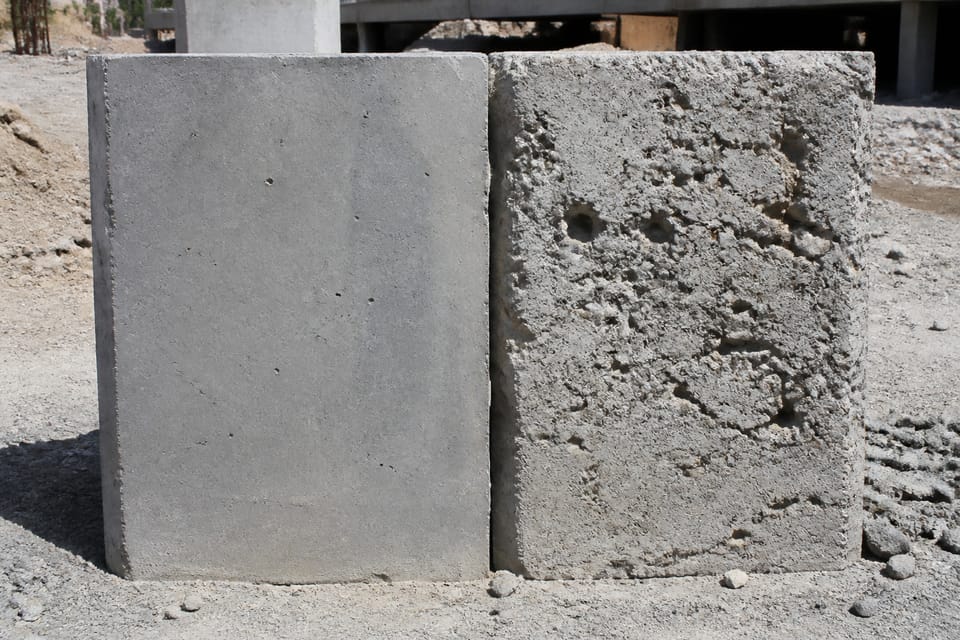
The cost of poor compaction is high. SP 23, a BIS handbook, says: “The presence of even 5 percent voids in the hardened concrete left due to incomplete compaction may result in a decrease in compressive strength by about 35 percent”. It is citing British research of 1947, so read it as an illustration. CCAA gives a similar warning for concrete with 10 percent trapped air, “reduced by as much as 50%”. These figures are about voids and trapped air. They are not a measure of hand work against vibrated work.
How is hand compaction done, if the engineer permits it?
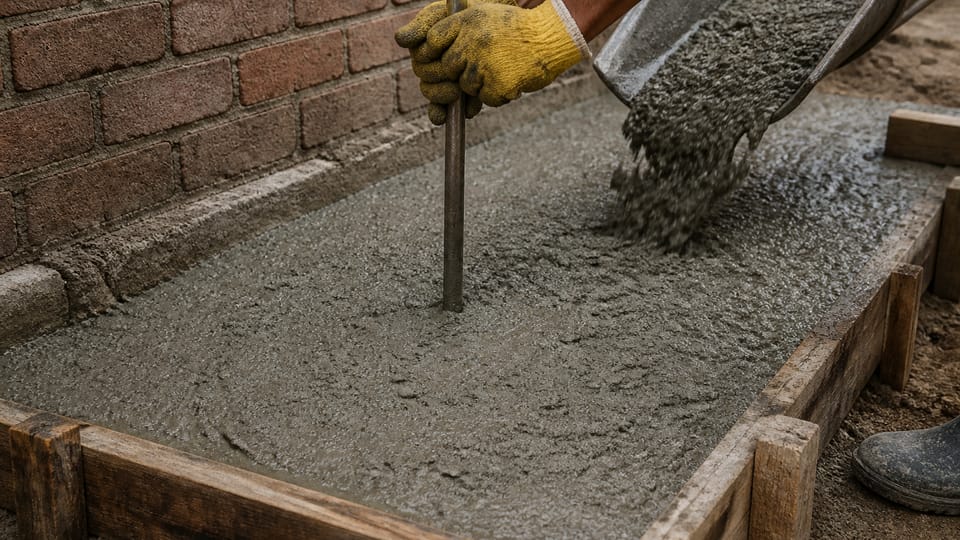
CPWD 5.4.3.1 gives the method in one sentence: “Hand compaction shall be done with the help of tamping rods so that concrete is thoroughly compacted and completely worked around the reinforcement, embedded fixtures, and into corners of the form.”
The working points below come from CPWD, IS 456 and one Australian guide, named on each.
- Work before it sets. IS 456 13.2 says concrete “shall be placed and compacted before initial setting of concrete commences and should not be subsequently disturbed”.
- Keep layers joined. CPWD 5.4.3.1 says layers go in so “that the bottom layer does not finally set before the top layer is placed.”
- Reach the corners and bars. That is where the clause asks for the work to be done.
- Do not shake the steel. CPWD 5.4.3.2 says: “Shaking of reinforcement for the purpose of compaction should be avoided.”
- Do not move the formwork or bars. IS 456 13.2 says: “Care should be taken to avoid displacement of reinforcement or movement of formwork.”
- Know when to stop. CPWD 5.4.3.2 says concrete is compacted “when the mortar fills the spaces between the coarse aggregate and begins to cream up to form an even surface”. That sentence is written around vibration. The Australian CCAA guide warns that “a smooth surface finish is not necessarily evidence of good compaction”.
The rod and stroke figures you may see, such as a 16 mm rod and 25 or 35 strokes, come from the test-specimen rules in IS 1199 (Part 5). They are for test moulds, not for a column or slab.
Can I add water to make it flow?
No. This is our advice, based on the water-cement ratio. No clause we read addresses water added for rodding. CPWD 5.4.1 says: “The consistency shall depend on whether the concrete is vibrated on or hand tamped”. So the mix is chosen for the method before the pour. That is the engineer’s or plant’s job, not a matter of a bucket at the mixer. IS 456 7.1 asks for a mix that “can properly be compacted with the means available”. The reasons are on our page on the water-cement ratio.
What if the vibrator stops during a pour?
No code gives a procedure, so this is site practice. Plan for it first. IS 3558 clause 4.1 says: “Sufficient stand-by equipment shall also be provided to keep placement of concrete fully operative when vibrators are undergoing repairs.” Ask for a spare vibrator before the pour.
If one fails and no spare comes:
- Pause feeding that part for the moment. This is not a stopping point.
- Rod what is already placed at once, around the bars, corners and edges.
- Call the engineer. Do not add water.
- Stop only where the engineer directs. IS 456 13.4 says concreting “shall be carried out continuously up to construction joints, the position and arrangement of which shall be indicated by the designer.” IS 456 16.6 also lists placing “interrupted without providing a proper construction joint” as liable to rejection. See construction joints.
- Note the area and show it to the engineer when the shuttering comes off.
A phone call during a pour is not the written permission that CPWD asks for before the work starts. Treat this as damage control, and let the engineer judge the result.
Does tapping the shuttering count as compaction?
Not by any Indian text we read. IS 1199 (Part 5) uses a mallet on test moulds, which is a different thing. Tapping is site practice. Do not count it as a replacement for working the concrete, and it must never move the shuttering.
What mistakes should I avoid?
These are practice points unless a code is named.
- Having no vibrator or spare on the day of a slab or column pour.
- Treating hand rodding as a cost saving.
- Adding water so the mix flows.
- Rodding only the top and missing corners and the base of a column.
- Using a rod that knocks the cover blocks or moves the steel.
- Rodding after the concrete has begun to set.
- Plastering over honeycomb before the engineer sees it. IS 456 16.6 says concrete “is liable to be rejected if it is porous or honey-combed”. Our page on honeycombing covers what it looks like.
Frequently asked questions
Is hand compaction allowed under IS 456?
We found no clause that permits it, and clause 13.3.1 says concrete shall be compacted using mechanical vibrators. We could not read Amendment 6, so ask your engineer to confirm.
What happens if concrete is not vibrated?
It can keep trapped air and voids, which lower its strength. You may see honeycomb when the shuttering comes off.
Can I use a rod to compact a column?
Only if your engineer says so. We name no member as safe for hand work, because no Indian text we read lists any cast-in-place member.
Does a small slab need a vibrator?
IS 456 13.3.1 has no size exception. Ask your engineer before the pour.
How do I know the concrete is compacted?
CPWD’s sign is mortar filling the gaps and creaming up to an even surface. A smooth top can still hide voids, so the first real look comes when the shuttering is removed.
Related guides
- Compacting concrete with a needle vibrator: method and mistakes
- Slump test of concrete: how it is done and what the number tells you
This guide is general information. Read the disclaimer. Your structural engineer decides how each pour on your house is compacted.
Sources
- IS 456:2000, Plain and reinforced concrete, code of practice: clauses 7.1, 12.6, 13.2, 13.3, 13.3.1, 13.4 and 16.6 (13.2 and 13.3 read on the page image). Read with Amendments 1 to 5; clause 13.3.1 is quoted as changed by Amendment 5 (July 2019). Amendment 6 was not read.
- CPWD Specifications 2019, Volume 1: clauses 4.2.7, 5.4.1, 5.4.3.1 and 5.4.3.2. For CPWD works, used here as a model, not a rule for private houses.
- IS 3558:1983, Code of practice for use of immersion vibrators for consolidating concrete: Foreword 0.2 and clause 4.1.
- IS 1199 (Part 5):2018, Making and curing of test specimens: clauses 6.3 and 6.3.1. Test specimens only.
- SP 7:2026, National Building Construction Standards (NBCS) 2026, Part C Section 5, clause 4: sends concrete workmanship to IS 456. From an unofficial archive.org copy.
- SP 23:1982, Handbook on concrete mixes, page 60. A BIS handbook citing British research of 1947, used as an illustration only.
- Cement Concrete and Aggregates Australia, Guide to Concrete Construction 2020, Part V Section 13, Compaction (archived copy). Australian guidance, not an Indian standard.
- American Concrete Institute, FAQ 783 on consolidation. American guidance, not an Indian standard.
General information only. It is not a structural design or professional advice. Ask a licensed structural engineer or architect to check your plans and site.