
Short answer
Where can concrete work stop and restart, and how should the joint be made? A construction joint is where concreting stops and restarts. It is not a movement joint. IS 456 says the joint positions are set by the designer, and that concreting continues up to the joint. The old surface must be cleaned and kept saturated surface dry before fresh concrete goes against it. Ask the engineer where each joint goes.
On this page (8)
A large concrete pour is often too big to finish in one go. Concrete can also stop for a reason nobody planned, such as a power cut or rain. Where the work stops and restarts, the two layers meet at a construction joint. This guide explains what the Indian concrete code says about these joints, how the old surface is prepared, and what to check. It gives no joint positions, spacings or bar details. The engineer’s drawing sets those.
What is a construction joint?
A construction joint is the place where concreting stops and then resumes. It is not a movement joint, which lets the concrete expand and contract. A construction joint is a seam between two pours of the same concrete.
IS 456 says that “Joints are a common source of weakness and, therefore, it is desirable to avoid them. If this is not possible, their number shall be minimized” (clause 13.4). So the aim is fewer joints, and the joints that are needed should be where the designer shows them.
Where is the joint placed?
The code says that “Concreting shall be carried out continuously up to construction joints, the position and arrangement of which shall be indicated by the designer” (clause 13.4). The designer sets where the joints go. This is practice: the contractor should not choose the place on the day.
The code also asks that construction joints be placed “at accessible locations to permit cleaning out of laitance, cement slurry and unsound concrete” (clause 13.4). A joint where no one can reach it cannot be cleaned properly.
The CPWD road specification uses the same idea: “Construction joints shall be provided as shown in the drawing and also at places where concreting is stopped due to unforeseen circumstances” (clause 16.37.16.1). That clause is for road pavements, so it is context here, not a building rule.
How is the old surface prepared?
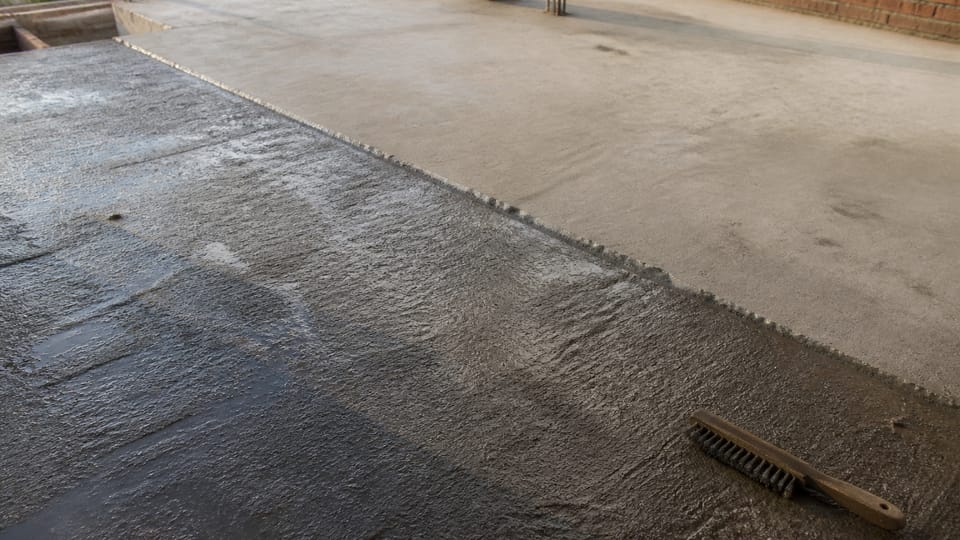
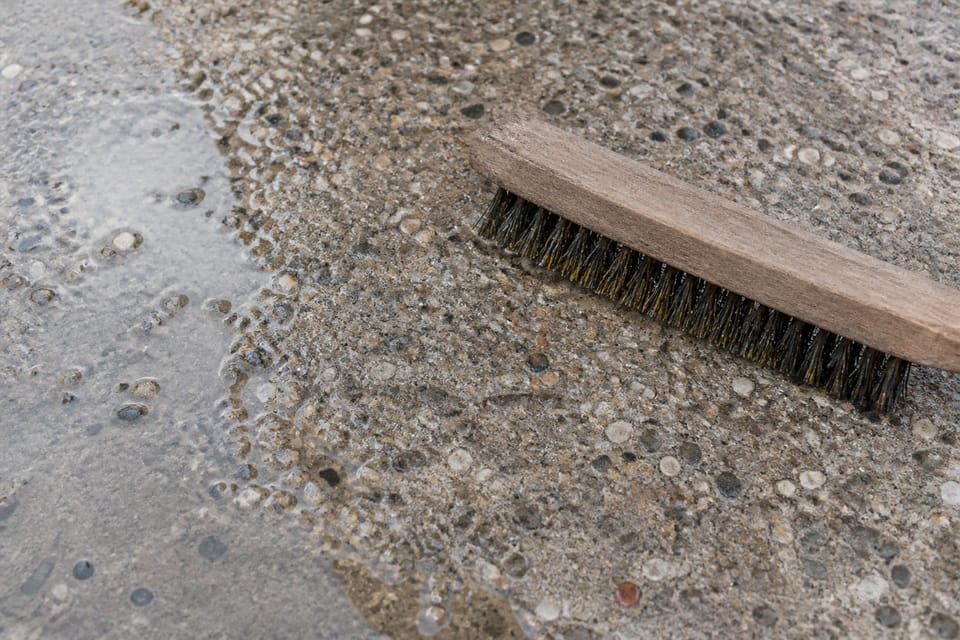
Preparation is what makes the new concrete bond to the old. IS 456 says that cleaning should be done “by using wire brush on the surface of joint immediately after initial setting of concrete” (clause 13.4). The code adds that “The prepared surface should be in a clean saturated surface dry condition when fresh concrete is placed, against it” (clause 13.4).
Where the old pour was cast against shuttering, the code says the recommended method of obtaining a rough surface is “to expose the aggregate with a high pressure water jet or any other appropriate means” (clause 13.4). In other words, the stone shows through the surface.
When the new concrete goes in, it should be “thoroughly vibrated near construction joints so that mortar from the new concrete flows between large aggregates and develop proper bond with old concrete” (clause 13.4). The code names no bonding grout and no fixed waiting period. It does set time limits: concrete is placed and compacted before initial setting begins (clause 13.2), and joint cleaning starts immediately after initial setting (clause 13.4). Ask the engineer whether a bonding grout is wanted. Ask the engineer whether one is wanted.
Where high shear resistance is needed at a joint, the code says that “shear keys may be provided” (clause 13.4). The engineer decides.
Sprayed curing membranes and release agents should be thoroughly removed from the joint faces (clause 13.4). Ask the engineer if a curing compound is planned for the work.
What should I check?
This section is practice, not a code rule.
- The joint is where the drawing or the engineer shows it, and where the drawing does not show a joint, and not in the middle of a span unless the engineer agreed.
- The old surface is clean, free of loose stone and dust, and wet but not standing in water.
- The new pour is placed before the old layer has set, and the time is recorded.
- The joint is accessible, so that it can be cleaned, and it is noted on the site register.
- Any bonding grout or shear key the engineer asked for is in place.
What mistakes should I avoid?
This section is practice.
- Stopping the pour in the middle of a span where the engineer had not agreed.
- Pouring late, after the first layer has set, so that the new concrete cannot bond.
- Leaving a dirty or dry surface for the next layer.
- Dropping concrete from a height onto the joint.
- Making a joint the engineer did not agree to, because the work stopped for a day.
Frequently asked questions
The answers below are general practice, not a code rule.
Is a construction joint the same as an expansion joint?
No. An expansion joint lets the building move. A construction joint is the place where a pour stops and restarts. See expansion joints in a house.
What do I do if the rain stops the pour?
Tell the engineer at once. The engineer decides whether the place where the work stopped is an acceptable joint, and what preparation it needs. Do not make the joint on your own.
Who decides where the joints go?
The designer. The code says the position and arrangement “shall be indicated by the designer” (clause 13.4).
Related guides
- Hot weather concreting in Indian summer
- Expansion joints in a house: where walls and slabs need a gap
- Chhat dhalai: what happens on slab casting day, from batch to curing
This guide is general information. Read the disclaimer. Your engineer decides where the joints go in your house.
Sources
- IS 456:2000, Plain and reinforced concrete: code of practice (fourth revision). Clauses 13.2 (placing) and 13.4 (construction joints and cold joints) read from the page images of a public copy. Current per the BIS record (valid to 2030-07-12).
- CPWD Specifications 2009, Volume 2, clause 16.37.16.1 (construction joints in cement concrete road pavement), read from the text layer of a third-party copy. Road context only; no building slab or beam clause was found.
Change log
- : Added Related guides link to newly published article(s): chhat-dhalai-what-happens-on-slab-casting-day-from-first-batch-to-curing. No other text changed. Approved by the reviewing engineer.
General information only. It is not a structural design or professional advice. Ask a licensed structural engineer or architect to check your plans and site.