
Short answer
What are the parts of IS 2386, and which tests does a house job need on the sand and the aggregate? IS 2386 is the set of methods of test for aggregates for concrete, in eight parts. Each part covers one group of tests, from particle size and shape to petrographic examination. Most of the methods give no pass or fail limit; the alkali test is an exception. The limits a job is judged against come from the aggregate specification. In site practice, particle size and specific gravity are often asked for first, and the engineer decides.
On this page (9)
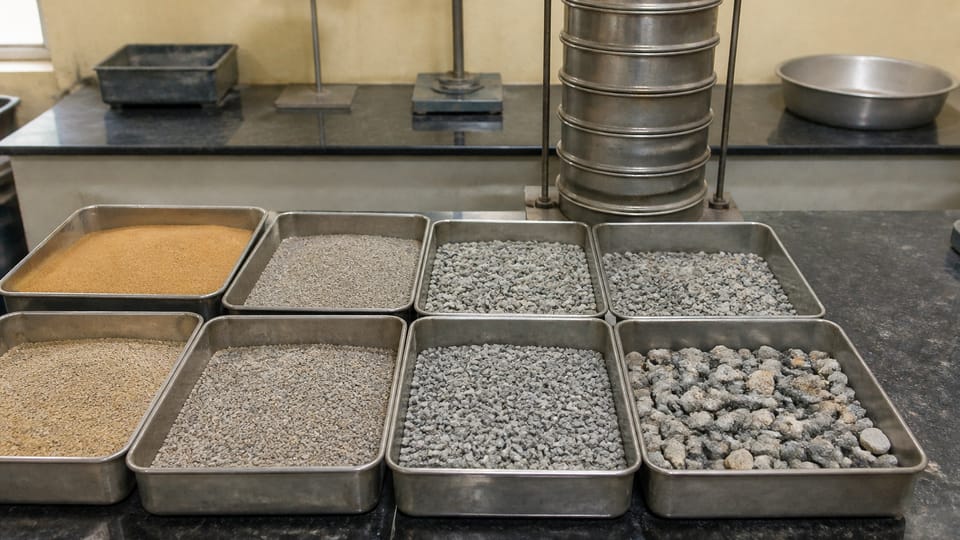
Concrete is only as good as the sand and the stone in it. Before a mix is designed, the aggregate is tested, and the methods for those tests are set out in IS 2386. The code is in eight parts, and it is easy to take the wrong part for the job. This page sets out what each part covers, and which tests a house job usually needs. It is about the test methods only.
The page gives no sieve size, no percentage and no mix ratio, and it quotes no limit from the methods. For most tests the limits come from the aggregate specification, and the engineer or the lab applies them.
What are the eight parts?
IS 2386 is titled “Methods of Test for Aggregates for Concrete”. Part VIII lists the eight parts, and each one covers a group of tests:
| Part | What the part covers | Typical use |
|---|---|---|
| I | Particle size and shape | Sieve analysis and the shape of the stone |
| II | Estimation of deleterious materials and organic impurities | Impurities in the sand and stone, such as clay, silt, coal and lignite |
| III | Specific gravity, density, voids, absorption and bulking | How heavy the aggregate is, how much water it takes up, and how sand swells when wet |
| IV | Mechanical properties | Crushing, fines, impact and abrasion values of the aggregate |
| V | Soundness | How the aggregate behaves in a sodium or magnesium sulphate solution |
| VI | Measuring the mortar-making properties of fine aggregate | How the sand behaves when made into mortar |
| VII | Alkali aggregate reactivity | Whether the aggregate reacts with the alkalis in the cement |
| VIII | Petrographic examination | A microscope look at the rock and its make-up |
Source: IS 2386 (Parts I to VIII):1963, the list of parts in Part VIII, as read. Most parts describe methods and report results without an acceptance limit. Part VII includes classification thresholds in its method, and Part VIII grades particles into quality classes. The limits a job is judged against come from the aggregate specification.
Which parts does a house job usually need?
These are practice points, not requirements of the standard. The engineer decides which tests the job needs.
- Particle size (Part I) is, in site practice, often the first test asked for on sand and coarse aggregate. It shows whether the grading is what the mix needs.
- Specific gravity and absorption (Part III) are often asked for with it, because they affect the water and the mix.
- Impurities (Part II) are asked for when the sand or the stone looks dirty, or when the source is new.
- Soundness (Part V), alkali reactivity (Part VII) and petrographic examination (Part VIII) are asked when the source or the site is doubtful, or when the engineer has a reason.
The mechanical tests (Part IV) are asked when the stone’s strength is in question, for example for a heavy load or a poor source.
What is in a test report?
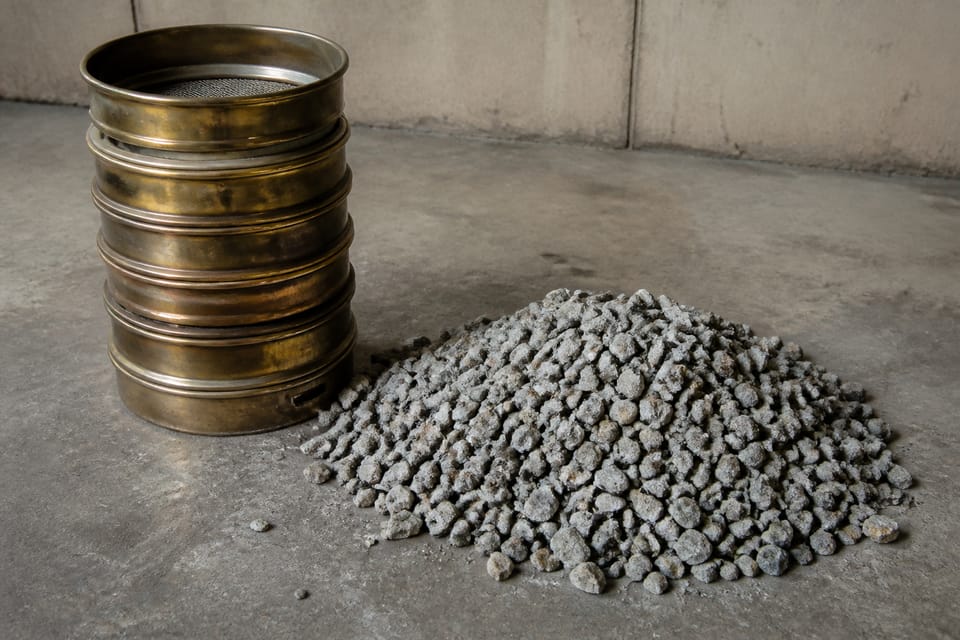
These are practice points, not requirements of the standard. Part IV has a reporting clause of its own. A test report should name the part and the edition of IS 2386 used, and the sample it came from. The report should give the result for each test, and the date. The owner should not expect one report to cover every part; each part is a separate test.
Inline image
What should an owner ask?
These questions are practice, not steps in the standard:
- Which part of IS 2386 did the lab follow? Ask for the part number and the edition.
- What was tested on my sand and stone? Ask for the report, not a verbal answer.
- Who checks the result against the limits? For most tests the specification sets the limits, and the engineer checks the report against it. The alkali test gives its own classification.
- Is the source new or doubtful? A new source is a reason to ask for more parts.
What mistakes should I avoid?
These are practice points:
- Reading a method as a pass or fail rule. The methods give results; the limits come from the specification.
- Asking for all eight parts for every job. Each part answers a different question, and the engineer picks the ones the job needs.
- Using an old report for a new delivery. The sand and stone change from one delivery to the next.
- Taking a single part as a full picture. Particle size alone does not show the strength of the stone; that is tested under Part IV.
Frequently asked questions
Is IS 2386 the same as the specification for aggregates?
No. IS 2386 gives the test methods. The specification sets the limits that the results are compared with.
Do I need every part for a house?
No. The engineer decides which parts the job needs. In site practice a house relies on a few of them; the engineer decides which.
Which edition should I ask for?
The archive copies read here are the 1963 edition of each part. Ask the lab which edition it follows and check the current status on the BIS portal.
Related guides
- Types of RCC slab in a house: one-way, two-way and flat
- Concrete grades M15 to M25 explained
- Concrete cube test: how cubes are made, tested and read
This guide is general information. Read the disclaimer. Your engineer and your testing lab decide which tests the aggregate for your house needs.
Sources
General information only. It is not a structural design or professional advice. Ask a licensed structural engineer or architect to check your plans and site.