
Short answer
Should a house use ready-mix or site-mixed concrete? IS 456 says ready-mixed concrete shall be preferred, mainly for large and medium project sites. IS 4926 sets the rules for supply: the purchaser should plan the pour, give the mix details and sign for each load. Site-mixed cement and aggregate must be measured by mass, and the mix must be mixed until uniform. Either way, the engineer decides the mix and the grade, and the supplier's records should match the site checks.
On this page (9)
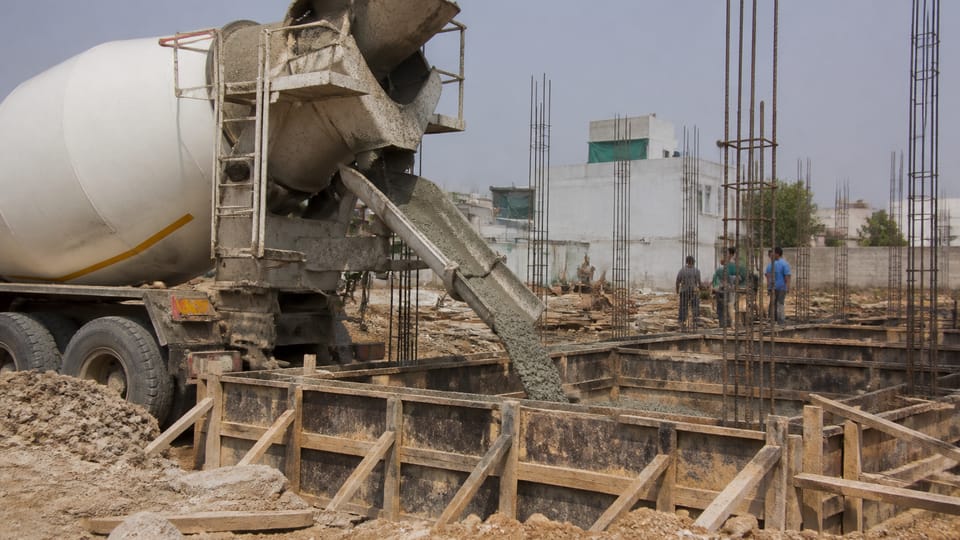
Concrete for a house can come from a ready-mix truck, or be mixed on the site from cement, sand, stone and water. Both can be made to a good standard. This guide explains what the Indian codes say about ready-mixed concrete, what they say about site mixing, and what to check on the day. It gives no price, no supplier name and no mix ratio. The engineer’s drawing and mix decide those.
What is ready-mixed concrete?
IS 4926 covers “the production and supply of ready-mixed concrete”. It says that the standard “does not cover the placing, compaction, curing or protection of concrete after delivery” (clause 1). So the standard stops at the delivery. The pouring, the compaction and the curing on your site remain your job, under the engineer.
The standard defines ready-mixed concrete as concrete “mixed in a stationary mixer in a central batching and mixing plant or in a truck-mixer and supplied in the fresh condition” (clause 3.13). Concrete mixed in a small machine on your site is not covered by that definition.
What does IS 456 say about the choice?
IS 456 gives the basic preference. It says that “Ready-mixed concrete supplied by ready-mixed concrete plant shall be preferred” (clause 10.2). The same clause goes on: “For large and medium project sites the concrete shall be sourced from ready-mixed concrete plants or from on site or off site batching and mixing plants”.
The code does not define “large and medium project sites”, and it says nothing about a single house. So the preference is clear, but the choice for a small house is the engineer’s and the builder’s, with the site and the supply in view.
What must the buyer do?
IS 4926 puts several duties on the purchaser, which is the owner or the builder who orders the concrete.
- The purchaser “should plan his arrangements so as to enable a full load of concrete to be discharged within 30 min of arrival on site” (clause 5.2.1.1). Responsibility for the concrete “passes to the purchaser after a delay of more than 30 min” caused by the purchaser’s lack of preparedness (clause 6.2.1).
- The purchaser “shall provide to the producer the details of the concrete mix or mixes required by him” (clause 7.1).
- The concrete should be discharged “within 2 h of the time of loading” from the truck-mixer, unless the conditions for longer time apply, such as retarding admixtures, cool humid weather or chilled concrete (clause 5.2.2.1).
- Each load is signed for. The discharge is confirmed by the purchaser’s signature (Annex G-2).
The supplier’s duties include keeping records. The producer must keep records “to provide confirmation of the quality and quantity of concrete produced”, and keep them for “at least one year” (clause 13). The records for each load include the estimated slump and the time the concrete was loaded (clause 10.2.1.4). Ask for these records for your pour.
What about site mixing?
IS 456 covers site-batched and mixed concrete in clause 10. It says that “In batching concrete, the quantity of both cement and aggregate shall be determined by mass”. Volume batching is allowed “only where weigh-batching is not practical” (clause 10.2.4).
The mixing must go on until the mix is uniform. The code says that “The mixing shall be continued until there is a uniform distribution of the materials and the mass is uniform in colour and consistency. If there is segregation after unloading from the mixer, the concrete should be remixed” (clause 10.3). For guidance, the code gives a minimum mixing time of at least two minutes (clause 10.3.1).
The code also says that transport should be “as rapidly as possible by methods which will prevent the segregation” of the concrete (clause 13.1).

What should I check?
This section is practice, not a code rule.
- The mix and the grade on the drawing, and the delivery slip showing the same mix. Ask the engineer if you are not sure.
- The time from loading to discharge, and that the labour and the pump or the chute are ready before the truck arrives.
- The supplier’s records for the pour: the slump, the load time and the quantity, kept for the year the standard requires.
- For site mixing, that cement and aggregate are measured by weight as the engineer asks, and the mix is uniform before it is placed.
- Each load signed for by the person who received it, with any water added on site written down.
What mistakes should I avoid?
This section is practice.
- Ordering the truck before the labour and the pump are ready, so the load waits and the concrete stiffens.
- Adding water at the site to make the concrete easier to place, without the engineer’s and the supplier’s agreement. IS 4926 (clause 10.2.1.6) allows no water to be added to the truck-mixer drum before discharge beyond the amount needed for the specified workability, unless the purchaser specifically requests it and signs for it.
- Choosing site mixing without a weighing and mixing routine, and then mixing by eye.
- Not keeping the delivery slips and records for the pour.
- Treating the time limits as the same for every mix. The limits depend on the mix and the conditions, and the supplier should state them for each load.
Frequently asked questions
Is ready-mixed concrete stronger than site-mixed concrete?
This guide gives no strength comparison. Both must meet the mix the engineer specifies. The standards do not rank the two for strength, and the supplier’s test results and your site tests are what show the grade of the concrete in your house.
Does a small house need ready-mix?
The standards do not say so. IS 456’s preference is stated for large and medium project sites. It does not address a single house. Ask the engineer which suits your house and your site access.
Can I order a small quantity?
Ask the supplier. This guide gives no minimum quantity or price. The supplier’s terms decide what is offered.
Related guides
This guide is general information. Read the disclaimer. Your engineer decides the mix and the grade for your house.
Sources
- IS 4926:2003, Ready-mixed concrete: code of practice (second revision). Clauses 1, 3.13, 5.2.1.1, 5.2.2.1, 6.2.1, 7.1, 10.2.1.4, 10.2.1.6, 13 and Annex G-2, read from a public copy and checked on page images. BIS record: current.
- IS 456:2000, Plain and reinforced concrete: code of practice (fourth revision). Clauses 10.2, 10.2.4, 10.3, 10.3.1 and 13.1, read from the page images of a public copy. Current per the BIS record.
General information only. It is not a structural design or professional advice. Ask a licensed structural engineer or architect to check your plans and site.