
Short answer
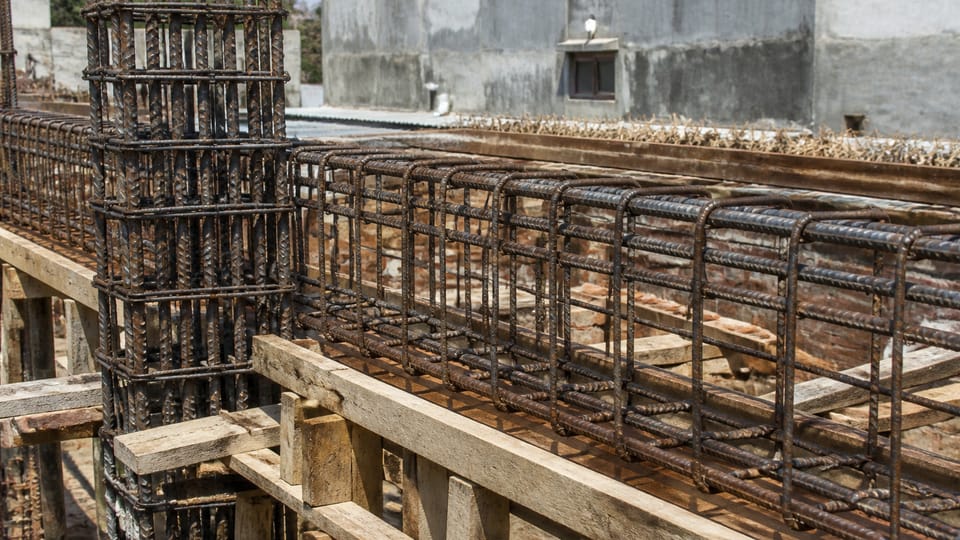
What is the difference between stirrups and ties? On site, a stirrup is usually the loop in a beam, and a tie, or ring, is the loop in a column. In IS 456, stirrups in a beam act mainly as shear reinforcement, and ties give column bars lateral support against buckling. The shapes can look the same, and the codes do not use the names the same way. Your structural drawing sets each one.
On this page (11)
- What is the difference between a stirrup and a tie?
- What does a stirrup do in a beam?
- What does a tie do in a column?
- Why do the codes seem to use the names differently?
- Why are the loops closer together at some places?
- What went wrong in past earthquakes?
- What can I check before the pour?
- What mistakes should I avoid?
- Frequently asked questions
- Related guides
- Sources
Look at the steel of any beam or column, and you will see small loops of bar around the long bars. Your bar bender may call them rings, stirrups, ties or links. This page explains what the loops do in a beam and in a column, why the names get mixed up, and what you can check before the concrete goes in. It gives no bar size, spacing, hook length or hook angle. Those are design values, and your engineer’s drawing sets them.
What is the difference between a stirrup and a tie?
The main difference is the job and where the steel sits, not the shape.
| Point | Stirrup | Lateral tie |
|---|---|---|
| Where it is usually found | Beam | Column |
| Main job in IS 456 | Shear reinforcement (cl 40.4) | “effective lateral support against buckling” for the bars (cl 26.5.3.2) |
| Other jobs | Holds compression bars; resists torsion | Tip 19 lists carrying shear from earthquakes and containing the concrete |
| Other site names | Ring, link | Ring, link, binder |
| How drawings may mark it | Stp | Ct |
The marks come from IS 5525, which says such symbols may be used. So read the legend on your own drawing.
Neither loop carries the main squeezing and bending load of the member. The long bars and the concrete do most of that work. IS 456 clause 26.2.2.4(b) groups these loops as “secondary reinforcement, such as stirrups and transverse ties”. Secondary does not mean optional. The member depends on them.
What does a stirrup do in a beam?
A beam under load wants to crack at a slant near its supports. That is a shear crack, and it can fail suddenly. Stirrups cross that crack and hold it.
IS 456 clause 40.4 lists shear reinforcement in the forms of “Vertical stirrups”, “Bent-up bars along with stirrups” and “Inclined stirrups”. A stirrup also does two other jobs in the code:
- It restrains compression bars. Clause 26.5.1.2 says: “Compression reinforcement in beams shall be enclosed by stirrups for effective lateral restraint.”
- It resists twisting. Clause 26.5.1.7(a) says: “The transverse reinforcement for torsion shall be rectangular closed stirrups”.
IITK-BMTPC Earthquake Tip 18 gives three jobs in plain words. Stirrups “carry the vertical shear force and thereby resist diagonal shear cracks”, “protect the concrete from bulging outwards due to flexure”, and “prevent the buckling of the compressed longitudinal bars due to flexure”. This is guidance, not a code clause.
So “stirrups only resist shear” is wrong.
What does a tie do in a column?
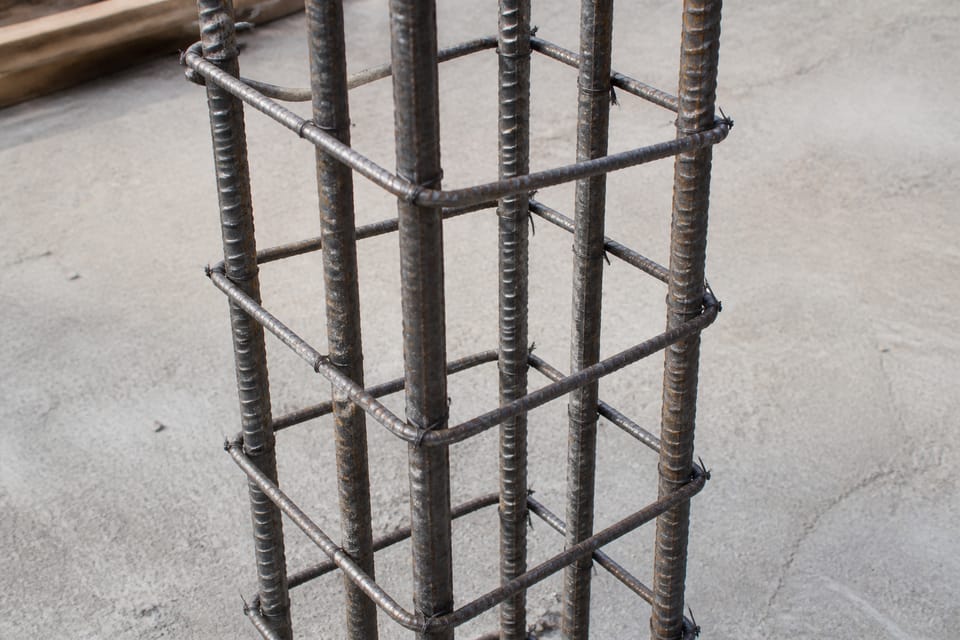
A column is squeezed, and its long bars want to bow outward like a thin stick pressed from both ends. Ties stop that. IS 456 clause 26.5.3.2(a) asks that “every longitudinal bar nearest to the compression face has effective lateral support against buckling”. It says this support comes from “circular rings capable of taking up circumferential tension or by polygonal links (lateral ties)”.
SP 34, the BIS detailing handbook, adds “transverse steel (ties) to resist bursting force”. IS 2502 warns that column steel “should be properly tied, otherwise the strength of the column will be considerably affected”, especially in heavily reinforced columns.
Earthquake Tip 19 adds the earthquake role. Ties “carry the horizontal shear forces induced by earthquakes”, “hold together the vertical bars and prevent them from excessively bending outwards”, and “contain the concrete in the column within the closed loops”. So “ties do not resist shear” is wrong too.
Why do the codes seem to use the names differently?
Because they do. IS 456 sends its definitions to IS 4845 and to a glossary, IS 6461. In the 1972 edition we could read, a stirrup is “A reinforcing device to resist shear and diagonal tension stresses in a beam”, and a tie is a “Closed loop of reinforcing bars encircling the longitudinal steel in columns”. A 2024 edition has replaced it, and we could not read that one.
Other texts differ:
- IS 13920, the code for ductile detailing, says: “Transverse reinforcement (also called hoops) in columns is typically called stirrups and that in beams is called cross-ties.” That is the reverse of common site usage. Its working word for most of this steel is “link”.
- NBCS 2026, the national building code, speaks of “Confining stirrups near ends of columns”.
- “Tie” has other meanings too. The 1972 glossary also uses it for a formwork tie.
So do not argue over the word. Ask which steel the drawing shows and where.
Why are the loops closer together at some places?
They sit closer near joints, where the member works hardest, and at laps, where one bar hands its force to the next, when the drawing shows it. Do not judge this by eye. Measure it against the drawing. IS 13920 has separate rules for closely spaced steel. Where it applies, it also bars construction joints in those zones: “Construction joint shall not be provided in the regions of beam having closely spaced transverse reinforcements.” Clause 7.4.2(e) says the same for columns.
The BIS listing shows IS 13920:2016 valid up to 31 July 2026, a date that has passed. Your engineer must confirm whether a later edition or amendment is now in force.
The beam-column joint needs special care. Earthquake Tip 20 says “closely spaced closed-loop steel ties are required around column bars” there, and that this “requires some extra effort”. It also warns: “Repairing damaged joints is difficult, and so damage must be avoided.”
What went wrong in past earthquakes?
An IIT Kanpur (NICEE) field page on the 2001 Bhuj earthquake found a “very common practice of poor detailing” in collapsed buildings with open ground storeys. It described thin, widely spaced ties with poorly anchored ends, and added: “This did not provide the required confinement to the core concrete.” Tip 19 shows such a failure.
What can I check before the pour?
Check the steel against the drawing, not against this page. This list is practice.
- Each loop is closed, if the drawing shows it closed.
- Hooks are bent as drawn and turn into the concrete core.
- Spacing matches the drawing, including near joints and laps.
- Ties continue through the beam-column joint, if drawn.
- Every long bar is held where the drawing shows it.
- Loops are tied at crossings. IS 456 clause 12.3 says: “Reinforcement should be secured against displacement outside the specified limits.”
- Cover blocks are in place.
- The engineer has signed off on any change.
What mistakes should I avoid?
These are practice points, unless a code is named.
- Leaving out loops at the joint because they are hard to fit.
- Spreading loops wider to save steel, or to make the pour easier.
- Cutting a loop to pass a conduit.
- Bending a hook differently from the drawing because it is easier to place.
- Bending loops too large, so they eat into the cover.
- Stopping a pour where the drawing shows close spacing. Where IS 13920 applies, it bars this.
Frequently asked questions
Are ties and stirrups the same thing?
They can look the same, but the common names point to different jobs. In most Indian site talk, stirrups are in beams and ties are in columns. The codes are not uniform, so read your drawing.
What is a ring in a column?
It is the site word for a lateral tie. IS 456 keeps “circular rings” for round loops, and calls square or rectangular ones polygonal links or lateral ties.
Why are stirrups needed in a beam?
Mainly to resist shear cracks near the supports. They also hold compression bars and help resist twisting.
Can I reduce the number of rings to save steel?
No. Only the engineer who designed the member can change it, in writing.
What spacing should I use?
The drawing gives it. We print no spacing because it depends on the design.
What hook should a stirrup or tie have?
Your drawing shows it. The rules differ between IS 456 and IS 13920, so do not take a hook rule from a website.
Related guides
- Types of RCC columns: tied and spiral, short and slender, and shapes
- Types of beams in a house: simple, continuous, cantilever, T and L
- IS 13920 explained: what ductile detailing means for a house
This guide is general information. Read the disclaimer. Your structural engineer designs and signs off every stirrup and tie in your house.
Sources
- IS 456:2000, Plain and reinforced concrete, code of practice: clauses 3, 12.3, 26.2.2.4(b), 26.5.1.2, 26.5.1.7(a), 26.5.3.2(a) and 40.4 (key clauses read on page images), read with Amendments 1 to 5. Amendment 6 was not read.
- IS 6461 (Part 3):1972, Glossary of terms relating to cement concrete, concrete reinforcement: clauses 2.99 and 2.105. A 2024 edition has replaced it; we could not read that edition.
- IS 13920:2016, Ductile design and detailing of reinforced concrete structures subjected to seismic forces: clauses 3.5, 3.9, 6.3.5.3 and 7.4.2(e), with Amendments 1 and 2. BIS shows validity up to 31 July 2026, a date that has passed.
- IS 5525:1969, Recommendations for detailing of reinforcement in reinforced concrete works: clauses 2.1 and 2.1.2.
- IS 2502:1963, Code of practice for bending and fixing of bars: clause 7.5.
- SP 34:1987, Handbook on concrete reinforcement and detailing: clause 7.0.
- SP 7:2026, National Building Construction Standards (NBCS) 2026, Part C Section 1 checklist. From an unofficial archive.org copy.
- IITK-BMTPC Earthquake Tips 18, 19 and 20 (C.V.R. Murty). Guidance written on the 1993 edition of IS 13920; used for how the steel works, not for code values.
- IIT Kanpur (NICEE), field page on reinforced concrete buildings after the Bhuj earthquake, 2001. Named without a link.
General information only. It is not a structural design or professional advice. Ask a licensed structural engineer or architect to check your plans and site.