
Short answer
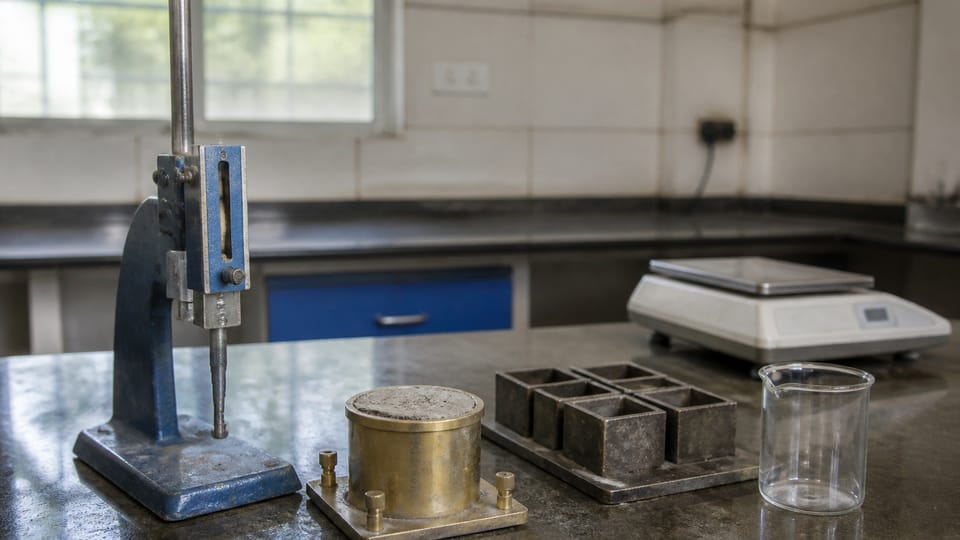
What are the tests on cement? The physical tests on cement are in the IS 4031 series, which has 15 parts. The main ones are fineness (Parts 1 and 2), standard consistency (Part 4), initial and final setting time (Part 5), soundness (Part 3) and compressive strength of mortar cubes (Part 6). They are laboratory tests. Site tricks such as floating cement in water are not standard tests.
On this page (9)
Cement is bought by the bag, but a bag is a product made to a standard, and the standard says how its quality is tested. This page explains the laboratory tests in the IS 4031 series, what each one is for, who normally runs them, and what an owner can and cannot do on site. It prints no limit values, because the OPC and PPC limits are in IS 269:2015 and IS 1489 (Part 1):2015, which we could not read. The older editions, such as IS 269:2013 and IS 1489 (Part 1):1991, have been withdrawn, so we do not quote them as current.
What does IS 4031 cover?
IS 4031 is the Indian Standard series for methods of physical tests on hydraulic cement. BIS lists 15 parts. Chemical analysis is in a separate standard, IS 4032. The product standards, such as IS 269 for ordinary Portland cement, set the limits that the tests are checked against. The parts a house owner hears about are these.
| Test | IS 4031 part | What it measures | Reported as |
|---|---|---|---|
| Fineness, by dry sieving | Part 1:1996 | The proportion of cement grains larger than a standard sieve mesh | Residue left on the 90 micron sieve, percent by mass |
| Fineness, by air permeability | Part 2:1999 | The specific surface of the powder (Blaine method) | Specific surface, in cm2/g in the test and in m2/kg in the product standards |
| Standard consistency | Part 4:1988 | The water that makes a paste of standard consistency, as a preparation for other tests | Percent of water by mass of dry cement |
| Initial and final setting time | Part 5:1988 | When the paste starts to stiffen and when it has set | Minutes |
| Soundness | Part 3:1988 | Whether the set cement expands harmfully later (Le Chatelier and autoclave methods) | Expansion in mm (Le Chatelier) or percent (autoclave) |
| Compressive strength | Part 6:1988 | The strength of mortar cubes made with standard sand | N/mm2 (MPa), at the ages the product standard asks for |
Other parts exist for masonry cement, strength of plastic mortar using prisms, heat of hydration, drying shrinkage, density, air content, water retentivity, false set and wet sieving. They matter for particular cements and works, and not for a typical house.
What does each test tell you?
Fineness. Part 1 says it measures fineness “as represented by the mass of residue left on a standard 90 µm IS Sieve” and Part 2 gives the specific surface by the Blaine method, and notes that its values are relative rather than absolute. Finer cement generally reacts faster (general engineering knowledge, not stated in IS 4031). This is a property for the product standard to limit.
Standard consistency. Part 4 finds the amount of water at which the Vicat plunger penetrates to a set point near the bottom of the mould. It is not a pass or fail test. The setting-time test uses the result: the paste for it is gauged with a fixed fraction of the consistency water.
Setting time. Part 5 uses the Vicat needle. Initial setting time is the time from adding water to when the needle fails to pierce the test block to a set height above the bottom of the mould, and final setting time is when the needle makes an impression on the block while its attachment does not. The result is reported in minutes. A cement must not set too fast, and it must not take too long to set, so the product standard sets a minimum for the initial setting time and a maximum for the final setting time. See the sibling page on the setting time and the Vicat test for how it is done.
Soundness. Part 3 checks that the cement does not expand harmfully after setting. In the Le Chatelier method, paste in a mould is kept in water, boiled, and the opening of the mould is measured before and after. The difference “indicates the expansion of the cement”. The autoclave method does the same on bars with steam pressure. Unsound cement can expand and crack the work after it has set.
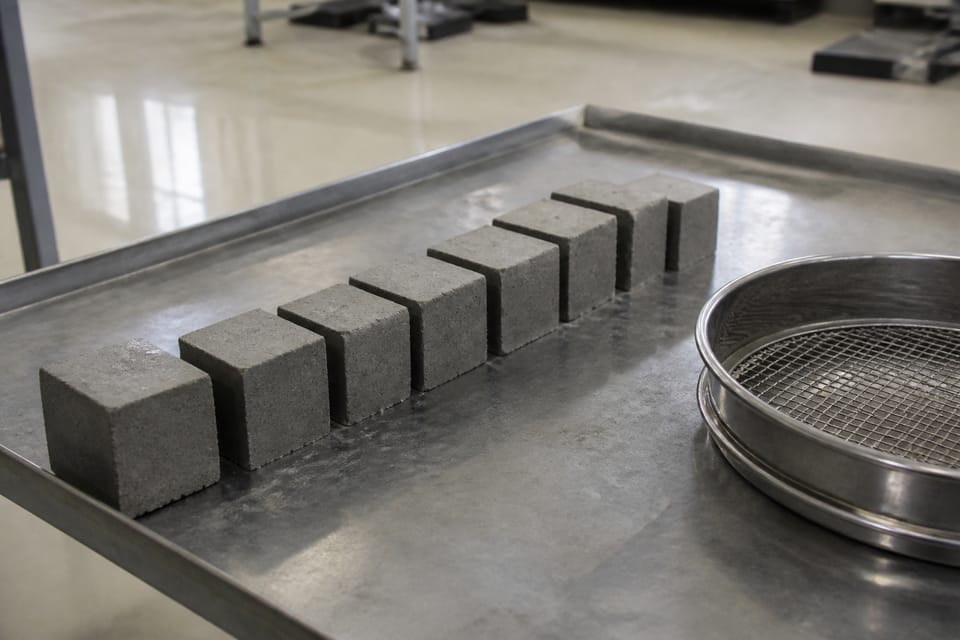
Compressive strength. Part 6 makes mortar cubes of cement and standard sand, cures them, and crushes them. The age (such as 3, 7 and 28 days) comes from the product standard. This is why grades of OPC are named for their 28-day strength. It is a cement test on mortar cubes, and it is not the concrete cube test on site: see the concrete cube test.
The standard’s methods are laboratory methods. Most of them (Parts 2 to 6) hold the room, materials and water at stated temperatures and humidities, and Parts 3 to 6 name 27 ± 2 °C for the moulding room and the water. That is a laboratory condition and cannot be reproduced at site.
Who runs these tests, and when?
A manufacturer holding a BIS licence tests its cement under the scheme of that licence, and the product standard sets the limits. For a government work, CPWD 2019’s list of mandatory tests for mortars (sub-head 3) lists the physical tests of cement (fineness, soundness, setting time, strength and consistency) as laboratory tests, at a frequency set for each lot, and asks for the producer’s certificate with each delivery. That is departmental practice, and it cites the 2013 OPC editions that BIS now lists as withdrawn. A house owner does not normally order these tests, and a laboratory test is for the engineer to decide, for example on a large work, or for old, damp or doubtful cement. The bag’s marking, the licence and the storage are what an owner can check: see checking cement on site and cement shelf life and storage.
Are the float test, the thumb test and the rub test standard tests?
No. Dropping cement in water to see whether it floats, pressing a pinch between the fingers to judge fineness, feeling whether the bag is cool or smooth, and judging setting time by hand are not in IS 4031. CPWD 2019’s mandatory-test list for mortars lists no field tests for cement either; it lists field tests only for sand. These checks may help you spot damp or lumpy cement, and they do not measure fineness, setting time or strength. Hard lumps in cement usually mean that moisture has got in, as the shelf-life page says.
What should I ask for?
This is practice, not a standard.
- The manufacturer’s test certificate or batch details, in writing from the dealer or supplier, where the engineer wants them.
- The packing date and batch number on the bag, and the BIS Standard Mark and licence number.
- The grade and type that the drawings or the engineer ask for: see OPC vs PPC vs PSC cement.
- Bags that are intact, dry and without hard lumps, stored as the shelf-life page describes.
- A laboratory test only when the engineer asks for it.
What mistakes should I avoid?
These are practice, not code rules.
- Using the float, thumb or rub test as a pass or fail test.
- Accepting old or lumpy cement.
- Mixing batches or types in one stack.
- Not checking the packing date.
- Storing bags on the floor or against a wet wall.
- Trusting the mark on the bag alone, with no check of the batch or the storage.
Frequently asked questions
How many tests are there on cement?
The IS 4031 series lists 15 parts of physical tests. The main ones are fineness, consistency, setting time, soundness and compressive strength.
What is the setting time test of cement?
A Vicat apparatus test (IS 4031 Part 5) that gives initial and final setting time in minutes.
Can I test cement at site?
Not by a standard method. The IS 4031 tests are laboratory tests. At site you can check the bag, the date, the licence, lumps and storage.
Does a higher setting time mean better cement?
No. The product standard asks for a minimum initial setting time and a maximum final setting time.
Where are the limits for OPC and PPC?
In IS 269:2015 for ordinary Portland cement and IS 1489 (Part 1):2015 for Portland pozzolana cement. We could not read these editions, so this page prints no limit.
Related guides
- Checking cement on site: bag marks, licence and lab tests
- Cement shelf life and storage
- OPC vs PPC vs PSC cement
This guide is general information. Read the disclaimer. Your engineer decides whether a laboratory test is needed for your cement.
Sources
- IS 4031 (Parts 1 to 6):1988 to 1999, Methods of Physical Tests for Hydraulic Cement: Part 1:1996 fineness by dry sieving, Part 2:1999 fineness by Blaine air permeability, Part 3:1988 soundness, Part 4:1988 standard consistency, Part 5:1988 initial and final setting times, Part 6:1988 compressive strength (scope, principle, apparatus, test conditions and reporting; scope and principle on page images). BIS records Parts 1 to 15 as current, as of 2026-10-29.
- BIS standards database (BIS API), queried 2026-10-29: IS 4031 Parts 1 to 15 titles and status; IS 269:2015 and IS 1489 (Part 1):2015 in force. The texts of IS 269:2015 and IS 1489 (Part 1):2015 were not readable, so no limit from them is printed.
- CPWD Specifications 2019 Vol 1 (Central Public Works Department), sub-head 3 mortars, the list of mandatory tests and clause 3.1.2 (text read; departmental practice, not an Indian Standard).
General information only. It is not a structural design or professional advice. Ask a licensed structural engineer or architect to check your plans and site.