
Short answer
What tests does IS 1786 require on TMT bars? IS 1786:2008 asks for a tensile test (strength, elongation and proof stress), a bend test and a rebend test on sample pieces, plus chemical analysis and mass checks. A failed sample leads to two more samples; if either of those fails, the material is not deemed to comply. Ask the manufacturer for the test certificate for your bundles.
On this page (9)
A bar in a delivery of TMT steel carries a grade name, such as Fe 500 or Fe 500D. The grade is a promise, and the tests in IS 1786 are how it is checked. This page covers the tests the standard asks for, how the sample pieces are taken, and what the retest rule means for a bundle. It gives no price, no brand and no ranking, and it does not explain how to test bars at home.
What tests does IS 1786 ask for?
IS 1786:2008 asks for these tests on sample pieces from each lot:
- Tensile test (clause 9.2). It measures the tensile strength, the percentage elongation and the 0.2 percent proof or yield stress. The total elongation at maximum force is also measured where the buyer asks for it (the footnote to Table 3).
- Bend test (clause 9.3). The test piece is doubled over a mandrel “by continuous pressure until the sides are parallel”. It passes if “there is no rupture or cracks visible to a person of normal or corrected vision on the bent portion”.
- Rebend test (clause 9.4). The piece is bent to an included angle of 135 degrees, aged by keeping it in boiling water at 100 degrees C for 30 minutes, cooled, and then bent back to 157.5 degrees. It passes if there is no rupture or cracks visible to a person of normal or corrected vision on the rebent portion.
- Chemical analysis (clause 4.2). The standard sets maximum limits for carbon, sulphur, phosphorus and their sum. The limits depend on the grade.
- Dimensions and mass (clauses 6.2 and 7.2). The mass per metre and the length must fall within the tolerances in the standard’s Table 2, unless the buyer and maker agree otherwise.
- Bond (clause 8.3). The bond between bar and concrete is checked by the rib shape (clause 5.2) or by a pull-out test (clause 5.7), as the standard describes.
Clause 9.1.2 says the test pieces are full sections. Clause 9.1.2.1 lets only the deformations be machined, on bars of 28 mm and above, for the tensile, proof stress and elongation tests; in a dispute, full-section results govern (Amendment No. 1). Clause 9.1.3 allows ageing at not more than 100 degrees C for not more than 2 hours.
What are the limits for the 500 grade?
Table 3 of IS 1786:2008, as amended in 2012, sets the tensile limits by grade. The rows below are for the Fe 500 family:
| Grade | 0.2 percent proof or yield stress, minimum (N/mm2) | Elongation, minimum (percent, gauge length 5.65 square root of area) | Total elongation at maximum force, minimum (percent, where specified by the buyer) |
|---|---|---|---|
| Fe 500 | 500 | 12.0 | not required |
| Fe 500D | 500 | 16.0 | 5 |
| Fe 500S | 500 | 18.0 | 8 |
The table also sets a ratio of tensile strength to yield stress for each grade. For Fe 500 the ratio must be at least 1.08, with a tensile strength of at least 545 N/mm2. For Fe 500D it must be at least 1.10, with a tensile strength of at least 565 N/mm2. The standard’s footnote defines the ratio as tensile strength divided by the proof or yield stress.
The bend limits in Table 4 are given as multiples of the bar size, and the multiple depends on the grade and on whether the bar is 20 mm or less. Read Table 4 in the standard for the value you need; this page does not copy it.
How are the samples taken?
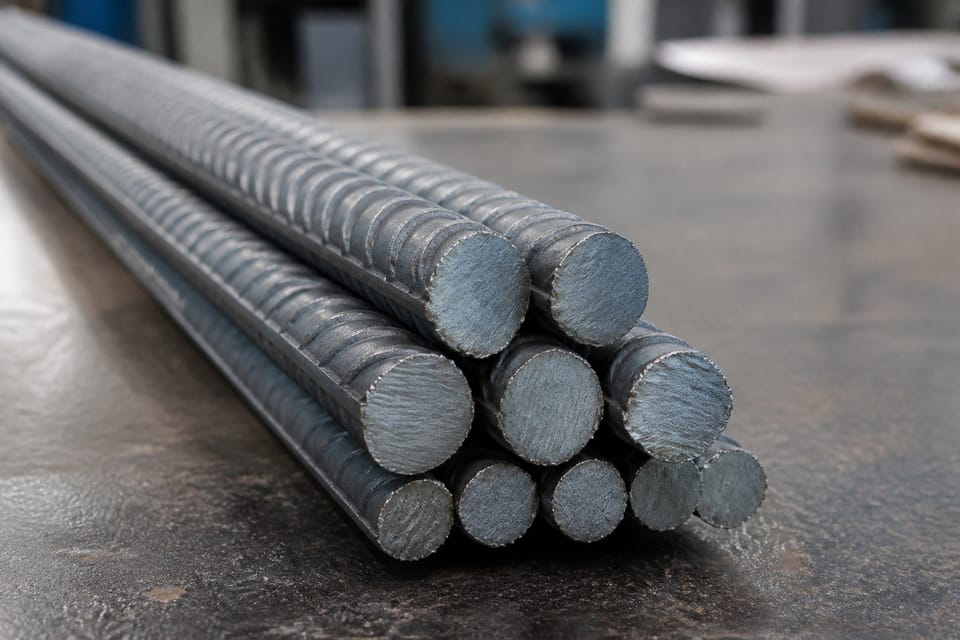
Clause 9.1.1 says the test pieces are selected by the buyer or the buyer’s representative, from the cuttings or from any bar after cutting to size. Clause 9.1.4 says the maker must first give the mill records, with the mass of each bundle and the identification marks.
Clause 11.1 sets the number of samples. For each cast or heat under 100 tonnes, two samples are taken; for a cast or heat of 100 tonnes or more, three. The samples come from each size of finished bar at random.
What happens if a sample fails?
Clause 9.5 sets the retest rule. If any test piece first selected fails any test, two further samples are taken for each failure:
- If both further samples pass, the material they represent is deemed to comply with that test.
- If either further sample fails, the material represented is not deemed to comply with the standard.
Clause 4.3.1 adds that rust, seams, surface irregularities or mill scale are not cause for rejection, provided a hard wire-brushed test specimen meets all the requirements.
What certificate should I ask for?
Clause 10 says routine inspection and testing is the manufacturer’s job, and the records must be kept and available to the buyer. Where material goes through a supplier, clause 10 says the manufacturer supplies a certificate with the results of all the required tests on samples from the delivered material. Clause 12.4 lists what the manufacturer’s certificate must show: the place of manufacture, the nominal diameter, the grade, the rolled-in marking, the cast or heat number, the date of testing, the mass of the tested lot and the individual results. It applies where the material is not inspected at the manufacturer’s works.
The standard says a bundle “may also be suitably marked with the Standard Mark” (clause 13.4). That mark is optional under this clause and is governed by the BIS Act. A bundle without it is not, on that ground alone, a breach of IS 1786.
What mistakes should I avoid?
- Trusting the grade name without a certificate. The grade is a claim that the tests back. Ask for the certificate for the cast or heat in your bundles. This is practice, backed by clause 10 and clause 12.4.
- Taking a test rule from a website without a clause number. Some pages say tests need a machine above a set bar size, or that a bar must not be bent with a hammer. IS 1786 does not say either. Check the clause before you act on it. This is practice.
- Mixing up the bend test standard. IS 1786 refers to IS 1599 for the bend test method, and its reference list gives 1599:1985. Cite the edition you have read, and check the edition in force on the BIS portal.
- Treating rust as a fail. Clause 4.3.1 says rust alone is not a reason to reject, if the brushed specimen passes. This is standard text.
Frequently asked questions
Does IS 1786 say a bar over a set size needs a tensile test?
No. Clause 9.2 requires the tensile test for the bar. The size-related rules are the 28 mm machining allowance in clause 9.1.2.1 and the mandrel diameters in clause 9.3 (Table 4) and clause 9.4.1, which depend on bar size and grade. None of them requires a tensile test by size.
What is the difference between a bend test and a rebend test?
The bend test doubles the piece over a mandrel once. The rebend test bends it to 135 degrees, ages it in boiling water, and bends it back to 157.5 degrees (clause 9.4). The rebend test is the stricter check of ductility after ageing.
What does D or S in the grade mean?
The D and S letters mark grades with enhanced and additional requirements (note 2 under clause 1.1). For Fe 500D, Table 3 sets elongation of at least 16.0 percent, a TS/YS ratio of at least 1.10 and, where the buyer asks for it, total elongation at maximum force of 5 percent. The TMT grades page explains the grades.
Can I do these tests myself?
IS 1786 sets the tests and the sampling for the bars in a lot. It does not describe a site test. Ask a testing laboratory, and ask your engineer what the tests should show for your job.
Related guides
- TMT vs HYSD vs CTD vs mild steel bars: what IS 1786 and IS 432 say
- TMT bar full form and grades
- Rust on TMT bars: what the codes say and how steel should be stored on site
This guide is general information. Read the disclaimer. Your structural engineer decides the steel for your house, and the test certificate for each bundle is the reference.
Sources
General information only. It is not a structural design or professional advice. Ask a licensed structural engineer or architect to check your plans and site.