
Short answer
Can rusted TMT bars be used? IS 456 clause 5.6.1 says reinforcement shall be free from loose mill scales, loose rust, paint, oil, mud or any substance which may reduce bond. IS 1786 says rust is not a cause for rejection at the mill if a hard wire-brushed specimen passes. No code gives an acceptable rust grade, so the engineer decides on the bars you have.
On this page (11)
- What does IS 456 say about rust on bars?
- What does IS 1786 say, and why is it not the same thing?
- What does CPWD say?
- How does IS 4082 say steel is stored?
- What do the codes not say?
- What should I do about rusty bars? (practice)
- How can I stop bars rusting on site? (practice)
- What mistakes should I avoid? (practice)
- Frequently asked questions
- Related guides
- Sources
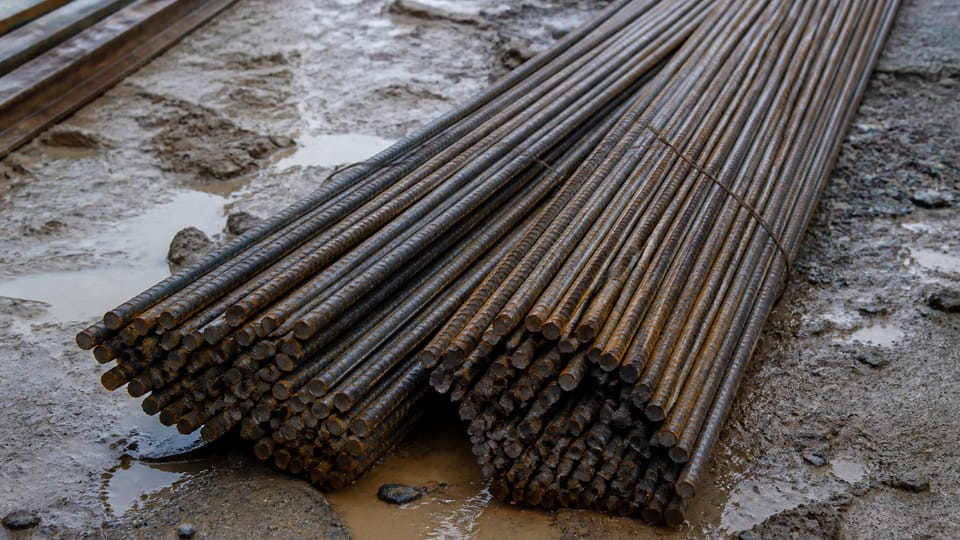
Bars that have sat on a site through a monsoon are rusty, and the owner is told, depending on who is speaking, that rust is harmless, that rust improves the grip, or that the whole lot must go back. The standards give a more careful answer and a less satisfying one: they say what must not be on the bar when concrete goes round it, they say what a mill may not reject a bar for, and none of them gives a pass mark for how much rust is too much. This page sets out what the codes say, how they say steel is stored, and what the owner does while the engineer decides. It gives no mass-loss figure, no cleaning chemical and no brand. For the pre-pour checks on steel, see before the slab pour: an owner’s checklist for formwork and steel.
What does IS 456 say about rust on bars?
IS 456:2000 clause 5.6.1 says: “All reinforcement shall be free from loose mill scales, loose rust and coats of paints, oil, mud or any other substances which may destroy or reduce bond. Sand blasting or other treatment is recommended to clean reinforcement.” Clause 5.6.2 adds that special precautions such as coating of reinforcement “may be required for reinforced concrete elements in exceptional cases and for rehabilitation of structures”, and refers to specialist literature. Clause 5.7 says storage of materials “shall be as described in IS 4082”.
So the code’s test is at the time the concrete goes in: the bar is free from loose rust, loose mill scale, paint, oil and mud. It does not define “loose”. It gives no test and no grade of rust, and it does not say that a thin, tightly held rust is allowed or that it is not.
What does IS 1786 say, and why is it not the same thing?
IS 1786:2008 clause 4.3.1 is about the bar as a product: “Rust, seams, surface irregularities or mill scale shall not be the cause for rejection provided a hard wire brushed test specimen fulfils all the requirements of this specification.” That is a product-standard rule for manufacture and supply. It says rust is not by itself a ground to reject a bar for a failure of the product standard if a wire-brushed specimen still meets the requirements. It does not say rusty bars are fine to place in concrete, and it does not replace the IS 456 test at placing. Read the two clauses separately.
IS 1786 clause 7.2.2 and Table 2 give tolerances on the nominal mass of a bar, “unless otherwise agreed to between the manufacturer and the purchaser”. The table is for the mill’s product and is not a test for rust loss on a site bar. See how many 12 mm bars in 1 tonne? Weight per metre and a check for the weight idea.
What does CPWD say?
CPWD Specifications 2019 Volume 1, clause 5.3.1, says steel for reinforcement “shall be clear and free from loose mill scales, dust, loose rust, coats of paints, oil or other coating which may destroy or reduce bond”. It adds that the steel “shall be stored in such a way as to avoid distortion and to prevent deterioration and corrosion”, and that “prior to assembly of reinforcement on no account any oily substance shall be used for removing the rust.” So oil is not a way to clean or protect bars before the pour. CPWD is a specification for the works it covers, not a BIS standard.
How does IS 4082 say steel is stored?
IS 4082:1996 clause 4.13 gives the storage rules for reinforcement:
- Separate areas for each classification of steel (clause 4.13.1).
- Stored “in such a way as to avoid distortion and to prevent deterioration and corrosion”. It is “desirable to coat reinforcement with cement wash before stacking to prevent scaling and rusting” (clause 4.13.2).
- Bars of different classification, size and length stored separately, to minimise wastage in cutting (clause 4.13.3).
- For long storage, bars are stacked above ground level, and in coastal areas or for long storage a coat of cement wash is given to prevent scaling and rusting (clause 4.13.4). The clause gives a minimum height above the ground, which belongs to the engineer and the supervisor and is not printed here.
IS 4082 is titled “Recommendations”. The other rules for the site store are in pre-monsoon checklist for your house and your building site.
| Document | When it applies | What it says about rust |
|---|---|---|
| IS 456:2000 clause 5.6.1 | At placing the concrete | Free from loose mill scales, loose rust, paint, oil, mud or anything which may destroy or reduce bond |
| IS 1786:2008 clause 4.3.1 | In manufacture and supply of the bar | Rust is not a cause for rejection if a hard wire-brushed specimen meets all the requirements |
| CPWD 2019 Vol 1 clause 5.3.1 | On CPWD works, before assembly | Free from loose rust and oily coatings; never use oil to remove rust |
| IS 4082:1996 clause 4.13 | In storage | Stored to prevent deterioration and corrosion; cement wash desirable, and required by 4.13.4 in coastal areas or for long storage |
What do the codes not say?
We found no code that gives an acceptable rust grade, a mass-loss percentage, a test for loose rust on a site bar, a rule that “light” or “tight” rust is allowed, or a statement that rust improves bond. We searched the NBCS 2026 text for “rust” and “mill scale” and found no clause on rust on reinforcement before concreting. We have not reviewed foreign standards, which are not Indian rules. So the decision on bars that have rusted rests with the engineer, who looks at the bars and the structure.
What should I do about rusty bars? (practice)
This is practice, apart from the clauses named.
- Stop the doubtful bars before they go into the pour. Do not let the bar bender tie them in.
- Photograph them, with a coin or a tape in the picture, and keep the bill and the batch or mill certificate.
- Call the engineer. The engineer decides whether to accept, clean or reject.
- Understand the three levels in plain words: a thin orange-brown dusting that is held tightly on the bar; loose, flaking rust and scale that comes off in the hand; and deep pitting, where the bar looks eaten and thinner.
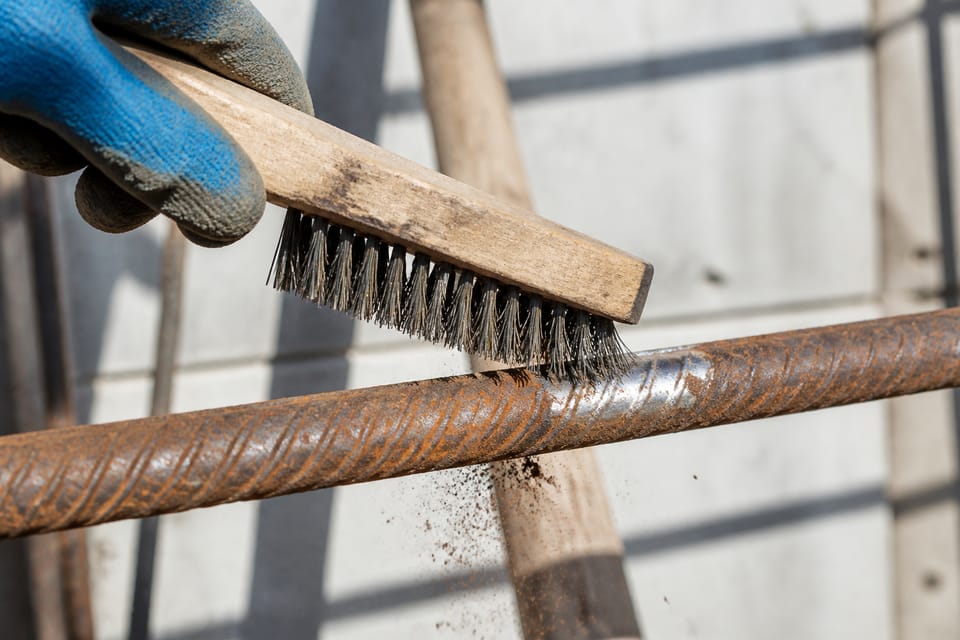
- A simple look, as a principle and not a pass mark: rub with a wire brush and see whether loose rust comes off, whether clean metal and the ribs show after brushing, and whether the bar looks as thick as a fresh bar of the same size. Give the result to the engineer.
- Clean with a wire brush. Use no acid or chemical unless the engineer says so, and never oil.
- Remove mud, oil, dried cement slurry and paint from the bars before the pour, as clause 5.6.1 asks.
How can I stop bars rusting on site? (practice)
- Keep bars off the ground, on bricks or timber, and covered against the rain, loosely, with room for air to move. Plastic wrapped tight can trap moisture.
- Keep them away from mud, sand, salt and cement slurry that splashes and dries on the bars.
- Stack by size and grade, and use the oldest first.
- Cover the stack before the first heavy rain, and do not leave bars lying across the plot in monsoon.
- IS 4082 asks for a cement wash in coastal areas or for long storage. Ask the engineer before putting any other coat on the bars, because paint and oil are what the code says to keep off.
- Order the steel to match the work, so that it does not wait a season.
What mistakes should I avoid? (practice)
- Leaving bars on bare ground or in mud.
- Letting mud and cement splash dry on the bars.
- Accepting oily or painted bars.
- Using loose flaky rust or scale because “rust helps bond”. No code says so.
- Rejecting all rusted bars without asking the engineer.
- Cleaning with acid or chemicals without the engineer.
- Mixing grades and lots in one stack.
- Not keeping the batch certificate and the bill.
- Believing any bar “never rusts”.
Frequently asked questions
Can rusted TMT bars be used?
The engineer decides. IS 456 asks for no loose rust, loose mill scale, paint, oil or mud at placing. No code gives an acceptable rust grade.
Does rust improve the bond with concrete?
No code we read says so. IS 456 lists loose rust and other substances as things which may reduce bond.
Is IS 1786 saying rusty bars are fine?
No. Clause 4.3.1 says rust is not a cause for rejection at the mill if a wire-brushed specimen meets the requirements. The placing test is IS 456 clause 5.6.1.
How do I clean rusty bars?
IS 456 recommends sand blasting or other treatment. On a small site, a wire brush is the usual tool. Ask the engineer before using any chemical, and never use oil.
How should steel be stored on site?
Separately by classification and size, protected from corrosion, above ground level in long storage, with a cement wash coat desirable and required in coastal areas or for long storage (IS 4082 clause 4.13).
Related guides
- Before the slab pour: an owner’s checklist for formwork and steel
- TMT bar full form and grades: what Fe500, Fe500D and Fe550D mean
- Pre-monsoon checklist for your house and your building site
- Corrosion of steel in concrete: why bars rust inside a slab
This guide is general information. Read the disclaimer. Your engineer decides whether the bars on your site can be used.
Sources
- IS 456:2000, Plain and Reinforced Concrete, Code of Practice: clauses 5.6.1, 5.6.2 and 5.7 (page images read). BIS lists it as in force, valid to 2030-07-12.
- IS 1786:2008, High Strength Deformed Steel Bars and Wires for Concrete Reinforcement (fourth revision): clauses 4.3.1 and 7.2.2 with Table 2 (page images read). BIS lists it as in force, valid to 2028-01-31.
- IS 4082:1996, Stacking and Storage of Construction Materials and Components at Site, Recommendations (second revision): clauses 4.13.1 to 4.13.4 (page images read). BIS lists it as in force, valid to 2028-05-31. CPWD Specifications 2019 Volume 1, clause 5.3.1 (page image read).
Change log
- : Added Related guides link to newly published article(s): corrosion-of-steel-in-concrete-why-bars-rust-inside-a-slab-and-how-the-code-guards-against-it. No other text changed. Approved by the reviewing engineer.
General information only. It is not a structural design or professional advice. Ask a licensed structural engineer or architect to check your plans and site.