
Short answer
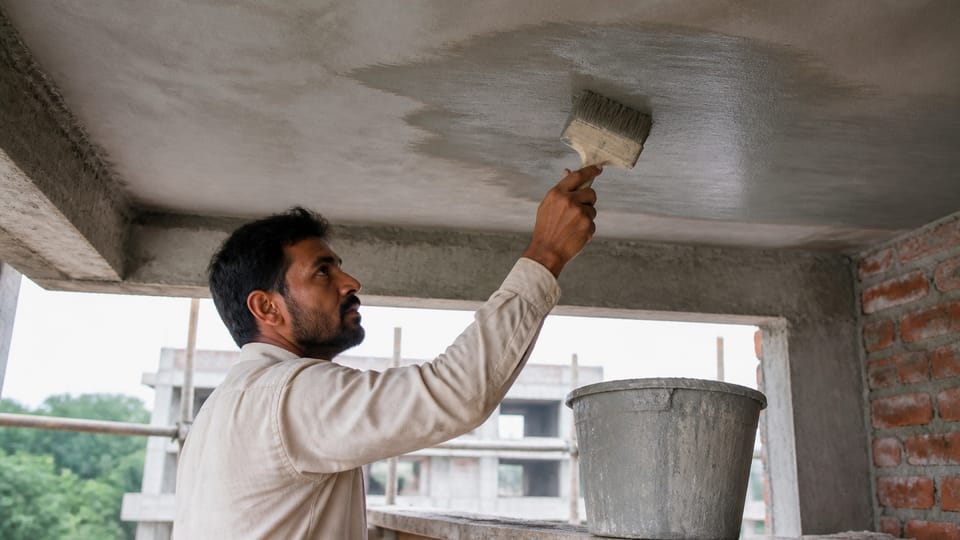
What is cement slurry? IS 1443 defines grout or slurry as neat cement mixed with water to a honey-like consistency, with no sand or aggregate added. It is brushed on as a bond coat, for example under a floor topping (IS 2571). The codes give no single ratio for all uses, and none of them treats plain slurry as waterproofing.
On this page (9)
“Cement slurry” is said at every site, and it means different things to different people: a thin brush coat, a thick finish on a floor, a grout, even a waterproofing. The Indian codes use the word for several different jobs, and in some clauses as something to clean off. This page sets out what a slurry is, where the codes call for it, and what they leave unsaid. It gives no consumption per square metre, no price and no brand, and it does not give a single ratio, because the codes do not give one for all uses. For plastering as a whole, see how to plaster a wall: the steps from preparation to finish.
What is cement slurry?
The one definition we found is in IS 1443:2018, the code for laying cement concrete tiles, clause 3.1.3: “Neat cement mixed with water to honey-like consistency; it may include pigments for grouting joints of tiled floor. Sand, stone dust or any other aggregate shall not be added.” So a neat cement slurry is cement and water only, judged by its consistency, not by a single ratio.
The codes use the word more widely than that definition. IS 1661 uses a slurry that contains fine sand. IS 456 uses “cement slurry” for the layer on a construction joint that has to be removed. Check which one is meant before you say yes to “slurry”.
Where do the codes call for it?
| Use | Code and clause | What it says |
|---|---|---|
| Before plaster on a soft smooth surface | IS 1661 clause 12.1.2 | “On a soft smooth surface after hacking a thin coat of cement slurry (1 : 1 :: cement : fine sand) may be applied.” For a hard surface like concrete it gives a dashed mortar, not slurry. |
| Before a bonded floor topping | IS 2571 clauses 8.2.3.1, 9.2.3, 9.3.2 | “neat cement slurry shall be thoroughly brushed into the prepared surface of the base concrete just ahead of the finish”; over lime concrete, “a thin layer of neat cement slurry” |
| Before deck concrete over precast floor units | IS 4326:2013 clause 9.2.5 | Cement slurry applied over the rough top surface “immediately before laying the deck concrete” |
| Bed for cement concrete tiles | IS 1443 clause 6.1.2 | “The top of mortar shall be kept rough so that cement slurry can be absorbed” |
| Cleaned off a tiled floor | IS 1443 clause 7.1 | Surplus slurry is cleaned from the joints “before it sets hard” |
| Cleaned off a construction joint | IS 456 clause 13.4 | Joints are placed to allow cleaning out of “laitance, cement slurry and unsound concrete” |
IS 1661 does not give a quantity, a thickness or a time for its slurry coat. The quantities appear only in IS 4326 (a cement quantity per square metre) and in the CPWD Specifications, which give several different quantities for different works. We do not print them: the figures differ between sources and between uses.
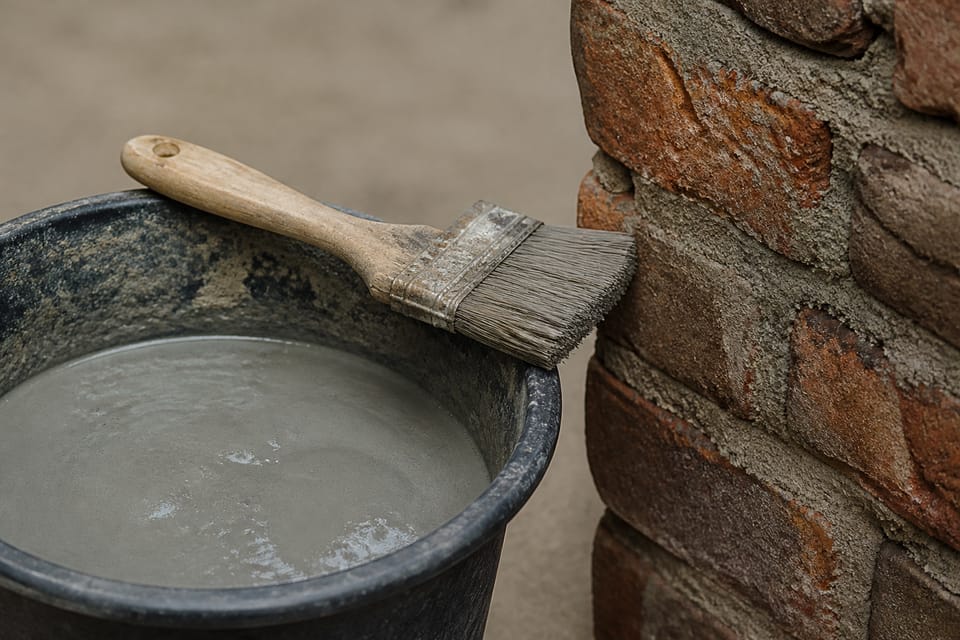
The CPWD Specifications 2019 use “neat cement slurry” on a vertical construction joint before fresh concrete (clause 4.2.8.1, applied “before it is dry”; for horizontal joints it asks for a mortar layer instead), under flooring, and over the mortar bed for ceramic tiles (clause 11.15.4.3, “honey like consistency”), and clause 11.2.5.2 uses a thick slurry as a finish on green floor concrete. These are works specifications, not BIS standards.
What do the codes not say?
- No code we read says that plain cement slurry is waterproofing or bridges a crack. Crystalline waterproofing slurries are a separate product system: CPWD specifies them (Sub Head 6.17) and the maker’s data sheet applies. Plain cement slurry is not that.
- IS 1661 gives no slurry for concrete. It asks for a dashed mortar after roughening the surface, and for the surface to be moistened sufficiently before plastering.
- IS 15477:2019 for tile adhesives does not mention slurry in the text we searched. IS 1443 mentions slurry only in passing for cement concrete tiles. CPWD 11.15.4.3 is the only source we read that tells you to spread slurry over the bed for ceramic tiles.
- No code we read gives a water ratio for slurry used as a bond coat. CPWD gives one cement-to-water figure for a smooth finish on skirting, which is a different use.
- “Slurry” in CPWD also means bentonite slurry for diaphragm walls, which has nothing to do with this page.
How do masons handle it? (practice)
This is practice, apart from the clauses named.
- Mix it fresh, in small batches, and stir before use.
- Brush it on in a thin coat. Do not pour it.
- Clean the surface first: remove dust, oil and loose material. IS 2571 asks for dirt and laitance to be removed before a bonded topping.
- Apply a small area at a time, and put the plaster or topping on while the slurry is still wet. Slurry that has dried is no bond.
- Do not reuse stale slurry or add extra water to make it flow.
What mistakes should I avoid? (practice)
- Letting the slurry dry before the plaster, topping or tile goes on.
- Brushing it onto dust, oil or laitance.
- A thick coat that shrinks and flakes.
- Using slurry to fill a crack. Plain slurry in a moving crack does not stop it.
- Believing slurry waterproofs a bathroom or a terrace.
- Using slurry as a substitute for tile adhesive.
- Confusing a thick neat cement finish with a bond coat.
What should I ask the mason? (practice)
- Which surface is this, and is it smooth or hacked?
- Are you using slurry, a dashed mortar or a bonding agent, and why?
- Is the slurry mixed fresh, and will you plaster while it is wet?
- Is this a bond coat or a waterproofing product, and which data sheet applies?
Frequently asked questions
What is the cement slurry ratio?
IS 1443 defines slurry as neat cement and water to honey-like consistency, with no ratio. IS 1661 has a slurry of cement and fine sand 1 : 1 for soft smooth surfaces after hacking. The codes give no ratio that fits all uses.
How much cement slurry per square metre?
The sources differ by use and edition, so no single figure is given here. Ask the engineer or the specification.
Does cement slurry waterproof?
No code we read says so. It is a bond coat or finish, not a waterproofing system.
Can I use slurry instead of tile adhesive?
CPWD describes a slurry over a mortar bed for ceramic tiles laid the traditional way (clause 11.15.4.3). Tile adhesives are a separate system.
Can I keep slurry overnight?
Practice says no: mix it fresh and use it while it is workable.
Related guides
- How to plaster a wall: the steps from preparation to finish
- Construction joints in concrete: where a pour stops and restarts
- Terrace leakage and waterproofing: methods, slope and ponding test
- Grout vs mortar: what each is made of and where each is used
This guide is general information. Read the disclaimer. Your engineer and mason decide the bond coats for your house.
Sources
- IS 1443:2018, Laying and Finishing of Cement Concrete Tiles, Code of Practice (second revision): clauses 3.1.3, 6.1.2 and 7.1 (page images read). BIS lists it as in force, valid to 2028-07-31. It is the code for cement concrete tiles, not ceramic tiles.
- IS 1661:1972, Application of Cement and Cement-Lime Plaster Finishes, Code of Practice (first revision): clause 12.1.2 (page images read). BIS lists it as in force, valid to 2027-01-31; it is an old code.
- IS 2571:1970, Laying In-situ Cement Concrete Flooring, Code of Practice (first revision): clauses 8.2.3.1, 9.2.3 and 9.3.2 (page images read). BIS lists it as in force, valid to 2027-01-31.
- IS 4326:2013, Earthquake Resistant Design and Construction of Buildings, Code of Practice: clause 9.2.5 (page image read). BIS lists it as in force, valid to 2028-07-31.
- IS 456:2000, Plain and Reinforced Concrete, Code of Practice: clause 13.4 (page image read). BIS lists it as in force, valid to 2030-07-12.
- CPWD Specifications 2019 Volume 1: clauses 4.2.8.1, 6.17, 11.2.5.2, 11.4.4 and 11.15.4.3 (page images read). CPWD is a specification for the works it covers, not a BIS standard.
Change log
- : Added Related guides link to newly published article(s): grout-vs-mortar-what-each-is-made-of-and-where-each-is-used. No other text changed. Approved by the reviewing engineer.
General information only. It is not a structural design or professional advice. Ask a licensed structural engineer or architect to check your plans and site.