
Short answer
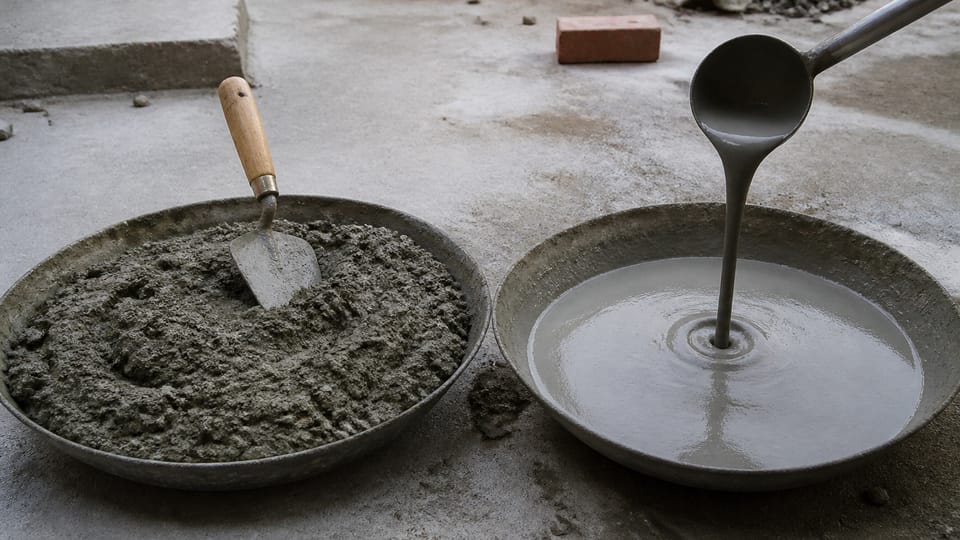
What is the difference between grout and mortar? Mortar is a workable mix of cement or lime, sand and water that beds and joins bricks or blocks. Grout is usually a thinner mix used to fill gaps, and the masonry code calls it mortar of pourable consistency. Tile grout is a separate product made to fill tile joints, and it is pressed in as a paste. Ask which grout is meant.
On this page (10)
Your contractor says “grout it”, or a website tells you never to use mortar in place of grout. Then a tile shop sells you a bag of grout that looks nothing like the thin grey mix used on a crack. Both words are real, but “grout” covers several different things. This page explains how grout and mortar differ, what each is made of, and where each is used in an Indian house. It gives no mix ratios, no prices and no brand advice. For ratios, see the mortar ratio guide.
What is mortar?
IS 2250, the Indian code for masonry mortars, describes mortar as a mix of cementitious materials, water and inert materials such as sand, made “for use in building together with masonry units”. In plain words, it is the layer that beds and joins bricks and blocks. It may be cement mortar, lime mortar, or composite mortar with both cement and lime. On many Hindi-speaking sites it is called masala, which is site usage and not code language. The word can also mean building materials in general.
IS 2212, the brickwork code, says brick is laid “on a full bed of mortar”. Plaster is also a cement and sand mix, but this code definition is about masonry.
What is grout?
There is no single answer, so ask which grout is meant. Four uses of the word matter most in a house. The texts we read have others, such as grouting the ground under a dam.
- Pourable masonry grout. IS 1905, the masonry code, says: “Grout — Mortar of pourable consistency.” NBCS 2026, the national building standard, repeats this, and its earthquake clauses describe a mix of cement, sand and water “for filling small voids”.
- Tile joint grout. IS 17190 covers products that fill joints between tiles and stones. This grout is pressed in. One maker’s sheet for a cement tile grout says “The mix must never be fluid”. Read the tile grout guide for the types.
- Neat cement grout or slurry. This is cement and water. IS 1443 uses grout and slurry for this one mix in cement concrete tile work, and it bars sand. See the cement slurry guide.
- Injection grout. This is forced into a crack or void. IS 13935 describes non-shrink cement polymer grouts for masonry repair, in its seismic repair guidance.
CPWD’s specifications also use “grouted” as a verb. Brick tile paving on mumty roofs (the small roof over a staircase), for example, is “grouted with cement mortar”. So the word “grout” in a bill or a site instruction does not always name a separate material.
How do grout and mortar differ?
Read together, the Indian definitions separate them mainly by consistency and job. That is our reading: none of the standards we read compares the two directly. The table is also ours, and “usually” matters in every row.
| Point | Mortar | Grout |
|---|---|---|
| Main job | Beds and joins units | Fills a gap, joint or void |
| Consistency | Workable, holds its shape | Usually pourable. Tile grout is a paste |
| Usual make-up | Cement or lime, sand, water | Varies by use, as below |
| Sand | Usually. IS 2250 says inert materials such as sand, and also names burnt-clay and cinder aggregate | Depends on the use, as below |
| Code that defines or covers it | IS 2250 | IS 1905 for the word, IS 17190 for tile joints |
| Where you see it | Brick and block joints. Plaster is a similar mix | Tile joints, cracks, thick wall joints, voids |
Does grout have sand in it?
It depends on the code and the job. NBCS describes one with sand. IS 1443 bars sand for cement concrete tile work. IS 17190 allows cement tile grout with or without graded sand. The older IS 6461 listed both a neat cement grout and a sand grout. So neither “grout has no sand” nor “grout always has sand” is right.
For the cement grouts CG1 and CG2, IS 17190 gives upper limits: joints up to 5 mm without graded sand and up to 12 mm with it. Makers’ sheets differ, so the pack decides for the product you buy.
Where is each used in a house?
| Job | What the texts say |
|---|---|
| Brick and block joints | Mortar, on a full bed (IS 2212) |
| Thick brick walls | Mortar bed and flushing, and joints grouted at every course as well, for walls two-brick thick and over (IS 2212) |
| Floor tile laid on a mortar bed | Mortar bed, neat cement slurry over it, tiles fixed in that slurry (CPWD, ceramic tile item) |
| Filling tile joints | Tile grout, which CPWD says fills the space between tiles and supports the joints |
| Wall cracks | Depends on the crack. See the wall crack repair guide |
| Steel base plates | Grout or mortar, non-shrinking, filling the space fully (NBCS, a steelwork clause) |
Note the third row. CPWD says tiles are “fixed in this grout”, and it means a neat slurry layer over a mortar bed. That is different from a bag of joint grout. Tile adhesive is a third thing: see tile adhesive types.
For crack injection, IS 13935 treats minor and medium cracks of 0.50 mm to 5 mm with pressure injection of non-shrink cement polymer grout. For cracks wider than about 5 mm, it says a treatment other than injection is indicated. This is seismic repair guidance, so an engineer decides whether it applies to your wall.
Non-shrink factory grout is sold for bases and anchors, as makers’ sheets show. NBCS and IS 13935 mention non-shrink grout, but our title search of the BIS listing found no Indian product standard for it, so read the maker’s sheet.
Can I use one in place of the other?
Not as a habit, and the answer depends on the job. These points are practice and our own reading, except where a code is named.
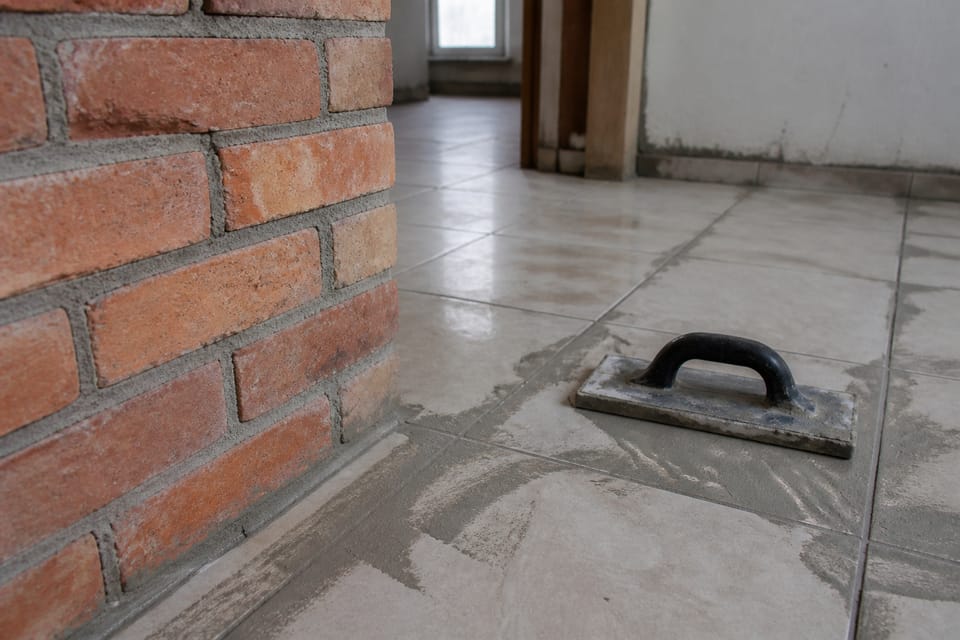
- Mortar in thin tile joints. Mortar sand may be too coarse to enter a thin joint, so the joint can stay part-filled. No code we read bans it for ceramic tiles, but IS 1443 fills cement concrete tile joints with a grout that has no sand. CPWD grouts open brick tile joints in roof paving, up to about 12 mm wide, with cement mortar. For ordinary tile joints, use a grout meant for them.
- Joint grout as a tile bed. IS 17190 defines tile grout as a joint filler, so we do not read it as a bed. The bed comes from mortar or a tile adhesive.
- Grout to lay bricks. A pourable mix does not hold a brick up or keep a level, so bricks go on a mortar bed.
- Extra water to turn mortar into grout. Adding water does not make a designed grout. Follow the specification or the pack.
What mistakes should I avoid?
These are practice points, except where a code is named above.
- Saying “grout” to a mason without agreeing which one you mean.
- Reading US advice as Indian. In the US, “mortar” for tiles usually means tile adhesive.
- Filling movement or expansion joints with tile grout. IS 17190 excludes them from its definition of grout.
- Applying IS 1443 rules to ceramic tiles. It covers cement concrete tiles.
- Mixing too much at once. IS 2250 says that generally cement mortar is mixed only for 30 minutes of work. For a bagged grout, follow the pack.
- Pouring thin cement into a wall crack and calling it repaired. Find out why it cracked first.
- Expecting grout to waterproof a floor or fix a tile that sounds hollow.
Frequently asked questions
Is mortar the same as grout?
No, though they are related. The masonry code calls grout mortar of pourable consistency. Tile grout is a different product, covered by its own code.
Can I use mortar as tile grout?
Not for ordinary thin tile joints, as a matter of practice. For cement concrete tiles, IS 1443 bars sand in the grout. Use a grout meant for the joint width.
Can I use grout to stick tiles?
Do not use bagged joint grout as an adhesive. Use a mortar bed or tile adhesive as your contractor’s specification says. The “grout” CPWD fixes tiles in is a neat slurry on a mortar bed.
Is grout stronger than mortar?
There is no general answer. Grouts and mortars both vary widely, and none of the standards we read makes that comparison.
Is pointing the same as grouting?
No. Pointing finishes a mortar joint at the wall surface. See types of pointing. Grouting fills a gap.
Is cement slurry the same as grout?
Sometimes. IS 1443 uses the two words for one mix in cement concrete tile work. CPWD also has a “cement mortar slurry” with sand for filling roof cracks, so ask whether it contains sand.
Related guides
- Cement vs concrete vs mortar: the difference in plain words
- Tile grout: cement vs epoxy grout and what CG and RG mean
- Mortar ratio for brick walls: 1:4, 1:5 or 1:6?
- How to regrout floor and bathroom tiles: raking out and refilling
This guide is general information. Read the disclaimer. Your structural engineer or the project specification decides what goes where in your house.
Sources
- IS 1905:1987, Structural use of unreinforced masonry, Code of practice (third revision): clause 2.10.
- IS 2250:1981, Preparation and use of masonry mortars, Code of practice (first revision): clauses 1.1, 2.1 to 2.3 and 8.2.1, and the foreword.
- IS 17190:2020, Grouts for filling of joints of tiles and stones, Specification: clauses 1, 3.4, 3.20, 4.1 and 4.2 and the foreword.
- IS 2212:1991, Brick works, Code of practice (first revision): clause 11.1.1.
- IS 1443:2018, Laying and finishing of cement concrete tiles, Code of practice (second revision): clauses 3.1.3 and 7.2. It covers cement concrete tiles only.
- IS 13935:2009, Seismic evaluation, repair and strengthening of masonry buildings, Guidelines (first revision): clauses 1, 5.2, 6.2 and 6.3.
- IS 6461 (Part 7):1973, Glossary of terms relating to cement concrete, Part 7 Mixing, laying, compaction, curing and other construction aspects: clauses 2.230 and 2.280. WITHDRAWN 2025; BIS lists a 2024 edition, which we could not read.
- CPWD Specifications 2019, Volume 1: clauses 11.15.4.1 to 11.15.4.3, 11.29.1, 12.11.4, 12.12.0 and 12.12.4. Copy hosted by IIT Bombay.
- CPWD Specifications 2019, Volume 2: clauses 14.49.1.5 and 22.8.2.9. Copy hosted by IIT Bombay.
- SP 7:2026, National Building Construction Standards 2026: Part C Section 4 clauses 2.10 and 8.1.10 and Part C Section 6 clause 24.15.4 (unofficial archive.org copy).
- Rekhta Dictionary, entry for masala: read for the site meaning of the word.
- One maker's data sheet, SikaCeram-638, September 2025: read only for how a cementitious tile grout is mixed. Not a recommendation.
General information only. It is not a structural design or professional advice. Ask a licensed structural engineer or architect to check your plans and site.