
Short answer
How do I prepare and paint the outside walls of a house? Make sure the wall is cured and dry, with no damp patches or powder. Fix the cracks and any damp first, because paint will not hide them. Treat any salt crust and mould, then use a primer suited to the wall, and finish with the topcoats the paint maker specifies. Do not paint in rain or on a damp wall. The Indian Standard IS 2395 gives the principles; the exact waiting times depend on the paint type and your engineer's advice.
On this page (10)
The outside of a house takes the full force of rain, sun and damp. Paint on the outside fails early when the wall is not ready, when a crack or a damp patch sits under the coat, or when the job is done in the wrong weather. This page sets out the steps, what the Indian Standards say about each, and what to check before you buy a single tin. It names no paint brand, gives no coverage figures and no drying times. Those come from the paint maker’s data sheet for your product, and your engineer or contractor should check them.
Why does the outside need a different job?
IS 2395 (Part 1), clause 4.1(b), says the information needed to plan the work includes whether the finish is external or internal, and “the extent to which the surface will be exposed to weather and rain.” So the outside needs its own planning. Lime and cement plaster are strongly alkaline when new. The standard says that when painting new walls, any paint system that will seal in the moisture shall be avoided (clause 5.2).
What should the wall be like before paint?
IS 2395 says a surface is ready for paint when it has properly set and cured, when the excess moisture has dried out of it and the backing, and when further movement of moisture will be negligible. Clause 5.2.2 does not give a number of days for that. The time depends on the plaster, the weather and the paint. Ask your contractor how the wall was tested, and consider a moisture meter test if one is used on site. The standard notes that a meter reads only a small area, and that a plastered wall can look dry and still be damp inside (Annex E).
If the wall stays damp, the standard says the cause must be found and the surface treated before painting. Painting over a damp wall makes the paint fail. Fix the leak or the seepage first; the damp walls page explains how to find the source.
What steps come first?
| Step | What to do | What the standard or the data sheet says |
|---|---|---|
| 1. Check the wall | Look for damp patches, darkening after rain, and powder that comes off on a finger | IS 2395 says a persistently damp surface must have its cause fixed first |
| 2. Clean the surface | Brush off dirt, loose material and dust; remove mould or algae | IS 2395 says loose and powdered material must be brushed off. On exterior porous surfaces, clause 5.6.2 requires any mould to be removed and an ammoniacal copper solution applied and dried thoroughly before painting |
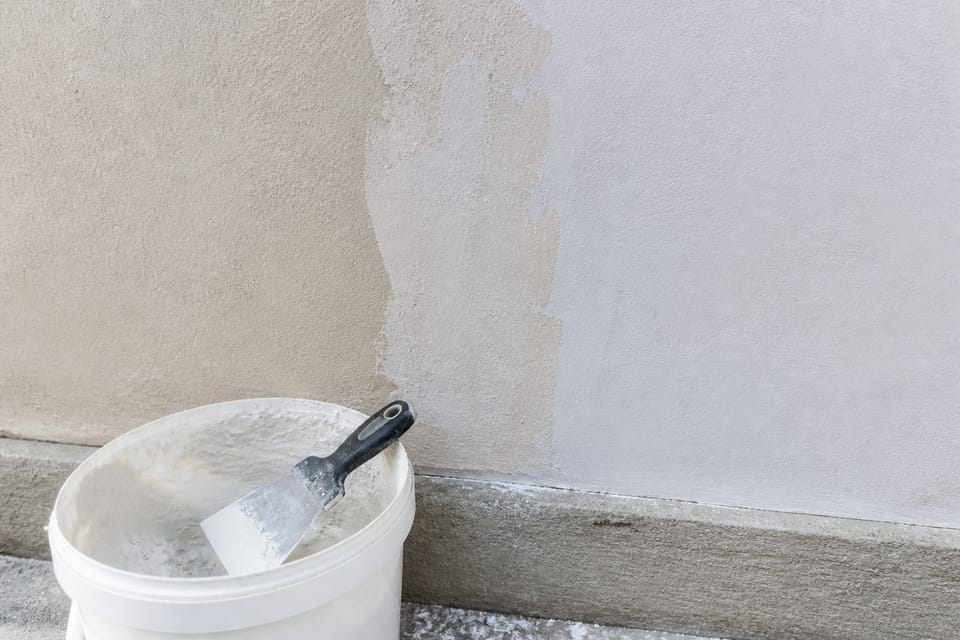
| 3. Deal with salts | Treat white salt crust (efflorescence) before painting. Dry brushing is the remedy the standard gives for the growth as it appears | IS 2395 says salts should not be washed off with water, because the water can carry them back into the pores |
| 4. Repair cracks | Cut major cracks in a V shape, make good, and let the repair dry | IS 2395 says loose areas and major cracks are cut in a V shape and made good before painting |
| 5. Fill and smooth | Stop small holes and rub down the surface where a smooth finish is wanted | IS 2395 asks for particular care with stopping, filling and rubbing down where smooth finishes are needed |
| 6. Prime | Use the primer the paint system needs | For solvent-based paints, IS 2395 Part 1 (clause 5.2.2) asks for an alkali-resistant priming paint. Part 2, Table 2, sets the primer for each paint type on new exterior surfaces |
| 7. Topcoats | Apply the finish coats the paint maker specifies, and let each coat dry before the next | The number of coats depends on the paint and the data sheet |
Steps 4 and 5 are easy to skip, and the cracks they leave show through the finish. Paint does not close a crack. A crack that is not filled will open again and show through the new coat. The hairline cracks page covers the crack side in more detail.
What primer should I use?
IS 2395 Part 1, clause 5.2.2, asks for an alkali-resistant priming paint when solvent-based paints are used. Part 2, Table 2, sets the primer for each paint type on new exterior surfaces: for exterior cement paint the first coat is cement paint itself, and for flat, semi-gloss and gloss paints it is one coat of alkali-resistant primer. Use the primer the paint maker recommends with the topcoat, check it against the table, and ask the shop or the painter to show you the data sheet for both.
For cement surfaces the standard also has a separate cement paint, covered by IS 5410. It says cement paint is suitable for porous masonry, concrete, stucco and rough plaster, except gypsum, and that the surface must be free of chalking and loose matter before it is painted. IS 5410 says these paints have “relatively better performance than distemper paints for outdoor protection and decoration of buildings.” It says the surface must be wetted before the paint is applied (clause 4.3). IS 2395 Part 1, Annex B, sets out wetting before painting and curing afterwards, so follow the paint maker’s instructions together with the annex.
When is the weather wrong?
IS 2395 gives no separate rule for each type of rain. In practice, these points apply:
- Do not paint in rain, or when rain is likely before the paint dries.
- Do not paint a surface that is wet, or that is damp to the touch.
- In hot dry weather, paint can dry too fast and leave marks. Work in shade where you can, and follow the data sheet for the temperature limits.
- IS 2395 Part 1, Annex B, sets a cold-weather limit for cement paint. Check the annex before you paint in winter.
- Do not leave a primer or a single coat exposed to the monsoon. Plan the job so that the wall is finished before the rains.
What mistakes should I avoid?
These are practice points, not code rules.
- Painting over a damp wall. Paint seals the damp in and the coat peels.
- Painting on new plaster too early. Ask the contractor how the wall was checked for dryness, and follow the paint maker’s wait.
- Covering cracks with paint. Fill and repair them first.
- Using interior paint outside. Use a paint made for outside walls.
- Skipping the primer. The topcoat will not bond evenly to the wall.
- Painting in the rain or the heat of the day. The weather can spoil the finish.
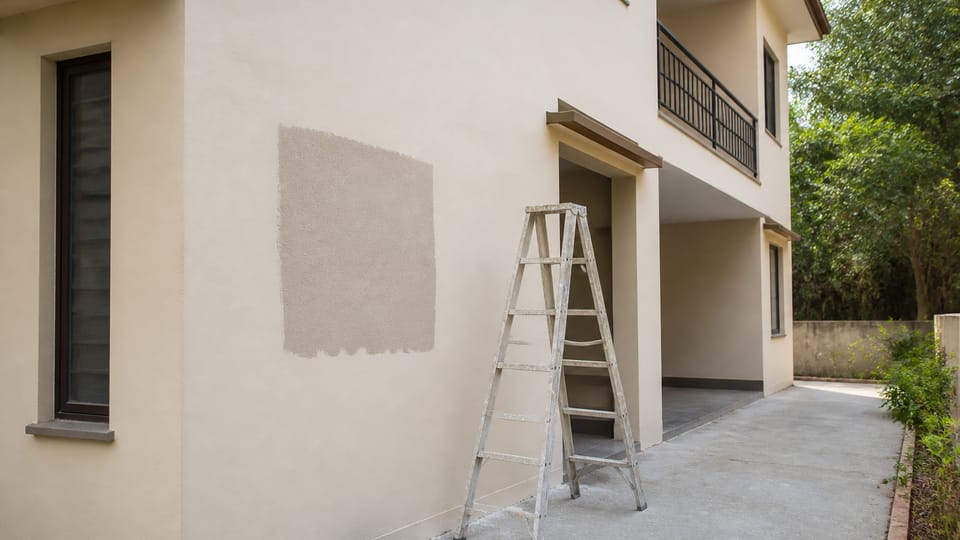
- Not testing first. Paint a small test patch on the real wall, let it dry, and check it for peeling, patchiness and salt.
- Letting paint reach the glass, the fittings and the aluminium frames. Mask them before you start.
What should an owner check on the job?
- The wall is dry, with no damp patches and no powder.
- Any salt crust and mould are treated before the primer.
- Cracks are filled and repaired, and the repairs have dried.
- The primer and the topcoat are the products the data sheet names for the wall.
- The coats are applied evenly, and each coat has dried before the next.
- The work is not done in rain or in the heat of the day.
- The test patch looks right after it has dried.
Frequently asked questions
How many coats of exterior paint do I need?
The number of coats depends on the paint and the data sheet for it. IS 2395 does not give one number for every exterior wall. Ask the paint maker, and check the coats on your test patch.
Can I paint over old exterior paint?
It depends on the condition of the old paint. If it is sound, clean and firmly stuck, it can be prepared and painted over. If it is peeling or chalking, remove the loose paint first. Ask the painter to check.
Can I paint exterior walls during the monsoon?
Only in a dry spell, on a dry wall, and without rain forecast before the paint has dried. Do not leave a primer or a single coat exposed to the rain.
How long should new plaster dry before I paint outside?
IS 2395 clause 5.2.2 says the wall must be properly set and cured, with the excess moisture dried out and further moisture movement negligible. It gives no single number of days for that. The standard does set longer minimum periods for some surfaces, such as new brickwork, cement concrete or stucco before cement paint, and new lime plaster, which should be left unpainted for a long time where possible. Ask your contractor and engineer, and follow the data sheet for your paint.
Will waterproof paint stop a leak?
No. Paint does not stop a leak. Find the source of the water and fix it, and then paint. The pre-monsoon checklist explains the checks before the rains.
Related guides
- Wall putty: coverage, coats and cracks
- Damp walls: rising damp, seepage or condensation
- Hairline cracks in plaster
This guide is general information. Read the disclaimer. The paint maker’s data sheet for your product, and your engineer or contractor, decide the preparation and the coats for your wall.
Sources
- IS 2395 (Part 1):1994, Painting of Concrete, Masonry and Plaster Surfaces: Code of Practice, Part 1 Operations and Workmanship (first revision, reaffirmed 2005). Clauses 1, 5.2, 5.3, 5.5, 5.6, 7.1, 7.2, 7.4 and Annexes A, B, C, E (read from a scanned copy; wording to be checked against the print before publication).
- IS 2395 (Part 2):1994, Painting of Concrete, Masonry and Plaster Surfaces: Code of Practice, Part 2 Schedules (first revision). Clause 4.
- IS 5410:2013, Cement Paint: Specification (second revision). Clauses 1, 4.2 and 4.3, and the foreword.
General information only. It is not a structural design or professional advice. Ask a licensed structural engineer or architect to check your plans and site.