
Short answer
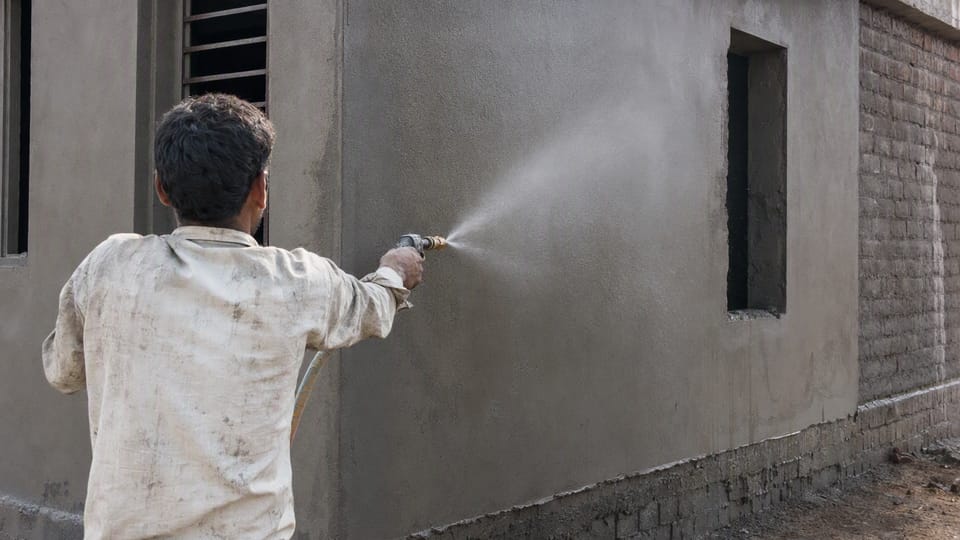
How many days should cement plaster be cured? IS 1661, the Indian code for cement plaster, says the finishing coat should be kept wet for at least seven days, and CPWD specifications also say at least 7 days. Each undercoat is kept damp until the next coat goes on. Start only once the plaster has hardened enough not to be damaged by water, use a fine spray rather than a hose jet, and do not let it dry out in between.
On this page (13)
- How many days should plaster be cured?
- When should curing start?
- How should plaster be watered?
- What about the wall before plastering?
- What about hot, dry or windy weather?
- Does the order of work matter?
- What happens if plaster is not cured properly?
- When can I paint or apply putty?
- What mistakes should I avoid?
- Frequently asked questions
- Related guides
- Work out your quantities
- Sources
Need quantities? Plaster quantity calculator
Cement plaster does not harden by drying. Like concrete, it needs water to set and gain strength, so it has to be kept damp for some days after it goes on. This is called curing. This page explains how long the Indian code and CPWD say to cure cement plaster, when to start, how to water it, how weather changes things, and what goes wrong when plaster dries too fast. It covers site-mixed cement and cement-lime plaster, not gypsum or ready-mix products, which follow their makers’ instructions.
How many days should plaster be cured?
| Coat | What IS 1661 says | What CPWD 2019 says |
|---|---|---|
| Undercoat(s) | “Each coat shall be kept damp continuously till the next coat is applied or for a maximum period of 7 days” (clause 16.1), and “Each under coat shall be damp-cured for at least two days” (clause 13.2) | Kept wet till the finishing coat is applied |
| Finishing coat, or single-coat plaster | “Kept wet for at least seven days” and protected from extremes of temperature and weather | “Kept wet for a period of at least 7 days” |
So the short answer is: at least seven days for the final coat, and the undercoat stays damp until the next coat goes on. Neither IS 1661 nor CPWD Sub Head 13 gives a different period for ceiling plaster, for outside walls, or for different cement types; if your engineer specifies longer, follow that.
CPWD adds a simple tip: mark the date of plastering on each section of wall, so anyone on site can see when its curing period ends.
When should curing start?
Not immediately. IS 1661 says moistening should start “as soon as the plaster has hardened sufficiently and is not susceptible to injury”, and CPWD says curing starts when the plaster has hardened enough “not to be damaged when watered”. Water sprayed on soft, fresh plaster can wash out the surface. The right moment depends on weather; your mason or engineer judges it on site.
How should plaster be watered?
IS 1661 is specific:
- Use “a fine fog-spray”.
- Do not soak the wall. Use “only as much water as can be readily absorbed”.
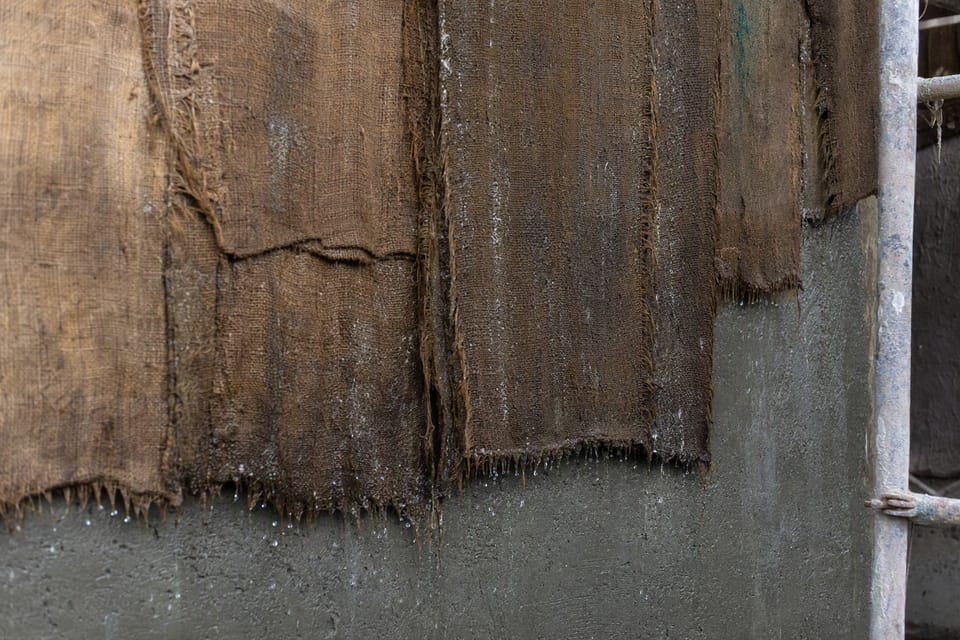
- On sunny or windward sides in hot, dry weather, hang mattings or gunny bags on the outside of the plaster and keep them wet.
In practice this means a spray nozzle or a fine sprinkle, not a strong hose jet, and enough rounds through the day that the surface never dries out between them. No standard gives a fixed number of times a day. Watering three times a day is not curing if the wall dries in between, which is the same lesson as for a concrete slab.
What about the wall before plastering?
Curing starts before the plaster goes on. A dry brick wall sucks water out of fresh plaster. IS 1661 warns that “high rate of suction withdraws all moisture from the plaster and makes it weak porous and friable”. It says the wall “shall not be soaked but only damped evenly”, with any dry spots moistened again. CPWD asks for the wall to be washed and kept wet before plastering starts.
What about hot, dry or windy weather?
IS 1661 warns that in hot, dry conditions, plaster may dry before it has set properly, leaving a weak, powdery surface that is a poor base for the next coat or for paint. It adds that “plasters containing cement are particularly sensitive in this respect”, and that the surface “should be continually kept wet during the curing period”. Wet gunny bags on sunny and windward walls, plastering those sides in shade or in the cooler part of the day, and watering more often are the usual site answers (practice).
Rain is not controlled curing. Protect fresh plaster from driving rain, and keep it damp through any dry spells in between (practice).
Does the order of work matter?
Yes. IS 1661 says it is an advantage to plaster the ceilings first, so the scaffolding can be removed before the walls are plastered, and CPWD asks for ceiling plaster to be completed before wall plaster. CPWD applies the same curing clause to ceiling plaster as to walls.
For two-coat work, IS 1661 says the first coat’s drying shrinkage should be largely complete before the next coat, and the undercoat must be kept damp in between and not allowed to dry. CPWD puts the finishing coat on when the undercoat has “sufficiently set but not dried”. How many coats your wall needs is covered on our plaster quantity page, and the plaster quantity calculator works out cement and sand.
What happens if plaster is not cured properly?
IS 1661 does not list defects under curing, but its defects clause names several in which shrinkage or fast drying can play a part:
- Crazing: “a series of hair cracks on the finished plaster surface”. The code lists proper time between coats and control of moisture and temperature after plastering among the ways to reduce it.
- Cracking: usually caused by movement in the wall or structure, but shrinkage in the undercoats can also crack the final coat.
- Softness or chalkiness: from too much suction by the wall, a finishing coat that is too thin, working the plaster after it has started setting, or exposing it to excessive heat or draught while it sets.
CPWD asks for cracked, soft or hollow-sounding portions to be cut out and redone. Not every crack comes from poor curing; our guide to hairline cracks in plaster explains the other causes and what to do.
When can I paint or apply putty?
Curing and drying are different things. Curing keeps the plaster wet for the first days so it sets well. After that, the wall has to dry out before most paints go on. IS 2395, the Indian painting code, says new cement plaster is highly alkaline at first and holds a lot of water that takes a long time to evaporate. It says a new surface is preferably left unpainted “for as long as possible”, that paints which seal in moisture should be avoided on new walls, and that where you cannot wait, a porous finish should be used.
No standard we read gives one waiting period for all putty and paint, but some give minimums for particular finishes. IS 2395 says cement painting should wait until the rendering has “aged at least three weeks”, and that solvent-based paints should not be used on new cement renderings “until several months have passed”. CPWD does not recommend oil-bound distemper “within six months of the completion of wall plaster” unless an alkali-resistant primer goes on first. For putty and other paints, follow the maker’s instructions; our wall putty guide covers what makers say.
What mistakes should I avoid?
These come from IS 1661, CPWD and site practice:
- Plastering a dry wall without damping it first.
- Spraying water on plaster before it has hardened, or using a strong hose jet.
- Soaking the wall instead of keeping it damp.
- Letting the plaster dry out between waterings, especially on sunny and windy sides.
- Stopping before the finishing coat has had its full curing period.
- Forgetting which wall was plastered when. Mark the date on each section, as CPWD suggests.
- Painting with a non-porous paint while the wall is still wet inside.
Frequently asked questions
How many times a day should plaster be watered?
No standard gives a number. The rule is that the plaster must stay damp continuously through its curing period, so in hot, dry or windy weather it needs watering more often than in cool, humid weather.
Is curing needed for ceiling plaster?
Yes. CPWD applies the same curing clause to ceiling plaster as to walls, and IS 1661’s curing clause covers all cement plaster. A fine spray is easier to control on a ceiling (practice).
Is 7 days of curing enough for plaster?
IS 1661 and CPWD both say at least seven days for the finishing coat. Some websites give longer periods; we found no Indian standard that does so for cement plaster. Your engineer may specify longer for your site.
Does gypsum plaster need curing?
Gypsum plaster is a different material; follow its maker’s instructions on curing. This page covers cement plaster.
Does plaster made with PPC need longer curing?
IS 1661 and CPWD’s plaster clauses do not give a different curing period for different cement types. The longer periods for blended cements that you may have read about come from the concrete code, IS 456, not the plaster code. Ask your engineer.
Related guides
- Hairline cracks in plaster: causes and what to do
- Plaster quantity: cement and sand per sq ft, with a calculator
- How many days to cure a concrete slab?
- Wall putty: coverage per kg, number of coats and why it cracks
- Gypsum plaster vs cement plaster: where each suits a house
This guide is general information. Read the disclaimer. Your engineer’s specification decides the curing period and method for your house.
Work out your quantities
- Plaster quantity calculator: Estimate the cement bags and sand for cement plaster on a wall or ceiling, from its size, thickness and mix, with doors and windows taken off.
Sources
- IS 1661:1972, Code of Practice for Application of Cement and Cement-Lime Plaster Finishes (First Revision, reaffirmed). Clauses 2.4.3, 7.1.2, 7.7.1, 8.2, 8.5, 10.4, 13.2, 16 and 18.2.
- CPWD Specifications 2019, Volume 2, Sub Head 13 Finishing: clauses 13.1.2, 13.1.4.1, 13.1.6, 13.1.8, 13.3.3, 13.4.7 and 13.19.3.1 (copy hosted by Puducherry PWD).
- IS 2395 (Part 1):1994, Painting Concrete, Masonry and Plaster Surfaces, Code of Practice, Part 1: Operations and Workmanship. Foreword, clauses 5.2 and 7.2, and Annexes A-3.1.1 and B-2.2.
- IS 456:2000, Plain and Reinforced Concrete, Code of Practice, clause 13.5.1 (concrete curing; cited only to show where blended-cement periods come from).
General information only. It is not a structural design or professional advice. Ask a licensed structural engineer or architect to check your plans and site.