
Short answer
How many types of waterproofing are there? No Indian Standard gives a number. This page uses the site's own seven groups: integral compounds, cementitious coatings, bituminous felts and membranes, liquid membranes, crystalline products, sheets and traditional lime concrete. IS 13182 clause 4.4.1 deems three kinds of material waterproof for wet areas: sheet, liquid membrane and flexible coating.
On this page (9)
Search for “types of waterproofing” and the lists mix three different things: what the product is made of, where it goes in the building, and what form it comes in. This page separates them. It names the Indian Standard that touches each group, says what that standard does and does not cover, and links to the pages that give the method. It gives no prices, no brands, no thicknesses and no “best” choice.
Does any Indian Standard say how many types there are?
No. We found no standard that classifies waterproofing into a stated number of types. IS 3067:1988 says only that “different types of damp-proofing and water-proofing materials” are used, and that it applies to treatments “using bitumen felts, bitumen mastic, lime concrete, etc.” The nearest thing to a list is IS 13182:2020 clause 4.4.1, which names three kinds of material “deemed to be waterproof” for wet areas:
- a flexible waterproof sheet flooring material with waterproof joints,
- a liquid membrane (two component or single component), and
- a flexible waterproof coating with resistance to ingress of moisture under pressure.
IS 13182 covers wet areas such as the kitchen, bathroom, balcony and a domestic overhead tank. It does not cover roof drainage or swimming pools. So the grouping below is this site’s own, made to be useful, and not a classification from a standard.
What are the main types?
| Group (our grouping) | What it is | Standard that touches it | Where it is commonly used (practice) |
|---|---|---|---|
| Integral compound | A compound mixed into the mortar or concrete | IS 2645:2003 | Mixed into plaster, coba mortar or concrete |
| Cementitious coating | A cement-based layer brushed or applied on the surface | IS 13182 refers to a “polymeric cementitious coating” for balconies | Wet areas, balconies, water tanks |
| Bituminous felt and membrane | Sheets saturated with bitumen, or modified bitumen sheets, laid on a prepared surface | IS 1322, IS 1346, IS 1609, IS 16532, IS 16525, IS 16526, IS 16540 | Terraces (felt and membranes); foundations and basements (felt damp-proofing) |
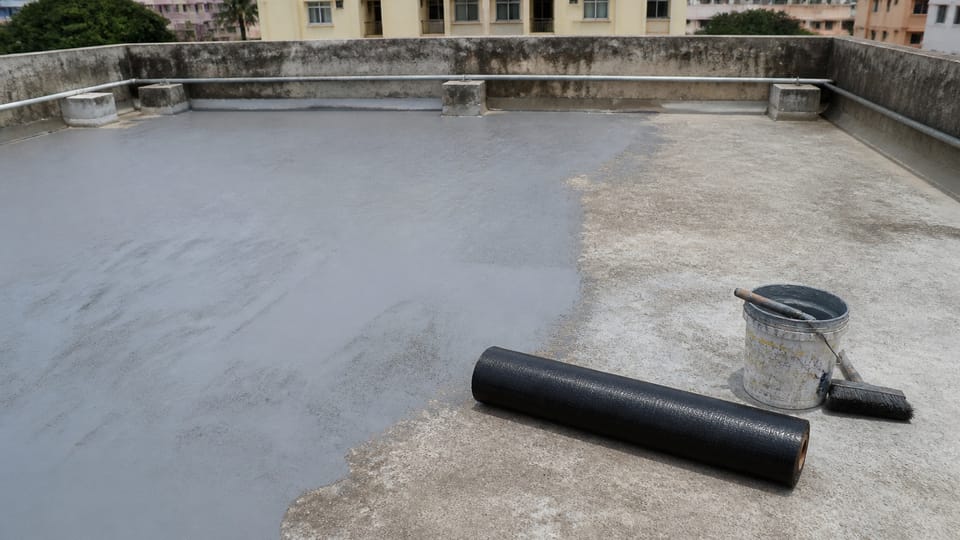
| Liquid membrane | A coating applied wet that cures into a continuous flexible film | IS 13182 clause 4.4.1; for acrylic polymer materials IS 13435 gives test methods only | Terraces, bathrooms, balconies |
| Crystalline product | A product that works in the pores of concrete, as an admixture, coating or mortar | No Indian Standard found | Below-ground concrete, tanks (CPWD 22.14.3 lists the uses for the admixture) |
| Sheet | A prefabricated flexible sheet | IS 13182 clause 4.4.1; IS 7290 for polyethylene film on roofs | Wet-area floors; roofs |
| Traditional: lime concrete and brick bat coba | A thick, sloped layer of lime concrete or mortar with broken brick | IS 3036:2022 | Flat roofs |
The “where used” column is practice and is not taken from a standard, except where CPWD lists uses.
What do the standards say about each?
Integral compounds. IS 2645:2003 specifies integral waterproofing compounds “for cement mortar and concrete”, assessed by the permeability of mortar specimens and by setting-time and strength tests. It does not say where to use a compound or that it replaces a membrane. For what it does and does not say, see integral waterproofing compound: what IS 2645 says.
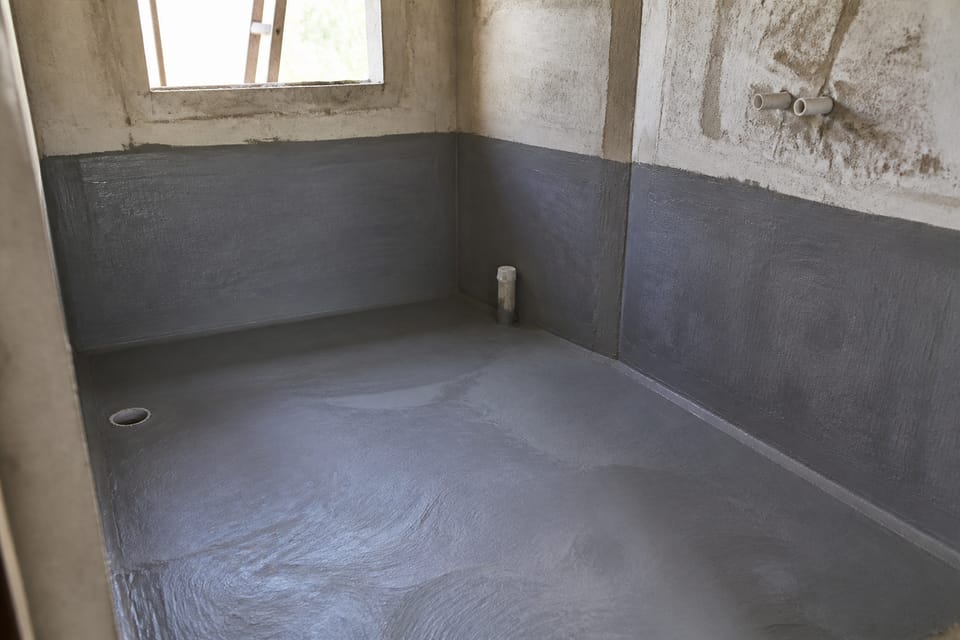
Cementitious and liquid coatings. IS 13182 uses the words “flexible waterproof coating” and “liquid membrane”, and for balconies and chajjas it recommends a “polymeric cementitious coating”. It does not list polyurethane or crystalline systems, and clause 4.4.1 names no acrylic system; the standard does mention an acrylic cementitious waterproof coating in a drawing note, so treat it as an example, not a type. For acrylic polymer waterproofing materials, IS 13435 Part 1 is a test method for solid content, and nothing more. We found no Indian Standard that specifies a polyurethane liquid membrane or tells you how to apply a coating.
Bituminous felts and membranes. IS 1322 specifies saturated and self-finished bitumen felts. IS 1346 covers applying bitumen felt on roofs, and IS 1609 covers bitumen felt damp-proofing for foundations, basements and walls: the two are separate uses. IS 4911 defines a membrane as “any functionally continuous flexible structure of felt or fabric and bituminous cementing material”, which is why “bituminous” and “membrane” overlap in the standards’ own terms. IS 16532 (APP) and IS 16525 (SBS) specify modified bitumen sheets. IS 16532 says in clause 1.2 that “This is a material specification only. Issues regarding the application techniques are beyond the scope of this standard.”
Crystalline products. We found no Indian Standard for crystalline waterproofing. CPWD’s 2019 specification has clauses for crystalline admixture, coating, dry-shake and mortar, and lists foundations, rafts, basement retaining walls, swimming pools and water tanks as recommended uses of the admixture (22.14.3). That is a government works specification, not an Indian Standard.
Sheets. IS 13182 lists flexible waterproof sheet flooring for wet areas. IS 7290 covers laying polyethylene film for waterproofing roofs. Standards for PVC and HDPE sheets exist for lining and geomembranes, and we did not read them for houses.
How is waterproofing different from damp proofing?
IS 4911 defines damp-proofing as treatment of a surface or structure “to resist the passage of water in the absence of hydrostatic pressure”, and waterproofing as treatment “to prevent the passage of water under hydrostatic pressure”. A damp-proof course is a separate layer: see damp-proof course: what it is and where it goes.
How do I choose a type for a place?
The standards do not rank the types. These are practice points to put to your engineer:
- Cracks and movement. A rigid cement coat suits a surface that does not move. Where cracks open and close, a flexible layer is the question to ask about.
- Moisture in the base. Some products need a dry base and some a damp one. Ask the maker’s data sheet, not a seller.
- Protection. CPWD says that on an accessible flat roof with an APP membrane, a separation layer should be laid before the protective layer. Bitumen and thin films left in the sun without protection are a risk to ask about.
- Details. Corners, pipe sleeves, outlets and parapet junctions decide most leaks. For a roof slab, CPWD 22.6.1 says no other work should be allowed on the treated area during or after the treatment.
- Testing. Ask for a flood or ponding test before the finish goes on. See the terrace and bathroom guides for how it is done.
For terraces, see terrace leakage and waterproofing methods. For bathrooms, see bathroom waterproofing steps and the ponding test. For damp walls, see damp walls: rising damp, seepage or condensation.
What mistakes should I avoid?
These are practice, not code rules.
- Choosing a product by name before finding the cause of the leak.
- Using a rigid coat where cracks move.
- Treating an integral compound as the whole waterproofing of a terrace.
- Applying a moisture-sensitive coating on a damp slab.
- Leaving a thin coat or membrane exposed without protection.
- Mixing up damp proofing and waterproofing.
- Believing a warranty replaces a test.
Frequently asked questions
How many types of waterproofing are there?
There is no standard number. This page uses seven groups: integral, cementitious, bituminous, liquid, crystalline, sheet and traditional lime concrete. That grouping is ours.
Is crystalline waterproofing a membrane?
No Indian Standard covers it, so we cannot say what one defines. CPWD describes crystalline products as admixtures, coatings, dry-shake and mortar that act in concrete, and lists below-ground uses.
Which IS code is for waterproofing?
It depends on the use. IS 13182 for wet areas, IS 3067 for design details, IS 1346 for bitumen felt on roofs, IS 1609 for bitumen felt damp-proofing and IS 2645 for integral compounds.
Is one product enough for the whole house?
The standards do not say. Different places need different details, so ask your engineer.
Related guides
- Terrace leakage and waterproofing methods
- Bathroom waterproofing: steps, wall height and the ponding test
- Integral waterproofing compound: what IS 2645 says
This guide is general information. Read the disclaimer. Your engineer decides the waterproofing for your house.
Sources
- IS 13182:2020, Waterproofing and Damp-Proofing of Wet Areas in Buildings, Recommendations (first revision): clauses 1.1, 1.2, 3.8 to 3.10, 4.4.1, 4.4.2, 5.3, 5.5.2(g), 5.8.2(b). BIS lists it as not withdrawn.
- IS 3067:1988, general design details and preparatory work for damp-proofing and water-proofing of buildings: clauses 0.2, 1.1 and 1.1.1.
- IS 1346:1991 (bitumen felts on roofs) clause 1.1; IS 1609:1991 (bitumen felt damp-proofing) clause 1.1; IS 1322:1993 (bitumen felts) clauses 1 and 3.1; IS 4911:1986 (glossary) clause 2.
- IS 16532:2017, APP Modified Bituminous Waterproofing and Damp-Proofing Membrane with Polyester Reinforcement: clauses 1.1 and 1.2. IS 16525:2017 (SBS), IS 16526:2017 and IS 16540:2017 are named by their BIS titles only; BIS lists all as not withdrawn.
- IS 2645:2003, Integral Waterproofing Compounds for Cement Mortar and Concrete: scope. IS 3036:2022 (lime concrete for a waterproofed roof finish), IS 9918:1981, IS 7290:1979 and IS 13435 (Part 1):2021 (a test method only): scope clauses.
- CPWD Specifications 2019 Vol 2, Sub Head 22 (water proofing treatment) clause titles and clauses 22.6.1, 22.14.3 and 14.51.1. A government works specification, not an Indian Standard. The hosting URL returned a page-not-found when checked on 2026-10-29; the clauses were read from a held copy of the book.
General information only. It is not a structural design or professional advice. Ask a licensed structural engineer or architect to check your plans and site.