
Short answer
How is a Mangalore tile roof laid, and how is it kept sound? The roof frame is finished first, then the reepers are fixed and the tiles are laid from the eaves up to the ridge, with the joints breaking so each tile overlaps the one below. IS 2858 says the joints must be leak-proof and the ridges edge-bedded in mortar. Check the roof at least twice a year and before the monsoon, replace broken tiles from the roof, and keep the valleys clear. The pitch, overlap and batten spacing are for your engineer.

On this page (9)
A Mangalore tile roof is one of the oldest roof coverings in India, and it is common in Kerala, Karnataka and Goa. Its tiles are heavy, so the roof frame has to carry them, and its strength depends on how the tiles are laid and kept in place. This page explains the laying order and the points IS 2858 asks for, and gives an owner’s maintenance checks. It gives no pitch, no overlap, no batten or rafter sizes and no prices. Those are for the engineer and the roofer.
What does IS 2858 cover?
IS 2858 is the Indian code of practice for roofing with Mangalore tiles. The standard for the tile itself is IS 654. IS 2858 deals with the roof covering as it is laid on the frame. Its foreword notes a specific advantage of a tiled roof: any broken tile can be replaced without much disturbance to the rest of the roof (foreword 0.2).
What must be ready before the tiles go on?
Clause 6.1 says the roof framework must be completed, and the reepers (the horizontal battens that carry the tiles) nailed into position, before the roof covering starts. The tile is laid on reepers, not directly on the rafters. Clause 8.1 says the joints of no two adjacent rows of reepers should come over the same rafter.
For the frame itself, see roof tiles vs metal sheets vs RCC slab: choosing a roof for a house. The frame and its size are for the engineer.
How are the tiles laid?
The code’s laying points, in plain words:
| Step | What the code says | Clause |
|---|---|---|
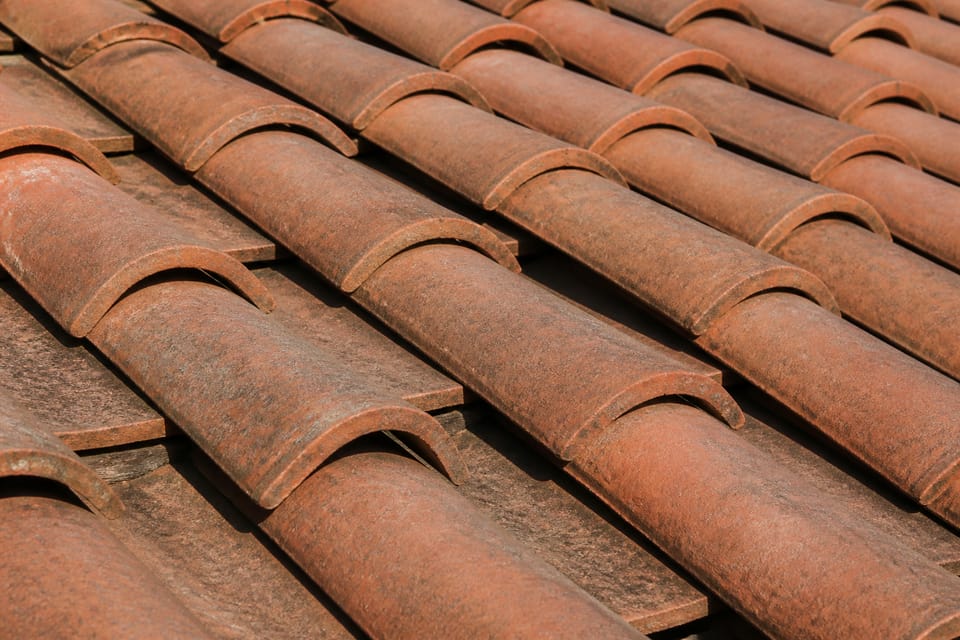
| Start at the eaves | Tiles are laid from the eaves towards the ridge, interlocked according to the design of the tile | 9.1 |
| Break the joints | Each tile is laid channel to channel, breaking the joint of the course below, so the catches rest fully on the battens | 9.1 |
| Lap as the design says | Head lap and side lap are set by the design of the tile | 4.2 |
| Leak-proof joints | The interlocking and the laying technique must ensure the joints are leak-proof | 4.1 |
| Eaves discharge clear | The lowest course overhangs the eave so the water runs off into the gutter | 9.1 |
| Bed the ridges and hips | Ridge and hip tiles are edge-bedded in mortar | 9.1 |
| Keep valleys clear | A clear and unobstructed channel must be formed, with an undercover for the courses next to the valley | 9.4 |
| Tie the bottom course | The bottom-most course is tied to the reepers or other roof elements by galvanized wire, and the eaves tiles are protected against lifting | 9.1.1 |
| Tie down on steep or exposed roofs | Where elevated sites or heavy rain may be expected, the pitch is increased, and then each tile is screwed or tied down to the roof frame | 4.2 |
What should I check on the roof?
Clause 12.1 lists an unsightly fall of the roof surface near the eaves as a failure that may occur if the laying of the tiles is not satisfactory. In practice, check these points at least twice a year, and before the monsoon:
- The tiles are all in place, with no gaps where the water can run in.
- No tile has slipped, cracked or lifted at the edges.
- The ridge and hip caps are firm and their mortar is sound.
- The valleys and the gutters are clear of leaves and debris.
- The eaves discharge into the gutter, not onto the walls.
- No plants or moss are growing in the joints.
The CPWD Maintenance Manual 2019 (clause 7.2, periodical checks) also asks for the roof, the rain water pipe inlets and outlets, and the drains to be cleaned at least twice a year and particularly before the monsoon. For that list, see pre-monsoon checklist for your house and your building site. The CPWD list is general roof guidance, not guidance specific to tiles.
How do I replace a broken tile?
IS 2858 says a broken tile can be replaced without much disturbance to the rest of the roof (foreword 0.2). Practice: lift the tiles around the broken one, slide out the broken tile and fit a new one in the same place. Ask the roofer to check the fixing and the joint before the tiles are left.
What mistakes should I avoid?
These are practice points, not code rules:
- Walking on a wet tile roof. Keep off the roof when it is wet.
- Putting a satellite dish, a solar panel or a water tank on the tiles without a check from the engineer.
- Cleaning the roof with a strong chemical that damages the tile or the plants around the house.
- Letting debris build up in the valleys until the water backs up under the tiles.
- Replacing a few tiles without checking why they broke.
Frequently asked questions
Can I walk on a Mangalore tile roof?
Keep off the roof when the tiles are wet, and walk on it only where the roofer has said it is safe. IS 2858 says the tile, as laid, can carry the weight of a man it is called upon to support during a repair (foreword 0.2). This page gives no load figure.
How often should the roof be checked?
This page gives no life span. The condition of the tiles, the frame and the mortar decides when repair or replacement is needed. Check the roof at least twice a year, and before the monsoon, and ask your engineer or roofer to look at it.
Does a Mangalore tile roof leak?
A tile roof can leak where the tiles are broken, where the joints are open, at the valleys and at the ridges. The checks above help find these points. Where the water comes in through the ceiling, the cause is not always the tiles, so ask the roofer to check the flashing and the frame too.
These answers are practice guidance, not code quotes.
This guide is general information. Read the disclaimer. Your roofer and engineer decide the frame, the pitch and the repair for your roof.
Related guides
- Roof tiles vs metal sheets vs RCC slab: choosing a roof for a house
- Pre-monsoon checklist for your house and your building site
- Metal roof sheets: GI vs galvalume vs colour-coated, and TCT and BMT
- Roof types and roof parts: what the terms mean for a house
Sources
- IS 2858:1984, Code of Practice for Roofing with Mangalore Tiles (First Revision). Foreword 0.2, clauses 4.1, 4.2, 6.1, 8.1, 9.1, 9.4 and 12.1 read from an OCR copy; check against a printed copy. Pitch, overlap and batten spacing are not used.
- CPWD Maintenance Manual 2019, roof inspection list (general roof guidance, not tile-specific). Read from the NDMC-hosted copy.
Change log
- : Added Related guides link to newly published article(s): roof-types-and-roof-parts-what-the-terms-mean-for-a-house. No other text changed. Approved by the reviewing engineer (owner report, 2026-10-31).
General information only. It is not a structural design or professional advice. Ask a licensed structural engineer or architect to check your plans and site.