
Short answer
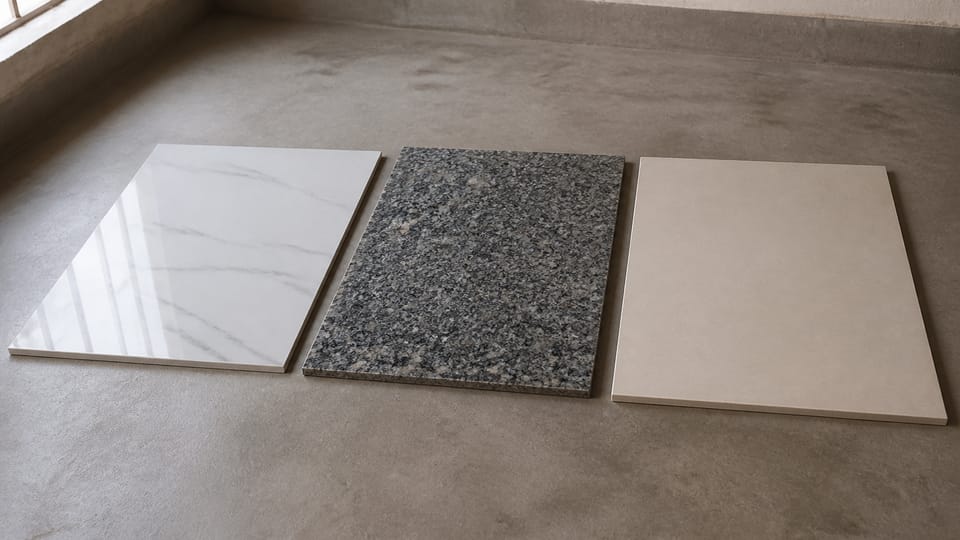
Which is better for a floor, marble, granite or vitrified tile? No single answer. Marble is a natural stone with veining that varies, granite is a natural stone that IS 14223 covers with its own tests, and vitrified tile is a manufactured tile. Each has its own Indian standard and tests. For your room, ask the seller for the test report for that exact product and check it against the standard named for it.
On this page (10)
People often ask which floor is better: marble, granite or vitrified tile. The honest answer is that the three are different kinds of material, and each has its own Indian standard. This page explains what each standard covers and which tests it names. It gives no prices, no rates, no brand or quarry rankings, and no slip or strength values for a floor. Those are for the seller’s test report and your engineer to check.
What is each one?
- Marble is a natural stone. IS 1130 is the Indian specification for marble in blocks, slabs and tiles.
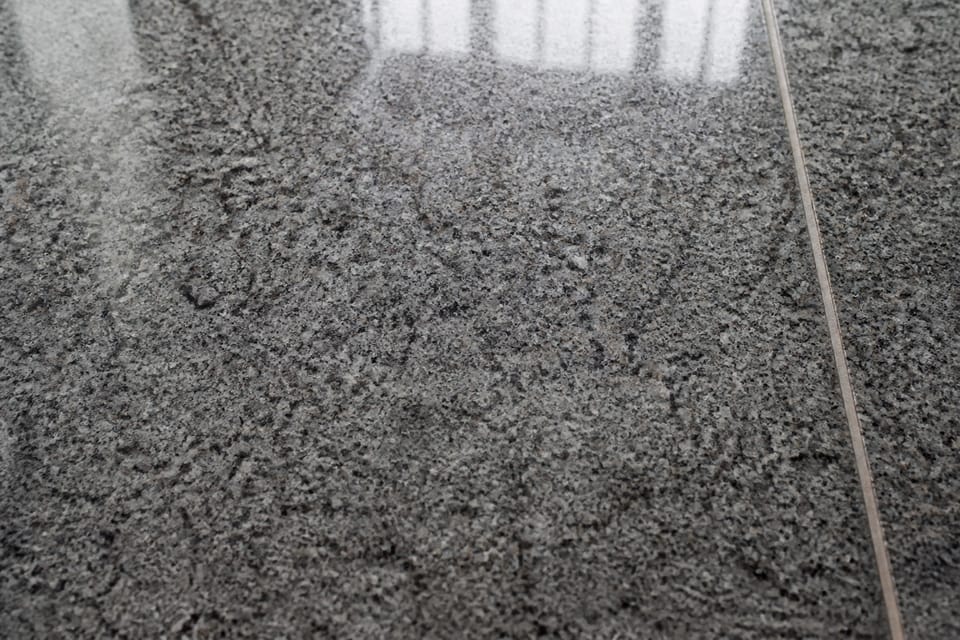
- Granite is a natural stone too. IS 14223 (Part 1) covers polished natural granite and similar stones. Stones that are commercially called granite fall under it.
- Vitrified tile is a manufactured ceramic tile. IS 13712 is the Indian standard for ceramic tiles. It classifies them by how much water they absorb. A fully vitrified tile is in the group with the lowest water absorption.
Marble, granite and vitrified at a glance
| Point | Marble | Granite | Vitrified tile |
|---|---|---|---|
| Standard | IS 1130:1969 (reaffirmed 2003 on the copy read) | IS 14223 (Part 1):2023 | IS 13712:2019 |
| Does the standard mention floors? | Yes. Its clause 0.4.1 says marble tiles are used in floors, dados and skirtings | Its scope does not name floors. It covers granite “used for various purposes” | Yes. The scope covers tiles for floor and wall surfaces |
| Water absorption | IS 1130 names a moisture absorption test | IS 14223 names a water absorption test | Fully vitrified tiles are below 0.08 percent (group Ia) |
| Tests the standard names | Moisture absorption, hardness, specific gravity | Specific gravity, water absorption, strength tests, hardness (Mohs, Schmidt and Shore), ultrasonic pulse velocity, wear | Water absorption, plus the tests listed in its Annex B for each property |
| Slip value | Not given in IS 1130 | Not given in IS 14223 | Not given in IS 13712. Annex B says the manufacturer declares the value |
| Appearance | Colour and veining cannot be guaranteed to match a sample | Not stated in the standard | Defined as glazed or unglazed, polished or unpolished (IS 13712 cl 3.1) |
The table names what each standard tests. It does not compare results, because the standards set the tests but the numbers belong to the product you buy.
Why does the water absorption band matter?
IS 13712 puts ceramic tiles into groups by water absorption. The fully vitrified group is below 0.08 percent. Porcelain is between 0.08 and 3 percent. Floor tiles are in higher groups, and wall tiles are above 10 percent. These are classification bands, not a pass mark for a floor. A tile that falls in a band has been classed by the standard. It does not mean the tile is good for your room.
Some sellers quote a single water absorption figure for vitrified tile. Ask for the test report and check the class it gives against the IS 13712 groups above.
What does the standard say about marble’s look?
IS 1130 says marble is a product of nature. Its clause 0.3 says it is impossible to guarantee uniformity of colour and veining, or other characteristics that may be represented in any sample submitted, and that a sample shows only an average. CPWD Specifications 2019 says the same in its marble note, using the word “difficult”. So two slabs from the same quarry can look different. Approve the sample, and expect some variation.
Wet rooms and slip
CPWD Specifications 2019, under clause 11.15A, uses a pendulum skid test for dry and wet conditions. Its Table 11.3 gives a criterion for each, applied to all types of flooring material, and it names the kitchen and toilet of a residential building as wet areas. That is a criterion for the test, not a rating of any stone or tile. IS 1130 and IS 14223 give no slip value. IS 13712’s Annex B says the manufacturer declares the slip value and the test method. Ask the seller for the pendulum or slip result for the exact tile.
CPWD clause 11.15.4.4 says that in bathroom, toilet, kitchen and balcony flooring a tile drop is given in addition to the slope, so water does not spread. That clause sits under pressed ceramic tile flooring, not under stone. In practice, the mason should apply the drop whatever the floor is made of.
What is practice, not a standard?
These points come from common practice and manufacturer or cleaning guides. No standard we read states them.
- Polished marble can be damaged by acid cleaners, and a sealer does not stop etching. Use a pH-neutral cleaner, as practice.
- Granite is harder to scratch than marble in common use. Treat this as practice, since the standard gives no scratch test result here.
- A flamed or honed granite surface can feel less slippery than a fully polished one. This is practice, not a standard rule.
What mistakes should I avoid?
- Buying on the word “granite” or “marble” alone. Ask what standard the stone is made to, and ask for the test report for that batch.
- Judging the whole batch from one sample. The standard says a sample shows an average. Look at several slabs.
- Using a polished stone in a wet room without a slip check. Ask for the slip test value, and let the mason set the tile drop.
- Treating a single number as a pass mark. IS 13712’s groups are classes. Read the whole report.
Frequently asked questions
Is granite stronger than marble?
This page does not give a strength value for either. IS 14223 names strength tests for granite, and IS 1130 names its own physical tests for marble. Ask the seller for the test report of each stone you are considering.
Which is cheaper, marble or granite?
This page gives no prices or rates. Cost depends on the stone, the finish, the size and the market, and it changes quickly. Get written quotes for the exact product.
Is vitrified tile the same as porcelain?
They are in the same family, but they are different groups. IS 13712 says a low water absorption tile is called porcelain, and an extremely low water absorption tile is called fully vitrified.
Can I use marble in a bathroom?
The standards do not forbid it. The choice depends on the slip test, the tile drop and how the room is used. Ask your engineer or mason before you buy.
Related guides
- Marble flooring: white and coloured marble under IS 1130, sizes and what to check
- Granite flooring: what IS 14223 says about polished granite, thickness and finish checks
- Ceramic vs vitrified vs porcelain tiles: the absorption groups
- Types of flooring for a house in India
This guide is general information. Read the disclaimer. Your engineer or a qualified mason decides the floor for your house.
Sources
- IS 1130:1969, Specification for Marble (Blocks, Slabs and Tiles), cl 0.3, 0.4.1, 1.1 and 7.1 (reaffirmed 2003 on the copy read). Table values not used.
- IS 14223 (Part 1):2023, Polished Building Stones, Part 1 Granite and Similar Stones (First Revision), cl 1 and the Table 1 test list. Values not used.
- IS 13712:2019, Ceramic Tiles: Definitions, Classifications, Characteristics and Marking (Second Revision), cl 3.1, 4.2 and Annexes B and C.
- CPWD Specifications 2019 Vol 1, cl 8.0.1 (marble note), 11.15.4.4 and 11.15A with Table 11.3 (wet-area note).
General information only. It is not a structural design or professional advice. Ask a licensed structural engineer or architect to check your plans and site.