
Short answer
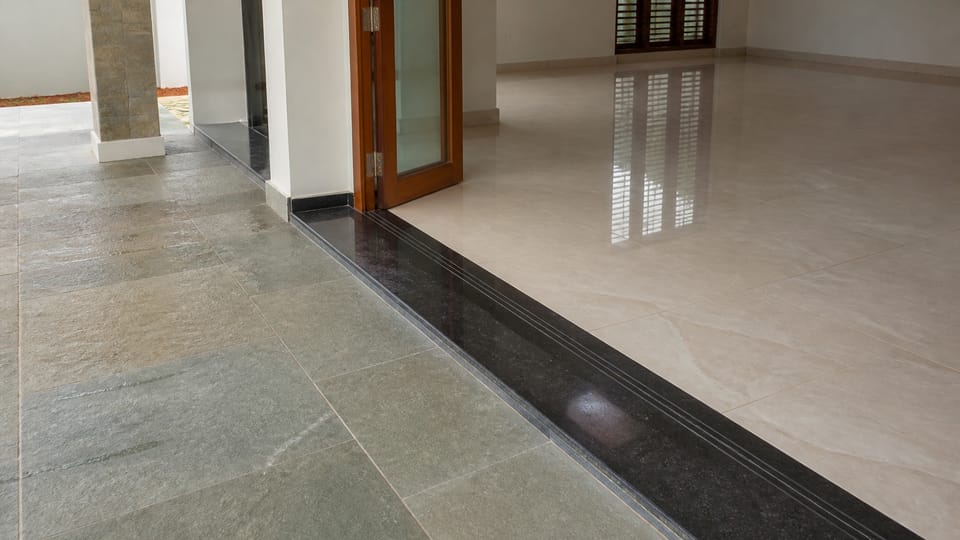
What are the types of flooring used in Indian houses? There is no single count. By material, Indian houses mainly use cement concrete, terrazzo, ceramic and vitrified tiles, natural stone (marble, granite, Kota and similar) and wood. By method, some floors are made in place (cement concrete, terrazzo) and others are laid as ready-made units (tiles, stone slabs, timber). Most are covered by an Indian Standard, but we found none that names Kota stone. The base under the floor matters as much as the finish.
On this page (12)
- How many types of flooring are there?
- What does each floor type look like in the standards?
- What is a cement concrete (IPS) floor?
- What is terrazzo, and is it the same as a cement tile?
- Is vitrified tile different from ceramic tile?
- What is natural stone flooring?
- What about wood, laminate and vinyl?
- What should I check before any floor goes down?
- What mistakes should I avoid?
- Frequently asked questions
- Related guides
- Sources
Shops and websites list many floor names, and the count changes from page to page. This guide sorts them into a few groups, says what each one is, and names the Indian Standard that covers it. It does not rank floors, choose a floor for a room or give prices. Those depend on your house, your base and your engineer.
How many types of flooring are there?
The number depends on how you group them. This page uses two groupings, which are our own way of sorting, not a standard’s.
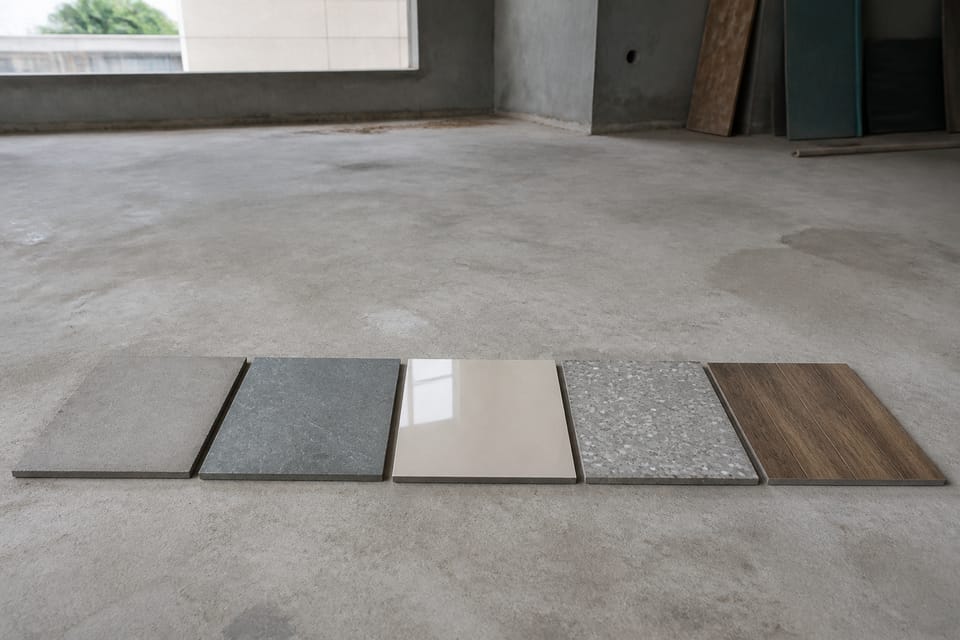
- By material: cement concrete, terrazzo, tiles (cement, ceramic, vitrified), natural stone (marble, granite, limestone including Kota, sandstone) and wood.
- By method: floors made in place (cement concrete, in-situ terrazzo) and floors laid as ready-made units (tiles, stone slabs, timber, vinyl or composite planks).
What does each floor type look like in the standards?
| Floor type | What it is | Indian Standard read |
|---|---|---|
| Cement concrete (often called IPS) | A concrete floor made in place on a base | IS 2571:1970 |
| Terrazzo, in place | Stone chips in cement, ground and polished on site | IS 2114:2018 |
| Cement concrete tiles, including terrazzo tiles | Factory-made tiles of plain cement, coloured cement or chip-in-cement | IS 1237:2012 (tiles), IS 1443:2018 (laying) |
| Ceramic, porcelain and fully vitrified tiles | Fired clay tiles, grouped by how much water they absorb | IS 13712:2019, IS 15622:2017 |
| Marble | Natural stone slabs and tiles | IS 1130:1969 |
| Limestone and sandstone | Natural stone slabs and tiles | IS 1128:1974, IS 3622:1977 |
| Granite (polished) | Natural igneous stone, polished | IS 14223 (Part 1):2023 |
| Hardwood parquet and wood block | Timber floor on a prepared base | IS 5389:1969 |
| Stone-polymer composite (SPC) planks | Factory-made plastic-stone planks and tiles | IS 17897:2022 |
The standards describe the products and how they are laid. None of them says which floor is best, and this page does not either.
What is a cement concrete (IPS) floor?
It is a concrete floor made in place. IS 2571 covers “in-situ cement concrete flooring for non-industrial and light industrial buildings”. It says heavy duty floors and acid and alkali resisting floors are not dealt with.
On finish, IS 2571 says a highly polished concrete floor is likely to be slippery, and a trowel-finished floor is reasonably non-slip. Over ramps and stairs that may get wet, it asks for a chequered finish “to make them non-slip” (clause 5.5.1).
The government specification CPWD 2019 adds a point about workmanship: dry cement or a cement and sand mix must not be used to soak up extra moisture from the wet concrete, and excessive trowelling should be avoided. This is a specification for government works, so read it as good practice for a house, not as a rule.
What is terrazzo, and is it the same as a cement tile?
Terrazzo is stone chips in a cement matrix. It comes in two forms.
- In place: IS 2114 covers in-situ terrazzo floors, skirtings and dadoes. Its foreword says the finish is still adopted in residential and public buildings, and that precautions are needed in laying it “to avoid crack development and consequent trouble in maintenance”.
- As tiles: IS 1237 covers cement concrete flooring tiles of three kinds: plain cement, plain coloured and terrazzo. The standard spells it “terrazo”. Its note says the standard does not apply to chequered tiles.
IS 1237 puts these tiles in two classes by use. General purpose tiles are for light loads in places such as offices, schools, hospitals and residential buildings, usually indoors. Heavy duty tiles are for heavy traffic such as footpaths, ramps, entrances and staircases of public buildings. Shops use other names for cement-chip tiles. That is trade usage, so ask the seller which standard the tile is made to.
IS 1443 describes efflorescence as “patches of whitish scum” from soluble salts, most noticeable on plain tiles.
Is vitrified tile different from ceramic tile?
Yes, and the Indian definition is about water absorption. IS 13712 says a low water absorption tile is also called porcelain tile, and an extremely low water absorption tile is called a fully vitrified tile, which may be glazed or unglazed, and polished or unpolished. The standard groups tiles by absorption:
| Group | Name in IS 13712 |
|---|---|
| B Ia | Ceramic fully vitrified tiles |
| B Ib | Ceramic porcelain tiles |
| B IIa and B IIb | Ceramic floor tiles |
| B III | Ceramic wall tiles |
Two cautions. First, vitrified does not mean zero absorption: the standard says absorption “may vary” with the degree of vitrification. Second, IS 15622 is titled “Pressed Ceramic Tiles” and covers glazed and unglazed pressed tiles for floors and walls. It is not a separate “vitrified tile” standard. For how tiles stack up against an epoxy floor, see epoxy flooring vs tiles for a house.
What is natural stone flooring?
Natural stone is sold as slabs or tiles, and the Indian Standards are written by rock type.
- Marble: IS 1130 defines marble in its foreword as a metamorphic rock formed by the re-crystallisation of limestone or dolomitic limestone, and says marble slabs are used for flooring and stairs. It also says marble is a natural product, so uniformity of colour and veining cannot be guaranteed.
- Limestone and sandstone: IS 1128 covers limestone slabs and tiles for flooring and face work. IS 3622 covers sandstone slabs and tiles for flooring, roofing and face work.
- Granite: IS 14223 (Part 1):2023 covers polished granite and similar igneous stones that are traded as granite. Its text does not mention floors.
- Kota stone: CPWD lists Kota stone flooring as its own item: slabs “of selected quality, hard, sound, dense and homogeneous” with the top face polished. None of the standards read names Kota stone. Do not assume it is granite or marble. Ask the supplier which standard the slabs are sold to.
What about wood, laminate and vinyl?
For solid timber, IS 5389 covers hardwood parquet and wood block floors. Its foreword names halls such as auditoria, squash courts and skating-rinks, so it is not written for an ordinary house floor. It still has points an owner can use: termite protection for timber floors “particularly to the ground floor” (clause 5.3), a damp-proof layer, which clause 5.4 says may prevent the entry of ground moisture, and no mixing of timbers of different hardness, to avoid uneven wear (clause 4.1.1). Mosaic parquet is not covered. CPWD says floor timber is seasoned and treated with preservative.
We found no Indian Standard for laminate or engineered wood floors, and CPWD has no item for them. Ask the seller for the product data sheet and a written warranty. IS 17897:2022 exists for stone-polymer composite (SPC) flooring tiles and planks.
What should I check before any floor goes down?
These checks apply to every floor type. The first three come from the standards and the CPWD specification we read, and the rest are practice.
- Damp from below or from the walls. IS 2571 says that where dampness may reach the floor, a more effective damp-proof treatment shall be given under the floor. See the damp-proof course guide.
- Slope in wet areas. CPWD asks for a “tile drop” in bath, toilet, kitchen and balcony in addition to the slope, and says bathroom floors are laid only after the WC and floor traps are fixed. Waterproofing comes first: see bathroom waterproofing.
- Hollow sound. CPWD says a finished tile floor “shall not sound hollow when tapped with a wooden mallet”.
- Practice, not a standard rule: ask for a sample of the exact batch, check that delivered pieces match it, and ask the engineer whether the heavier finishes suit your slab.
What mistakes should I avoid?
These are practice, not code rules.
- Choosing the finish before checking the base, the damp and the slope.
- Using a smooth, polished surface in places that get wet and have no anti-slip option.
- Taking a trade name such as “mosaic” as a guarantee of a standard.
- Fixing a floor over a damp slab.
- Mixing different batches of tile or stone in one room.
Frequently asked questions
How many types of flooring are there in India?
There is no fixed number. Sorted by material, the main groups are cement concrete, terrazzo, tiles, natural stone and wood. Sorted by method, a floor is either made in place or laid as ready-made units.
What is the difference between vitrified and ceramic tiles?
IS 13712 separates them by water absorption group. Fully vitrified and porcelain tiles absorb very little water. Ceramic floor tiles absorb more. The standard does not say any group is better for every use.
Is Kota stone granite?
Do not assume so. The standards read do not name Kota stone, and CPWD lists it as its own flooring item. Granite in IS 14223 is an igneous stone. Ask the supplier what the stone is and which standard it is sold to.
Is terrazzo the same as mosaic?
Trade usage differs. The standards read call the products terrazzo (in place or as tiles) and cement concrete tiles; the word “mosaic” appears only in IS 5389, for a timber parquet floor. Ask the seller which standard the product meets.
Is there an Indian Standard for laminate flooring?
We did not find one for laminate or engineered wood. IS 5389 covers hardwood parquet and wood block, and IS 17897 covers stone-polymer composite planks.
Related guides
- Epoxy flooring vs tiles for a house: where each works
- Bathroom waterproofing: steps and the ponding test
- Exterior wall tiles: how to fix them so they do not fall off
This guide is general information. Read the disclaimer. Your engineer decides the base and the floor for your house.
Sources
- IS 2571:1970, Code of practice for laying in-situ cement concrete flooring (clauses 1.1, 5.5, 5.5.1, 5.8, 5.8.1). Valid per the BIS record.
- IS 1237:2012, Cement Concrete Flooring Tiles: Specification (clauses 1, 3.3, 4) and IS 1443:2018, Laying and Finishing of Cement Concrete Tiles: Code of Practice (clause 3.1.2).
- IS 13712:2019, Ceramic Tiles: Definitions, Classifications, Characteristics and Marking (clauses 3.1, 4.2) and IS 15622:2017, Pressed Ceramic Tiles: Specification (scope).
- IS 2114:2018, Laying in-situ terrazzo floor finish: Code of practice (scope and foreword).
- IS 1130:1969, Marble (blocks, slabs and tiles); IS 1128:1974, Limestone (slabs and tiles); IS 3622:1977, Sandstone (slabs and tiles). Scope and foreword only.
- IS 14223 (Part 1):2023, Polished Building Stones: Granite and Similar Stones (scope and foreword). The text does not mention floors.
- IS 5389:1969, Code of practice for laying of hardwood parquet and wood block floors (clauses 1.2, 4.1.1, 5.3, 5.4 and foreword).
- CPWD Specifications 2019 Vol 1, Sub Head 11 Flooring (11.2, 11.10, 11.15, 11.17, 11.21, 11.25). A specification for government works, used here as a description of traditional practice, not as a rule for a private house.
General information only. It is not a structural design or professional advice. Ask a licensed structural engineer or architect to check your plans and site.