
Short answer
Why does a metal sheet roof leak and how do I fix it? Leaks usually start at laps that are too short or open, at fixings with failed washers, and at wall, ridge and gutter junctions. IS 12093 asks for holes in the crown of the corrugation, drilled not punched, washers matched to the bolt and nuts tightened from above. Trace the water path first, then repair the cause. Roof work is a fall risk: ask a professional.
On this page (8)
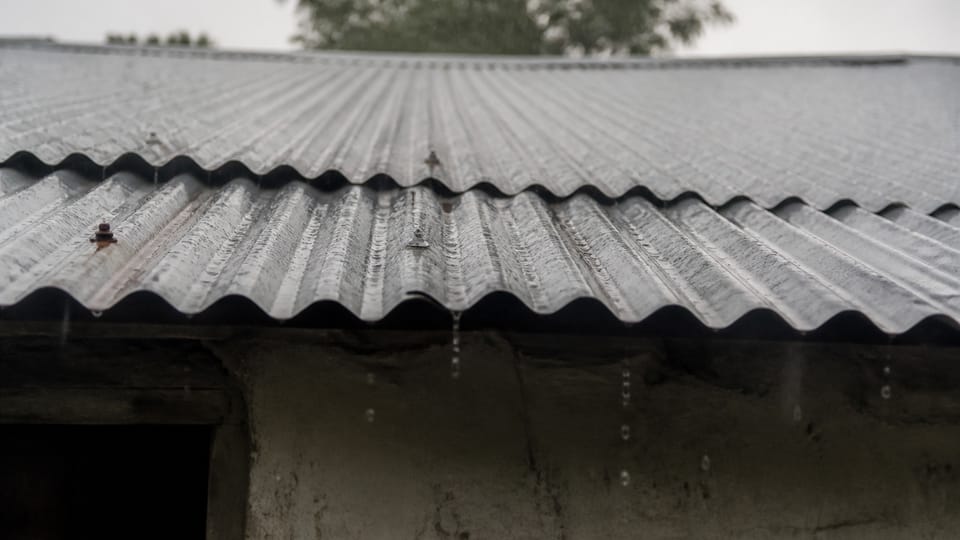
A metal roof leaks in three usual places: at the overlaps between sheets, at the fixings that go through them, and at the junctions with walls, ridges and gutters. This page reads what the Indian code for laying galvanized steel sheet roofs and the CPWD specification say, so you can judge whether your roof was laid properly. The standards describe new work. They have no clause on repairing a leak, so the repair steps here are practice, not code. It gives no brands, no prices and no purlin or truss design. For the sheet material itself, see metal roofing sheets: GI vs Galvalume vs colour-coated.
What do the codes say about laying a metal sheet roof?
IS 12093:1987 covers “plain and corrugated galvanized steel sheets”. It is a code of practice for laying and fixing, and we read it as not covering other sheet materials. It has no clause on maintenance, inspection or repair, and gives no minimum roof slope. The main points for leaks are these.
| Item | What the code says | Source |
|---|---|---|
| Laps | Minimum end lap of 150 mm and side lap of two corrugations; laps may be increased | IS 12093 cl 4.3 |
| Laps (CPWD) | End lap 15 cm, and 20 cm on slopes flatter than 1 vertical to 2 horizontal; two ridges of corrugations at each side | CPWD 12.1.4.3 |
| Minimum slope | A roof is not to be flatter than 1 vertical to 5 horizontal | CPWD 12.1.3 |
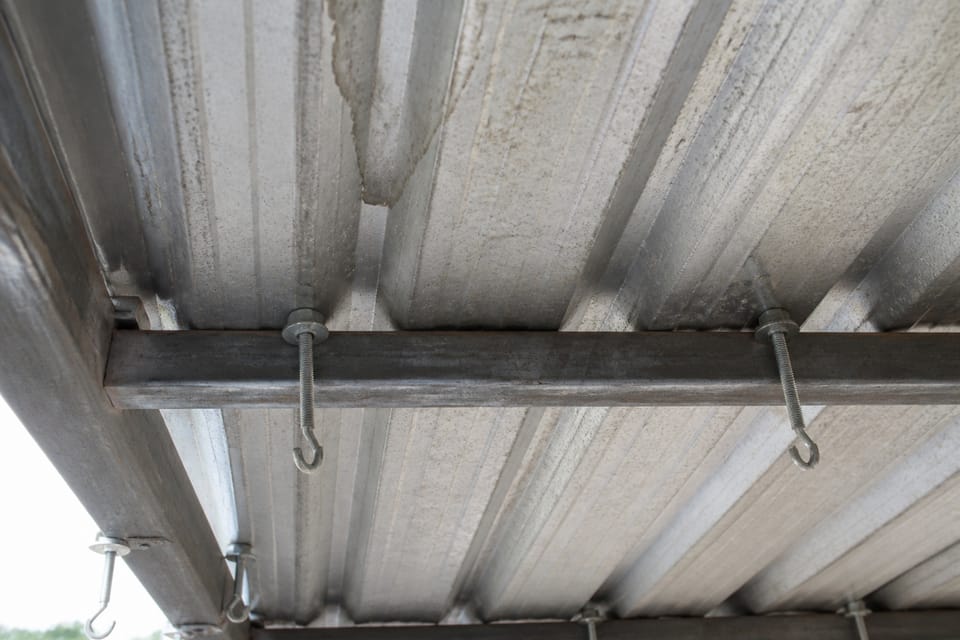
| Permanent fixing | By J or L hook bolts; the bottom layer is laid temporarily with nails | IS 12093 cl 5.2 |
| Holes | In the crown of the corrugations, drilled and not punched | IS 12093 cl 5.6 |
| Washers | Washer holes of the exact diameter of the hook bolt; a bitumen washer and a limpet washer with the nut (Fig. 1) | IS 12093 cl 5.6 and Fig. 1; CPWD 12.1.4.7 |
| Tightening | “The nuts shall be tightened from above to give a leak-proof roof” | IS 12093 cl 5.6 |
| Bolts, nuts and washers | Galvanised | IS 12093 cl 2.2 |
| Side laps on low slopes | Sheets joined at the side laps by galvanised seam bolts with bitumen and limpet washers, where the slope is less than 1 vertical to 2.5 horizontal | CPWD 12.1.4.9 |
| Lap painting | Laps painted with steel primer and two coats before the sheets are fixed | CPWD 12.1.4.4 |
| Wall junction | Sheets not built into gables and parapets; bent up along the wall and protected by flashing, or bitumen mastic “gola” (IS 12093) or a projecting drip course (CPWD) | IS 12093 cl 5.6; CPWD 12.1.4.5 |
| Gutter bolts | The connecting bolts shall be above the water line | CPWD 12.4.3.4 |
The two documents give different numbers in places: for example IS 12093 gives a 150 mm ridge lap and CPWD 12.1.4.3 gives 20 cm for ridge, hip and valley laps, and the end laps differ. So these are minimums for new work in each text and should not be merged into one rule. Your engineer or the sheet maker’s fixing sheet decides the lap for your slope. IS 12093 gives two different maximum bolt spacings in its clauses 5.3 and 5.4, and its bolt projection differs from CPWD’s, so we print no spacing.
What about screws and U-bolts?
IS 12093 specifies J or L hook bolts for permanent fixing. Its clause 2.3 mentions screws only “where used for plain sheet”. CPWD 12.1.4.7 says “Coach screws shall not be used for fixing sheets to purlins”, and uses J hooks for angle-iron purlins and L hooks for R.S. joists, timber or precast concrete purlins. Neither text addresses the self-drilling roofing screws that some sheet makers supply as a system: if your roof uses them, follow that maker’s fixing sheet and ask your engineer.
IS 730:2021 is the product standard for hook bolts. It covers J, L and U types, and leaves the coating “as specified by the purchaser”, so ask for galvanised bolts. IS 15498:2023 clause 4.2 c prefers U-bolts to J-bolts “wherever asbestos sheets are used”, in its guidelines for semi-engineered cyclone-resistant buildings. That is for asbestos sheets, and not a rule for metal sheets.
How do I find where it leaks?
This is practice, not a standard.
- Look from inside in daylight and after rain for the wet stain, then follow the water uphill. Water can run along a purlin or the underside of a sheet before it drips, so the drip is rarely directly under the hole.
- Check the usual places first: sheet laps, fixing points, the ridge, the wall junction, valleys and gutters.
- A hose test, one zone at a time from the low end upwards, can narrow it down. Do it only with someone at the inside to watch.
- Rule out condensation. A drip on a cool morning or with no rain, with no stain trail from a lap or fixing, can be condensation on the underside. No standard we read covers it. See damp walls: rising damp, seepage or condensation for the idea.
How do I fix a leak?
None of the codes give a repair method, so what follows is general practice. Ask your engineer or roofer, and ask the sheet maker before using any product on a coated sheet.
- Fixing leaks: replace a blown-out or backed-out fastener rather than reusing the hole, with the washer set so the sheet is not dimpled. Over-tightening crushes a washer. IS 12093 asks for nuts tightened from above, and sets no torque.
- Lap leaks: a lap that has opened, or a low-slope roof with no side-lap bolts, may need re-fixing so the sheets draw together. A sealing strip or tape in the lap is a common repair, but we found no standard on it, so ask for a product the sheet maker approves.
- Holes and rust: a rusted-through sheet is a reason to replace the sheet, not to patch repeatedly. A patch over spreading rust hides the problem. IS 12093 shows a bitumen washer in Fig. 1 and names a bitumen mastic gola at wall junctions, and CPWD specifies bitumen washers, but neither covers patching a leak with bitumen, so ask the sheet maker whether a product suits your coated sheet.
- Wall and ridge junctions: check the flashing, the gola or drip course and the ridge laps.
- Gutters: blocked gutters and valleys push water back under laps. See the pre-monsoon checklist.
- Safety: metal sheets are slippery when wet and are not made for walking. Do not climb a wet or rusted roof, work alone or work near power lines. See roof tiles vs metal sheets vs RCC slab for the point that a pitched sheet roof is not built for walking.
What mistakes should I avoid?
These are practice, not code rules.
- Tracing the leak to the stain below and not following the water uphill.
- Tightening a fastener until the washer is crushed.
- Reusing a blown-out hole with the same screw or bolt.
- Smearing sealant or coating over a wet, dusty or rusty surface.
- Sealing only a fastener when the lap is open.
- Fixing in the valley of the corrugation, when IS 12093 says the crown.
- Leaving gutters, valleys and flashing unchecked before the monsoon.
- Walking on wet or old sheets.
Frequently asked questions
How much should metal roof sheets overlap?
IS 12093 gives a minimum end lap of 150 mm and a side lap of two corrugations for new work. CPWD gives a longer end lap on flatter slopes. Your engineer or the sheet maker decides for your roof.
Why does my roof leak at the screws or bolts?
A hole may have been made in the wrong place, the washer may have hardened or been crushed, the fastener may have backed out, or the sheet around it may have rusted. IS 12093 asks for holes in the crown, drilled and not punched, with matching washers.
Can I just tighten the nuts or screws?
A gentle re-seat can help, but over-tightening damages the washer. IS 12093 asks for the nut to be tightened from above and gives no torque. Replace a failed washer or fastener.
Is a hook bolt better than a self-drilling screw?
IS 12093 and CPWD specify hook bolts for galvanized corrugated sheet, and CPWD bars coach screws. Self-drilling screws are a sheet maker’s system for some profiles: follow the maker and your engineer.
Can I use bitumen or tar on a leak?
IS 12093 shows a bitumen washer and names a bitumen mastic gola at wall junctions, and CPWD specifies bitumen washers, but we found no standard on patching a leak with bitumen or tar. Ask the sheet maker, especially for coated sheets.
Related guides
- Metal roofing sheets: GI vs Galvalume vs colour-coated
- Roof tiles vs metal sheets vs RCC slab
- Pre-monsoon checklist for house and site
This guide is general information. Read the disclaimer. Your engineer or roofer decides the repair for your roof.
Sources
- IS 12093:1987, Code of Practice for Laying and Fixing of Sloped Roof Covering using Plain and Corrugated Galvanized Steel Sheets: clauses 1.1, 2.2, 2.3, 4.3, 5.2, 5.6, 6.1 and Fig. 1 (page images read). It is a laying code for new work and has no maintenance, repair or minimum-slope clause. BIS lists it as not withdrawn; it cites older editions of IS 277 and IS 730.
- IS 730:2021, Hook Bolts for Corrugated Sheet Roofing (third revision): scope, clauses 3 and 9.1 and the Foreword (page images read).
- CPWD Specifications 2019 Vol 1, Sub Head 12.0 Roofing: clauses 12.1.3, 12.1.4.3, 12.1.4.4, 12.1.4.5, 12.1.4.7, 12.1.4.9, 12.1.6 and 12.4.3.4 (page images read). A government works specification, used as practice.
- IS 15498:2023, Improving the Cyclonic Resistance of Low Rise Houses and other Buildings, Guidelines: clause 4.2 c (page image read).
General information only. It is not a structural design or professional advice. Ask a licensed structural engineer or architect to check your plans and site.