
Short answer
What is the difference between a pile integrity test and a pile load test? A low strain integrity test (IS 14893:2021) taps the pile head and reads echoes to judge the shaft's continuity and shape; it does not give load capacity. A load test (IS 2911 Part 4:2013) pushes on the pile with a jack against dead weight or anchors and measures how it moves under load. They answer different questions; the engineer chooses which, and on how many piles.
On this page (10)
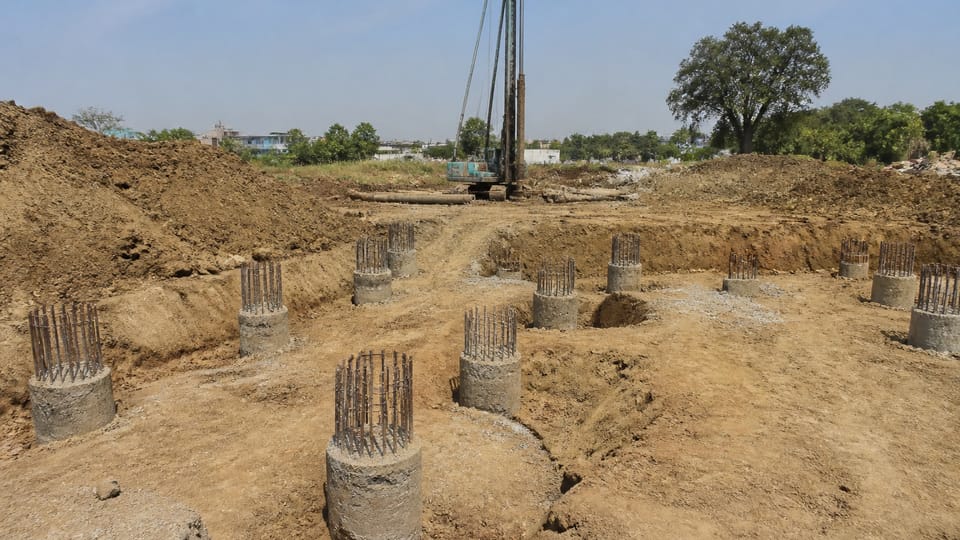
A pile is a deep column under the house, and once it is cast it is hidden underground. So it is checked after casting, and two different tests are used. This page explains them from the Indian standards, what each can and cannot tell you, and what to ask your engineer. It prints no test load, settlement limit, number of piles or waiting period, and no pass or fail rule for owners: the engineer specifies the tests and interprets them. For when a house needs piles, see pile foundations: when a house needs them and how piles are checked.
What is a pile integrity test?
IS 14893:2021 gives guidelines for low strain integrity testing by the pulse-echo method on the concrete piles covered by IS 2911 Part 1 sections 1 and 2. It defines integrity testing as a method of “qualitative evaluation of the physical dimensions (cross-sectional variation), soundness or defects of pile’s concrete with respect to its continuity” (clause 3.1). On site, “a small plastic/nylon/polycarbonate/tip hammer is used to produce a tap on the top of the pile”, and the stress wave travelling down the pile is reflected back from the toe and recorded by a transducer held on top (clause 5.1.1). Imperfections within the length “set up secondary reflections” (clause 5.1.2). The Foreword says the method gives information about “continuity and defects such as cracks, necking, soil incursions and changes in cross-section”.
The standard is just as clear about the limits: it “does not provide the load carrying capacity of piles” and none about verticality or position (clauses 8.1 and 8.2); the toe reflection may be insufficient in very long piles or with high skin friction (clause 8.3); its basic purpose is to identify major defects, and minor deficiencies may stay undetectable (clause 8.4); and it “may not also determine bulges in case of under-reamed piles” and is not suitable for jointed precast or steel piles (clause 1.2). The Foreword adds that it “is not intended to replace the use of static load testing”, and that the routine vertical load tests on working piles “do not provide direct information on structural integrity of piles”. Trained and experienced personnel are to perform and interpret the tests (clause 5.2.9), and the Foreword says it is for the Engineer-in-charge to decide whether the results point to defects that matter.
What is a pile load test?
IS 2911 (Part 4):2013 says “pile load test is the most direct method for determining the safe loads on piles”, more reliable than capacities computed by other methods because it is an in-situ test, and admits the difficulty of fixing an acceptable criterion (Foreword). It covers vertical (compression), lateral and pull-out tests (clause 1.1). In the common vertical test the load is applied “by means of a hydraulic jack against rolled steel joist or suitable load frame with adequate kentledge” (dead weight used for applying a test load, clause 3.9), or against anchor piles or rock anchors (clauses 7.1 and 7.1.3), and the settlement is read on dial gauges or displacement transducers (clause 7.1). Time, load and displacement are recorded and the load-displacement curve is an essential part of the presentation of the data (clause 10).
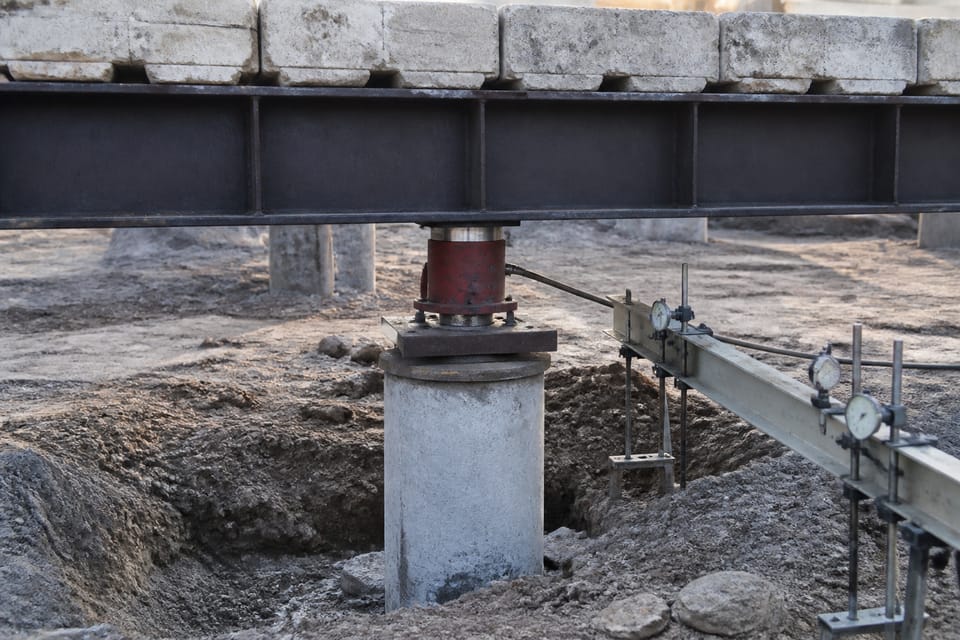
There are two kinds (clause 5): the initial test on a test pile that is not a working pile, to find the load capacity and set limits for the routine tests (clause 5.1), and the routine test on a working pile, “to check whether pile is capable of taking the working load assigned to it without exceeding permissible settlement” (clause 3.11). Working piles for routine tests are preferably chosen on the basis of things such as abnormal concrete consumption, boring problems, depth variation against the boring record, driving anomalies, piles under sensitive locations and “any doubt arising from non destructive test results” (clause 5.2.1). That is the link between the two tests.
How do the two tests compare?
| Integrity test (IS 14893:2021) | Load test (IS 2911 Part 4:2013) | |
|---|---|---|
| What it checks | Continuity and shape of the pile shaft, qualitatively | How the pile moves under load |
| How it is done | A hammer tap on the pile head and a sensor reading the echo | A jack pushing against dead weight or anchors, with gauges |
| Gives load capacity? | No (clause 8.1) | Yes, the standard calls it the most direct method |
| Replaces the other? | Not intended to replace static load testing | IS 14893’s Foreword notes that routine vertical load tests on working piles give no direct information on structural integrity |
| Who decides how many piles | The Engineer-in-charge (clause 7.7) | The code sets a share of piles (Part 4 clauses 5.1.1 and 5.2, not printed here); the engineer specifies the plan |
| Interpreted by | Trained and experienced personnel (clause 5.2.9); the Engineer-in-charge decides what the results mean (Foreword) | A geotechnical engineer (NBCS clause 9.3.3.1, in its combined piled-raft design steps) |
IS 14893 clause 7.1 says the piles are trimmed to cut-off level with laitance removed before the test and that no pile cap blindage work should be undertaken before it; NBCS clause 8.2.6 says an integrity test “may be carried out prior to laying of beam/caps”. The standards do not say that a routine load test must come before the cap.
What do the standards not say?
- A pass or fail rule for an owner. IS 14893 sorts results into report categories and says (Foreword) that final rejection of a pile may not rest on integrity testing alone and may be confirmed by static load tests and, where possible, by excavation or coring; the Engineer-in-charge decides.
- How many piles a house needs tested. The integrity count is left to the engineer; the load-test share is in IS 2911 Part 4 clauses 5.1.1 and 5.2 and is not printed here.
- A cost or a time for either test.
- That one test is enough: a test on some piles does not speak for all.
What should I ask the engineer or contractor? (practice)
This is practice, apart from the clauses named.
- Which tests are specified, on how many piles, and why?
- Who performs the tests, and who witnesses them for me?
- What is the pile number, cast date and test date in each report?
- Will I receive signed reports, and can I keep copies?
- What happens if a result is doubtful? Ask before work starts.
What mistakes should I avoid? (practice)
- Treating an integrity test as proof of capacity.
- Skipping tests to save time.
- Accepting a contractor-only report with no pile numbers or dates.
- Casting the pile cap before the results are reviewed.
- Ignoring a doubtful result, or assuming a test on one pile covers all.
What can I check myself? (practice)
That the engineer is present at the test, that the report names the pile and the date, and that you hold copies. Stay clear of a loaded test rig.
Frequently asked questions
Does an integrity test show the pile’s load capacity?
No. IS 14893 clause 8.1 says it does not provide the load carrying capacity of piles.
Is a load test only for big buildings?
The standards we read do not limit load tests by building size. IS 2911 Part 1 section 2 clause 6.3.1 says pile capacity “should preferably be confirmed by initial load tests”; the engineer specifies them.
Can I read the integrity test graph?
No. The standard asks for trained and experienced personnel, and the engineer interprets the results.
What if a pile result is doubtful?
The standards leave it to the engineer. A load test, coring or excavation may be used to decide. Ask before work starts.
Is a good integrity result enough?
No. It may miss minor defects and gives no capacity.
Related guides
- Pile foundations: when a house needs them and how piles are checked
- Soil test before building a house: what it is and why it matters
- Safe bearing capacity of soil explained: SBC, ultimate and allowable
- Pile cap vs footing: what a pile cap is and what it does
This guide is general information. Read the disclaimer. Your geotechnical or structural engineer specifies and interprets the pile tests for your house.
Sources
- IS 14893:2021, Low Strain Non-Destructive Integrity Testing of Piles, Guidelines (first revision): Foreword and clauses 1.1, 1.2, 3.1, 5.1.1, 5.1.2, 5.2.9, 7.1, 7.7 and 8.1 to 8.4 (text checked against the page images). BIS lists it as in force, valid to 2031-03-31. The 2001 edition is withdrawn.
- IS 2911 (Part 4):2013, Design and Construction of Pile Foundations, Code of Practice, Part 4 Load Test on Piles (second revision): Foreword and clauses 1.1, 3.9, 3.11, 5, 5.1, 5.2, 5.2.1, 7.1, 7.1.3 and 10 (page images read). BIS lists it as in force, valid to 2028-11-30.
- National Building Code of India, Second Revision (NBCS 2026, SP 7:2026), Part C Section 2 Soils and Foundations: clauses 8.2.6 and 9.3.3.1 (page images read). Its bracketed reference tags for the load test and the integrity test do not match its own reference list, so this page cites the standards by name and clause.
- IS 2911 (Part 1/Sec 2):2010, Design and Construction of Pile Foundations, Code of Practice, Part 1 Concrete Piles, Section 2 Bored Cast In-situ Concrete Piles (third revision): clause 6.3.1 (text). BIS lists it as in force, valid to 2030-05-31.
Change log
- : Added Related guides link to newly published article(s): pile-cap-vs-footing-what-a-pile-cap-is-and-what-it-does. No other text changed. Approved by the reviewing engineer.
General information only. It is not a structural design or professional advice. Ask a licensed structural engineer or architect to check your plans and site.