
Short answer
What is a plate load test on a house plot, and what does it tell the engineer? A plate load test loads a steel plate set at foundation level in a pit and records how the soil settles. IS 1888:1982 gives the method. The result is a load-settlement curve for a small area and limited depth. The engineer turns it into a safe bearing pressure with a factor of safety and a settlement check, so the plate test is not the bearing value by itself.
On this page (12)
Before a foundation is designed on a plot, the engineer wants to know how the soil under it will carry the load. A plate load test is one way to find out. It loads a steel plate on the soil at foundation level and watches how far the soil settles. This page explains how the Indian method, IS 1888, sets up and runs the test, what the test can and cannot tell you, and what the engineer does with the result.
The page gives no plate size, load step, settlement limit, pit size or safe bearing value. Those are for the engineer and the soil lab.
What does the standard say the test is for?
IS 1888 says it “lays down the method for conducting load test for estimation of bearing capacity of soils and its settlement” (clause 1.1). The foreword adds that the test finds the ultimate bearing capacity of the soil in place, and that it assumes the soil layers are reasonably uniform (foreword 0.2). The same test can also give the modulus of subgrade reaction, which is used in raft foundations and pavements.
The standard does not say that the test gives the bearing pressure directly. The load-settlement curve is what the test gives.
What are the limits of the test?
The standard is clear about its limits:
- Depth. The test reflects only the soil within a depth of less than twice the width of the plate (foreword 0.3).
- Settlement. The method does not give the ultimate settlement, particularly in clay (foreword 0.3).
- Exploration. A satisfactory load test should include adequate soil exploration under IS 1892, with attention to any weaker layer below the foundation (foreword 0.3).
- Size. In clay, the bearing capacity is nearly the same for a small plate and a larger footing. In dense sand, a larger footing gives a higher value, so a small plate tends to give a conservative result. The standard says it may be necessary to test with plates of several sizes, and the results are extrapolated to the real footing size (foreword 0.4).
Guidance notes add that a plate test on sand should not be relied on for the ultimate capacity because of scale effects, and that a short test does not predict the long-term settlement of clay (NPTEL). These are guidance, not standard text.
What is the apparatus?
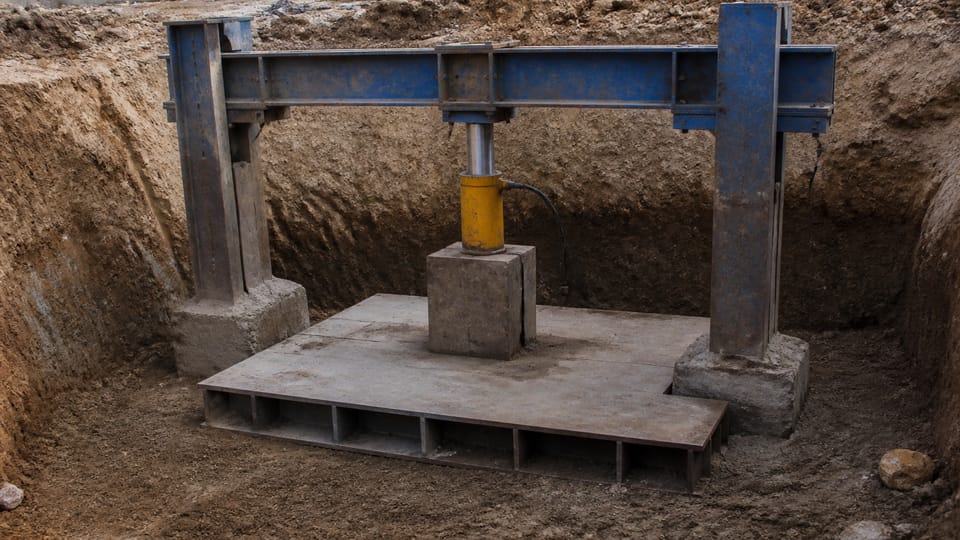
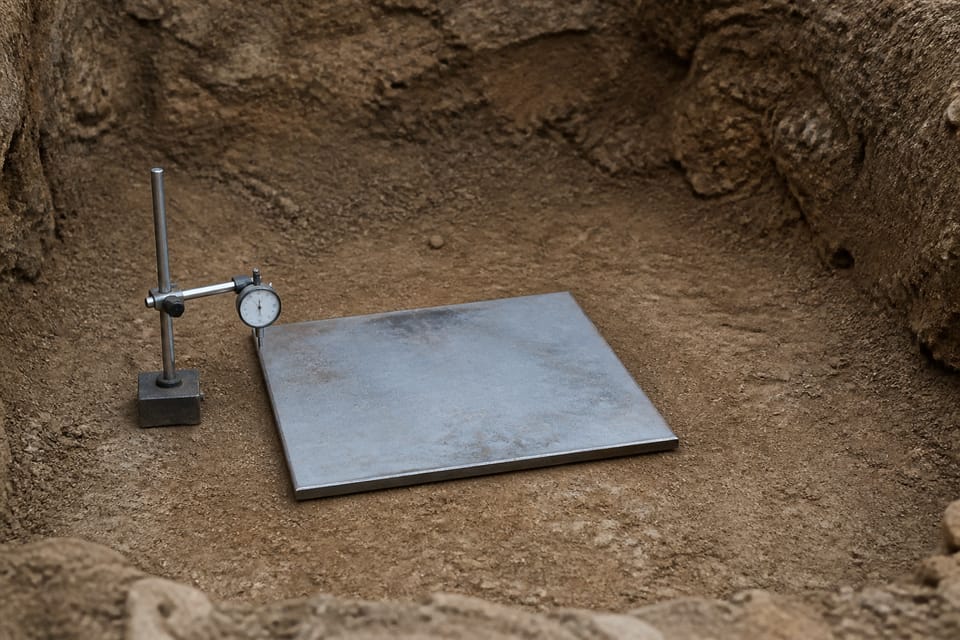
The test uses a loading frame or a loaded platform, a jack with a calibrated load-measuring device, a steel bearing plate, and dial gauges on a datum beam. The plate is a thick steel plate of a size chosen for the soil, with a chequered or grooved bottom. The settlement is read on dial gauges that measure to a fine fraction of a millimetre (clauses 3.1 to 3.6). Precast or in-situ concrete blocks may be used in place of a steel plate (clause 3.3).
How is the test run?
Clauses 4.1 to 4.7 describe the procedure in outline:
- Choose the location. The test is done at the proposed foundation level, under the worst estimated conditions. If the water table is within about one plate width of the test level, the test is run at the water-table level. If it is higher, the water is pumped down to the test level through a sump away from the plate. For cohesionless silt and fine sand, which cannot be drained this way, the test is run at the water-table level (clause 4.1).
- Dig the test pit. The pit goes to the foundation level, and its bottom is levelled, cleaned and protected from disturbance (clause 4.2).
- Set up the frame and the plate. The reaction is kept well clear of the test area. The plate is centred, levelled and seated under a small seating load before the test begins. The dead load of the equipment is recorded (clauses 4.3 and 4.5).
- Load in steps. The load is applied in equal increments without impact, and each step is held while the settlement is read at set times (clauses 4.6 and 4.7).
- Stop the test. The test continues until a settlement limit set in the standard or failure occurs, whichever is earlier. The standard gives the limit in the clause; this page does not repeat it (clause 4.7).
How is the curve read?
Clause 5.1 says the load-settlement curve is plotted, and the readings are corrected for the seating of the plate. Clause 5.1.1 describes four curve shapes, for loose to medium cohesionless soil, cohesive soil, partly cohesive soil and dense cohesionless soil. Clause 5.2 says the ultimate bearing capacity is read from the failure point, which is clear for dense cohesionless or cohesive soils. For the other soils, the standard uses a log-log plot to find a yield value.
The standard also says that the test pit is excavated below the plate to twice the plate dimension to examine and record the subsoil profile (clause 6.2). The safe bearing pressure is then worked out from the curve, and the standard scales the plate settlement to the footing settlement under clause 5.3. The formula is the engineer’s to apply, and the standard gives the safe-pressure reading for medium and dense sands only.
What does the engineer do with the result?
The test gives a load-settlement curve for a small plate.
| What the test gives | What the engineer adds |
|---|---|
| A load-settlement curve for a small plate | The choice of the failure point, which is a judgement except in dense cohesionless or cohesive soils |
| The settlement of that plate under each load step | A factor of safety to get a safe value |
| The soil behaviour near the test level, to about twice the plate width | Scaling to the size of the real footing |
| Corrected readings and the curve type | A check of the real footing’s settlement against the building’s limit |
Source: IS 1888:1982 clauses 5.1 to 5.3, with the engineer’s role as practice. The engineer:
- chooses the failure point on the curve, which is a judgement except in dense cohesionless or cohesive soils;
- applies a factor of safety to get a safe value;
- scales the result to the size of the real footing;
- checks the settlement of the real footing against the limit for the building; and
- checks for a weaker layer under the foundation level.
Settlement often controls the choice, and the test result is one input among the soil data.
Inline image
What should I ask?
These questions are practice, not steps in the standard.
- Who runs the test, and under whose instruction? Ask for the name of the soil laboratory and the engineer who uses the result.
- Where is the pit, and is it at the planned foundation level? A test above or below that level does not represent the foundation.
- Does the report give the full load-settlement curve? The standard asks for the time, load and settlement for each test, the test level, the water table, the pit profile and the plate size (clause 6.1).
- Has the engineer used the result for the design? Ask how the safe pressure was worked out and what controlled the choice.
- Is the soil uniform down to about the width of the foundation? If not, the test may miss a weaker layer below it.
- If the soil is clay, has settlement been assessed separately? The test is short and does not predict long-term settlement in clay.
What mistakes should I avoid?
These are practice points:
- Reading the test as the safe bearing capacity. The engineer applies the factor of safety and the settlement check.
- Treating one test as the whole plot. One test represents the soil near it, not the whole site.
- Testing at the wrong depth. The result is for the level tested, not the level of the foundation.
- Assuming a short test predicts the long-term settlement of clay.
- Using a small-plate result directly for a larger footing without the engineer’s scaling.
- Confusing the test method with the design method. IS 1888 is the method for the test. The design of the foundation is in other codes.
Frequently asked questions
Is a plate load test always needed for a house?
Not always. For many houses the engineer uses the soil investigation, the bore logs and the bearing values the design code gives. A plate test is used where the soil is unclear or the fill is doubtful. In practice it is also used on gravelly soil, where other tests are hard to carry out. The engineer decides.
Does the test show how the house will settle?
It shows the settlement of the small plate under the load. The engineer uses it, with other data, to check the settlement of the real foundation. Long-term settlement in clay needs a separate assessment.
Is IS 1888 the code for foundations?
No. IS 1888 is the method for the load test. The design of the foundation is covered by other codes that the engineer uses, such as the shallow foundation code IS 1080 and the code for the bearing values, IS 6403.
Related guides
- Safe bearing capacity of soil explained: SBC, ultimate and allowable
- Soil test before building a house: what it is and why it matters
- Plot checks before buying: slope, drainage, soil, road and flood risk
- Before the footing concrete: an owner’s checklist for pit and steel
- Plate load test vs SPT vs cone test: which soil test tells what
This guide is general information. Read the disclaimer. Your soil lab and your structural engineer decide the test, the result and the foundation for your house.
Sources
- IS 1888:1982, Method of Load Test on Soils (second revision). Scope 1.1, foreword 0.2 to 0.4, apparatus clauses 3.1 to 3.6, test-location and pit clauses 4.1 and 4.2, procedure clauses 4.5 to 4.7, curve clauses 5.1 and 5.2, and report clause 6.1 read in words. No numeric values are reproduced. BIS record valid to 2026-12-31; check the current edition before publishing.
- NPTEL, Foundation Engineering course notes on plate load tests (guidance on depth of influence, scale effects and consolidation). Guidance, not an Indian standard.
Change log
- : Added Related guides link to newly published article(s): plate-load-test-vs-spt-vs-cone-penetration-test-which-soil-test-tells-what. No other text changed. Approved by the reviewing engineer.
General information only. It is not a structural design or professional advice. Ask a licensed structural engineer or architect to check your plans and site.