
Short answer
What are gravel, sand, silt and clay, and how is each identified in the field? IS 1498 classifies soils for general engineering. Sand and gravel are cohesionless, silt is fine and has little plasticity, and clay is plastic over a moderate to wide range of water content. Simple field tests of dry strength, shine, feel and dilatancy help tell them apart. For foundations the standard gives only qualitative bearing notes; its road tables carry CBR figures that do not apply to a house, so the bearing capacity for your house comes from a soil test by an engineer.
On this page (9)
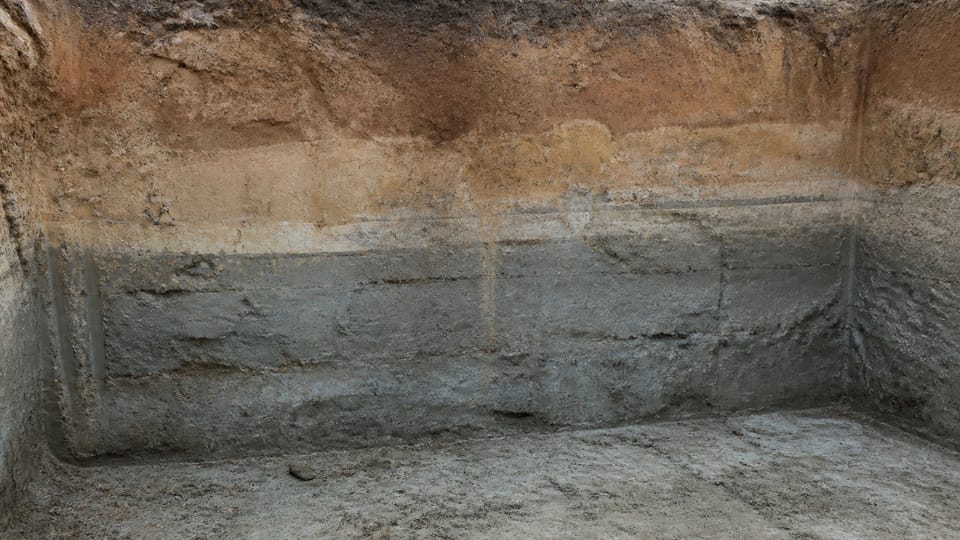
Under every house is soil, and the soil decides how the foundation is designed. People often use the words gravel, sand, silt and clay loosely, but the Indian standard for soil classification, IS 1498, gives them precise meanings. This guide explains those meanings in plain words, the field tests used to tell them apart, and what a soil report should say for a house. It gives no bearing capacity and no safe load. Those come from a soil test and the engineer’s design.
What does the standard say the soils are?
IS 1498 is “a system for classification and indentification of soils for general engineering purposes” (clause 1.1). Its guidance is that the soils are classed “based on those characteristics of the soil which indicate how it will behave as a construction material” (clause 0.3).
The standard gives four simple meanings:
- Clay is “An aggregate of microscopic and sub-microscopic particles derived from the chemical decomposition and disintegration of rock constituents. It is plastic within a moderate to wide range of water content” (clause 2.1).
- Silt is “A fine-grained soil with little or no plasticity” (clause 2.2).
- Sand and gravel are “Cohesionless aggregates of angular, sub-angular, sub-rounded, rounded, flaky or flat fragments of more or less unaltered rocks or minerals” (clause 2.3). The standard splits them by sieve size.
The standard notes that fine soils are classed “not according to particle size but according to plasticity and compressibility” (clause 3.2.2). So silt and clay are told apart by how they behave wet, not only by how fine they feel.
What field tests tell them apart?
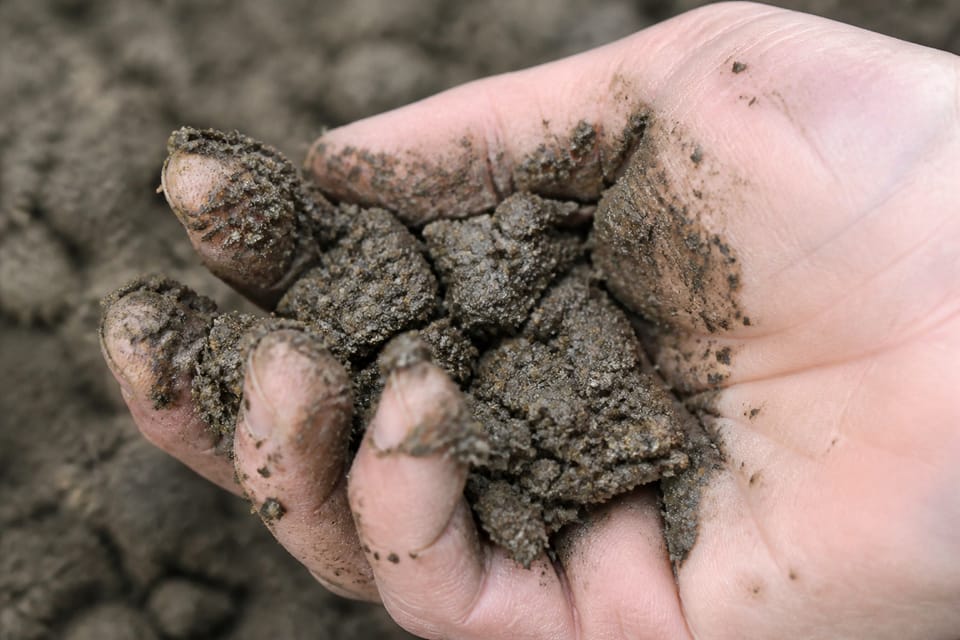
The standard describes simple tests that a trained person can do by hand. These are the tests the engineer or the geologist uses at the site.
- Dilatancy. Shake a wet pat of soil and watch the water come up and go away. The standard calls this “The appearance and disappearance of the water with shaking and squeezing” a reaction, and classes it as quick, slow or no reaction (clause 3.4.6).
- Dry strength. A dry pat is “low, if the dry pat can be easily powdered; medium, if considerable finger pressure is required and high, if it cannot be powdered at all” (clause 3.4.6).
- Shine. “The shiny surface imparted to the soil indicates highly plastic clay, while a dull surface indicates silt or clay of low plasticity” (clause 3.4.6).
- Feel. The standard says that “wet clay sticks to the fingers and dries slowly but silt dries fairly quickly and can be dusted off the fingers leaving only a stain” (clause 3.4.6), and that the feel takes experience.
The numbers used in these tests are in the standard’s clauses and are not printed here.
Does the standard say what each soil can bear?
No, not for a house foundation. The foreword says that soil investigation and classification is done “to evaluate the soil as regards its bearing power to a certain extent” (foreword 0.2). The standard’s table of soil characteristics gives qualitative notes such as “Good bearing value” or “Poor bearing”, and it says that “Design should be based on test results” (Table 6, note 1). Table 5, for roads and airfields, does print CBR percentages and sub-grade modulus ranges; those describe road sub-grades and should not be used for a house.
So a classification from this standard does not give the load a house foundation can carry. That needs a soil test on your site and the engineer’s design.
What should the soil report say?
The standard asks that the group name be “supplemented by detailed word descriptions, including the description of the in-place conditions for soils to be used in place as foundations” (clause 3.4). It describes the in-place condition by moisture, drainage, structure, cementation and compactness or consistency (clause 3.4.10).
The standard’s examples are framed for hydraulic and other structures, so for a house the engineer decides what to test and how deep to dig.
What should I check?
This section is practice, not a code rule.
- The soil report from a test on your plot, with the soil names and the in-place description.
- The depth and number of test pits or borings, as the engineer decides.
- Whether the water table is high in the monsoon, and whether the report says so.
- The foundation design that follows from the report, not a design copied from a neighbour’s house.
- Whether the soil is a black cotton or a clay that swells, which needs its own advice.
What mistakes should I avoid?
This section is practice.
- Naming the soil by eye and building on that name alone.
- Taking the bearing value from a neighbour’s report or a website.
- Digging only the top layer when the engineer asked for the deeper layers.
- Filling a soft patch and building on it without the engineer’s check.
- Building in the rain before the soil report is in.
Frequently asked questions
Is clay always bad for a house?
No. The standard describes soils by their behaviour, and the foundation design depends on the report and the engineer’s decision. Ask for the report before deciding.
Can I identify the soil myself?
The field tests in the standard are simple, but they need experience. Use them to talk to the engineer, not to decide the foundation.
Does the standard give the bearing capacity?
No. For foundations its table gives only qualitative bearing notes, and it says design should be based on test results. Its road table prints CBR figures that do not apply to a house.
Related guides
This guide is general information. Read the disclaimer. Your engineer decides the soil test, the bearing capacity and the foundation for your house.
Sources
General information only. It is not a structural design or professional advice. Ask a licensed structural engineer or architect to check your plans and site.