
Short answer
What is the difference between a 6 A and a 16 A socket? The number is the rated current the socket and its plug are made for. IS 1293:2019 lists 6 A and 16 A, plus a combined 6/16 A socket, and does not let a plug enter a socket of lower current rating. NBCS describes the 6 A socket for light loads not exceeding 100 W and the 16 A socket for domestic appliances not exceeding 2 kW. Your electrician sets the circuit.
On this page (11)
- What does 6 A or 16 A mean?
- Why can’t the plugs be swapped?
- What goes on each size? (NBCS)
- What about shutters and children?
- What do the standards not say?
- What should I ask the electrician? (practice)
- What mistakes should I avoid? (practice)
- What can I check myself? (practice)
- Frequently asked questions
- Related guides
- Sources
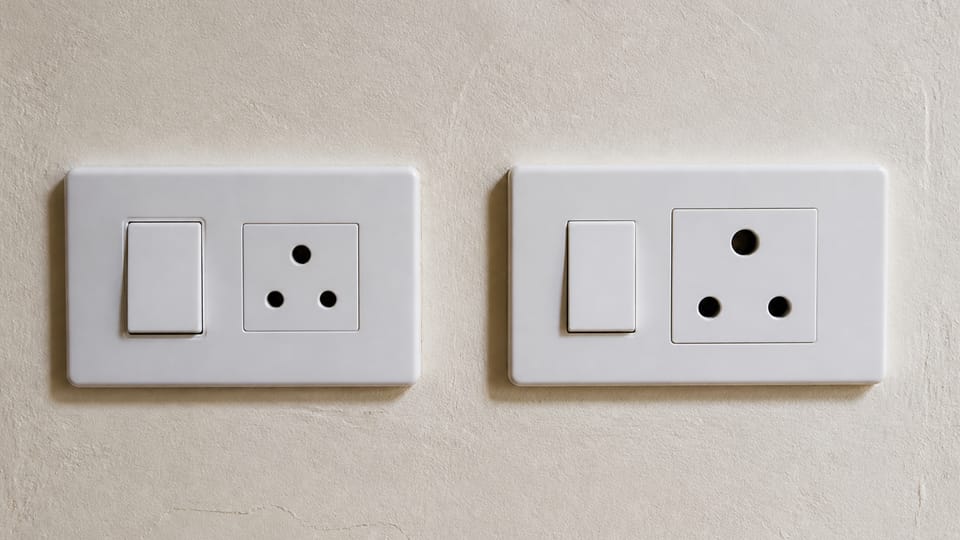
A house has two sizes of three-pin socket and they look alike from a distance. This page explains from the standards what the numbers mean, why the plugs are kept apart, and what NBCS says goes on each, with questions for your electrician. It gives no wire size, breaker rating, pin dimension, price or brand: the electrician sizes each circuit. For where sockets go on the wall, check your drawing and your electrician; this page does not give heights.
What does 6 A or 16 A mean?
IS 1293:2019 defines the rated current as the “current assigned to the plug or socket-outlet by the manufacturer” (clause 3.20). The standard covers plugs and socket-outlets for household and similar purposes, with a rated voltage not exceeding 250 V and a rated current not exceeding 16 A (clause 1). Its Table 2 (clause 6.1), as amended, lists the preferred combinations of types and current ratings: 2.5 A two-pole plugs, and 6 A and 16 A types in two-pole and two-pole-plus-earth forms. The 2019 edition deleted the older 10 A rating, and Amendment 1 added a 6/16 A row for combined socket-outlets to Table 2. So the number is a property of the pair, not of the plate it sits in.
Why can’t the plugs be swapped?
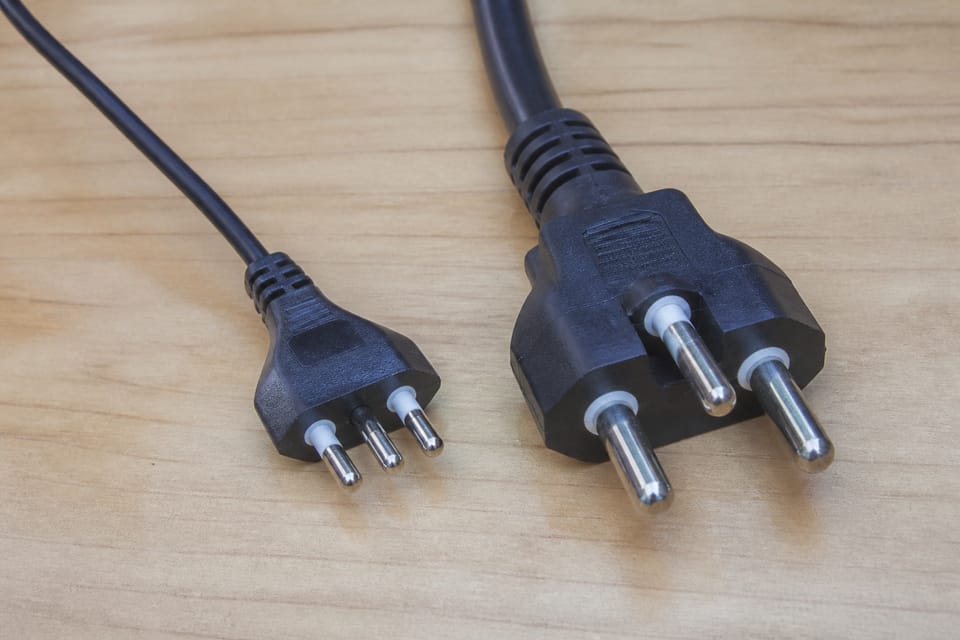
IS 1293 clause 9.2 says it must not be possible, within a given system, to engage a plug with a socket-outlet having a higher voltage rating or a lower current rating. The sizes are kept apart by the shapes in Annex B, which give the pins and the spacing for each rating; this page does not print those dimensions. Two points are worth knowing:
- The clause bars a plug entering a socket of lower current rating. It does not say a lower-rated plug must not enter a higher-rated socket, and the standard’s own combined socket is built to take both.
- The earth pin is longer than the other two (Annex B figure), and clause 11.1 asks that the earth connection is made before the current-carrying contacts become live when the plug goes in, and breaks last when it comes out.
What goes on each size? (NBCS)
NBCS 2026 Part D Section 2, clause 7.3, describes two types of socket-outlet:
| 6 A | 16 A | |
|---|---|---|
| NBCS description | For “light loads not exceeding 100 W”; a 3-pin socket-outlet in which 3-pin plug tops and 2-pin appliances like mobile chargers can be used | “Normally of 16 A capacity”; “recommended for use in respect of domestic appliances not exceeding 2 kW” |
| Load assumed in estimating current (clause 6.1.1) | 100 W | 2,000 W |
For individual air conditioners, clause 7.3 recommends an MCB-controlled socket-outlet for overload protection. Clause 13.4.1.1 asks for a geyser to connect from a 16 A socket-outlet. Kitchens are described as places where “a large number of combinations of 6 A/16 A sockets” would be desirable (clause 13.4.3). The NBCS figure for the combined type is captioned “6 A 3 pin, 6/16 A combined socket-outlet” (Fig. 4). NBCS also says each socket-outlet shall be controlled by a switch, preferably adjacent or combined with it, and that an earth wire is drawn along with the power wiring so that the third pin is effectively earthed. NBCS still mentions “about 10 A” plug tops for the 16 A socket, although IS 1293:2019 has dropped the 10 A rating, so use NBCS’s description as a description, not as a requirement.
What about shutters and children?
IS 1293 classes sockets as with or without shutters (clause 7.2.3); a shutter is “movable part incorporated into a socket-outlet arranged to shield at least the live socket-outlet contacts automatically when the plug is withdrawn” (clause 3.21). Shutters are one construction, not a requirement of IS 1293. NBCS clause 7.3, note 1, says that where a socket-outlet is accessible to children, an interlocked plug and socket, or a socket-outlet that is automatically screened when the plug is withdrawn, is necessary.
What do the standards not say?
- A wire size, circuit size or breaker rating for either socket: the circuit is the electrician’s design.
- How many sockets a room needs, or which brand.
- A pass or fail test at 100 W for a particular appliance on a 6 A socket. NBCS 7.3 describes the 6 A type as for “light loads not exceeding 100 W”; the electrician decides.
The pin dimensions are in IS 1293 Annex B; this page does not print them.
What should I ask the electrician? (practice)
This is practice, apart from the clauses named.
- Which sockets are 6 A and which 16 A, and where? Mark them on the drawing.
- What appliance is each 16 A socket for, and is each heavy appliance on its own circuit?
- Are the sockets shuttered, especially where children can reach?
- Are the plates marked with the rating, and is the Standard Mark shown? IS 1293 says the accessories “may also be marked with the Standard Mark” (clause 8.9).
- Is the earth wire connected at every socket? See earthing for a house: what it is, earth vs neutral, and why it matters.
What mistakes should I avoid? (practice)
- Putting a heavy appliance such as an air conditioner or geyser on a 6 A socket, or on a multi-plug.
- Forcing a plug in with a converter or adaptor, or with pins cut or wedged.
- Leaving a loose, warm or burnt socket in use: stop using it and call the electrician; do not open it.
- Chaining extension boards.
- Holding a shutter open with a wedge.
- Putting a socket where water splashes.
What can I check myself? (practice)
The rating marked on the socket face, a plug that fits snugly with no wobble, no discolouration or burning smell, and a plate fixed flat to the wall. Do not open the socket. NBCS asks for RCCB or RCD protection on kitchen socket circuits (clause 13.4.3) and on bathroom circuits (clause 13.4.1.3); ask your electrician about the rest, and see MCB vs RCCB vs RCBO: what each protects against at home.
Frequently asked questions
What is the difference between a 6 A and a 16 A socket?
The rated current of the socket and plug pair. The 16 A type is for heavier domestic appliances; NBCS describes the 6 A type for light loads.
Can I use a 6 A plug in a 16 A socket?
IS 1293 clause 9.2 bars a plug entering a socket with a lower current rating, so a 16 A plug does not go into a 6 A socket. NBCS 7.3 says a 16 A socket takes 16 A plug tops “as well as smaller type 3 pin plug tops of about 10 A capacity”, and the pin layout is what decides. Ask your electrician rather than using an adaptor.
What is a combined 6/16 A socket?
IS 1293 defines a combined socket-outlet (clause 3.6) with provision for plugging two or more types or ratings of plugs; Amendment 1 added a 6/16 A row for it to Table 2.
Do I need shutters?
IS 1293 treats shutters as one construction. NBCS says a socket accessible to children needs an interlocked or automatically screened type.
Is the earth pin optional?
No: NBCS clause 7.3 asks for an earth wire to each socket so that the third pin is effectively earthed. See the earthing guide linked below.
Related guides
- Earthing for a house: what it is, earth vs neutral, and why it matters
- MCB vs RCCB vs RCBO: what each protects against at home
- Electrical work in a house build: stages and inspection points
This guide is general information. Read the disclaimer. Your licensed electrician decides the circuits and sockets for your house.
Sources
- IS 1293:2019, Plugs and Socket-Outlets for Household and Similar Purposes of Rated Voltage up to and Including 250 V and Rated Current up to and Including 16 A, Specification (fourth revision), with Amendment 1 (December 2020): clauses 1, 3.6, 3.20, 3.21, 6.1, 7.2.3, 8.9, 9.2, 10.5 and 11.1, Table 2 (as amended) and Annex B (page images read for 3.6, 9.2, 10.5, 8.9, Table 2 and Annex B; others text). BIS lists it as in force, valid to 2031-01-12; the 2005 edition was withdrawn. The archive.org item is catalogued under a different identifier.
- National Building Code of India, Second Revision (NBCS 2026, SP 7:2026), Part D Section 2 Electrical and Allied Installations: clauses 6.1.1, 7.3 (with note 1), 13.4.1.1 and 13.4.3, and Fig. 4 (page images read).
General information only. It is not a structural design or professional advice. Ask a licensed structural engineer or architect to check your plans and site.