
Short answer
How often should an overhead water tank be cleaned, and how? The National Building Construction Standards 2026 say storage tanks shall be thoroughly cleaned at least once every year. IS 2065 calls this desirable. Drain the tank, plug the outlets, scrub, rinse, check for cracks and leaks, then disinfect as the code describes and flush before using the water. Keep the lid and mosquito mesh in place. Ask your local water supplier about stronger advice for your area.
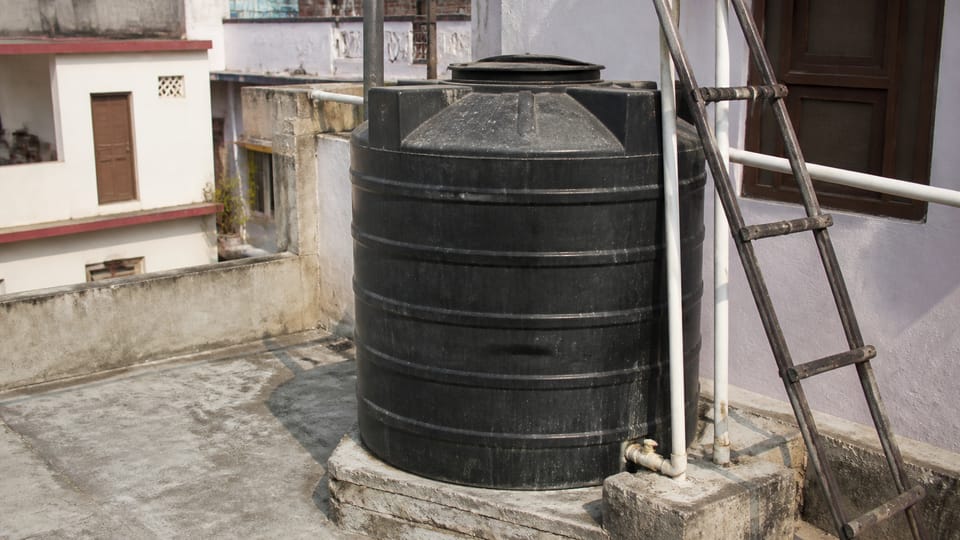
On this page (8)
A house tank collects sediment, dead insects and slime over time, and an open or cracked tank can breed mosquitoes. The national building standards give a yearly minimum for cleaning and a method for disinfecting. This page sets out what they say, then a safe order of work for a normal house tank. It gives no cleaning-service prices and names no products. It does not repeat how to test or repair leaks: see water tank leakage.
How often should an overhead tank be cleaned?
At least once every year, according to the codes. NBCS 2026 says communication pipes and storage cisterns “shall be thoroughly cleaned at least once every year in order to remove any suspended impurities that may have settled in the pipes or the tanks”. IS 2065 says the same but more softly: it is “desirable” to do so, and says the pipes should also be cleaned at intervals that depend on the quality of the water and the treatment it gets before use. NBCS clause 4.18.1 adds that tanks shall be “cleaned out periodically, if necessary”.
More often is practice. A Jammu and Kashmir school-education order of March 2025 tells schools to clean overhead and underground tanks at least twice a year, every six months, to use trained personnel or authorised service providers, and to keep a record of the date and method. That is a rule for those schools, not for houses. Some homes also clean a tank after a long period of disuse, or when the water looks or smells wrong. Ask your local water authority if it has its own advice.
What is the safe order of work?
The steps marked “code” come from NBCS 2026 or IS 2065. The others are practice.
- Switch off the pump and stop the inlet so the tank does not refill. IS 2065 asks for a stop valve so the tank can be isolated for cleaning (code). Practice: tell the household, and store drinking water before you start.
- Plug the outlets before cleaning “to prevent debris from entering the pipes” (NBCS 2026, clause 4.18.1, code). Do this before you drain, so the first dirty water and sediment do not run into the house pipes.
- Drain the tank through the wash-out pipe at its lowest point. IS 2065 asks for that pipe and for a slight fall of the tank floor towards it (code).
- Scrub the walls and floor with a clean, long-handled soft brush, then rinse out the dirt and slime. Practice. NBCS says to wire-brush a corroded metal tank but not to scrape it; that applies to metal tanks, not plastic.
- Look for cracks and leaks while the tank is empty. NBCS says tanks shall be examined for water tightness after cleaning (code). For how to find and repair leaks, see water tank leakage.
- Check the overflow pipe, the lid and any vent. NBCS says overflow pipes shall be examined and kept free from obstructions (clause 4.18.6, code). IS 2065 asks for a close-fitting, mosquito-proof lid and a mosquito-proof warning (overflow) pipe (clauses 11.3 and 11.4, code). NDMC asks for tightly fitted mosquito-proof lids and mesh on the pipes at the tank. Checking a vent is practice.
- Unplug the outlets, refill and disinfect as described below, then flush.
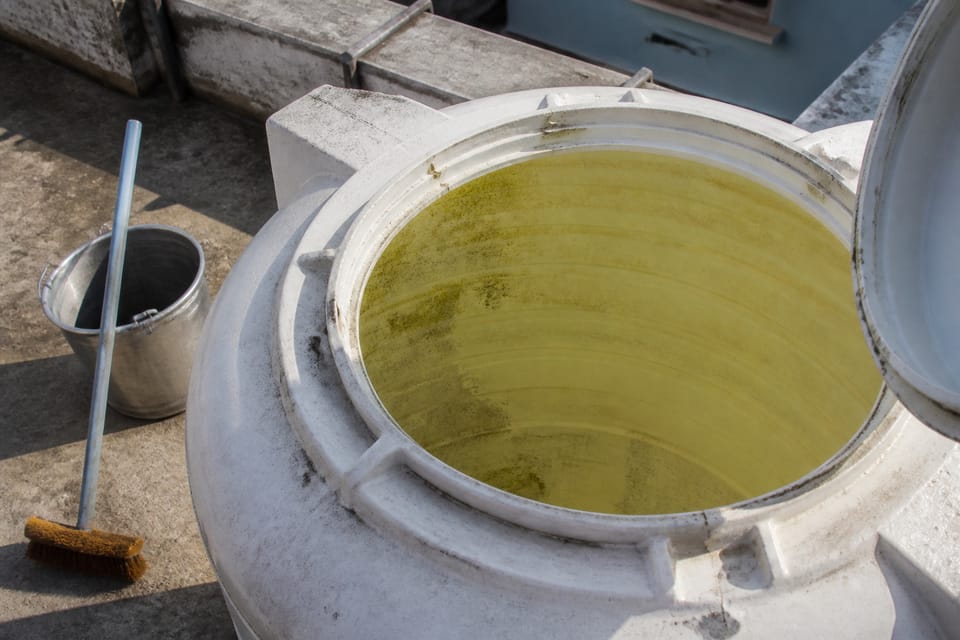
How is the tank disinfected?
NBCS 2026 (clause 4.16.2) and IS 2065 (clause 13.2) give the same method for storage tanks in buildings, except that only IS 2065 adds the line about makers’ proportions. Read it as the code’s method. NBCS clause 4.16.1 and IS 2065 clause 13.1 say that the method of disinfecting water mains and distribution pipes is subject to the Authority’s approval. That sentence is not repeated for the tank method. Because bleaching powder strength varies, ask your water supplier or plumber before you dose.
- Fill the tank and flush it out first.
- Fill it again and add a chlorine disinfecting chemical gradually as it fills, to mix it well.
- The dose is 50 parts of chlorine per million parts of water. With ordinary bleaching powder, the code gives 150 g of powder to 1,000 litres of water, mixed with water to a creamy consistency before it goes into the tank. If you use another product, IS 2065 says to follow the maker’s proportions.
- When the tank is full, stop the supply and open the taps one by one, working away from the tank. Close each tap when the water starts to smell of chlorine.
- Top up the tank, and add more of the chemical in the same proportions.
- The tank and pipes then stay charged for at least 3 hours.
- Finally, flush the tank and pipes thoroughly before any water is used for the house.
The code does not state the chlorine strength of the powder, and bleaching powder varies. This is why you should ask your water supplier.
What about safety?
The standards we read do not give a safety rule for entering a tank. These are the site’s plain-sense advice, so ask your engineer or a trained cleaner if in doubt.
- A tank can be a confined space. Do not go inside a tank alone, and have a second person outside.
- Keep the pump and float switches off while anyone is working near or in the tank.
- Do not mix disinfectant with toilet cleaners, acids or other chemicals, and keep chlorine away from skin and eyes.
- Use a firm ladder and keep the roof edge in mind.
- For a large or shared tank, hire trained people. The J&K school order also asks for trained personnel.
What mistakes should I avoid?
These are practice, not code rules.
- Disinfecting without scrubbing the slime and sludge out first.
- Sending the first dirty water into the house pipes. Plug the outlets and drain it away.
- Using a toilet cleaner, an acid or a detergent in a drinking-water tank.
- Leaving the lid loose, or leaving the overflow and vent open to mosquitoes.
- Drinking the water before it has been flushed after disinfection.
- Cleaning only the tank and ignoring the underground sump, if you have one.
- Blocking the wash-out pipe, or never fitting one.
Frequently asked questions
How often should I clean my overhead water tank?
The codes say at least once every year (NBCS 2026 “shall”, IS 2065 “desirable”). A school order in Jammu and Kashmir says every six months for schools. Clean it sooner if the water smells or looks dirty.
Can I use bleaching powder?
The codes name ordinary bleaching powder for disinfection and give a quantity for it, but bleaching powder strength varies. Ask your water supplier or plumber before you dose.
Do I need to empty the tank to clean it?
The code method starts with filling and flushing the tank and plugging the outlets before cleaning. Some services offer cleaning without emptying, but no code text we read describes it.
How do I stop mosquitoes breeding in the tank?
IS 2065 asks for a close-fitting mosquito-proof lid and a mosquito-proof overflow pipe. NDMC asks for tightly fitted mosquito-proof lids and mesh on the pipes at the tank.
Where should the dirty water go?
Not into the house pipes. The standards we read do not say where to drain it. As practice, drain it through the wash-out pipe to a place where it will not mix with drinking water.
Related guides
- Water tank leakage: how to find and fix it
- Water tank size for a house
- Rainwater harvesting for a house
- IS 2065 explained: the water supply code, clause by clause
This guide is general information. Read the disclaimer. Your local water supplier and your plumber decide the method for your house.
Sources
- SP 7:2026, National Building Construction Standards (NBCS) 2026, Part E Plumbing Services, Section 1 Water Supply, clauses 4.16.1, 4.16.2 (cleaning and disinfection) and 4.18.1, 4.18.6 (maintenance). Read from an unofficial archive.org copy of the text; the page images were not checked.
- IS 2065:1983, Code of practice for water supply in buildings (second revision), clauses 11.3 to 11.8 and 13.1, 13.2. BIS lists it as not withdrawn, valid to 2027-02-28.
- Directorate of School Education Jammu, Government of Jammu and Kashmir, letter on cleaning overhead and underground water storage tanks in schools, 24 March 2025. A school order, not a household rule.
- New Delhi Municipal Council, Public Health: citizen's responsibility in prevention of dengue and malaria (overhead tank lids and mesh).
Change log
- : Added Related guides link to newly published article(s): is-2065-explained-the-water-supply-code-clause-by-clause-for-a-house. No other text changed. Approved by the reviewing engineer (owner report, 2026-10-31).
General information only. It is not a structural design or professional advice. Ask a licensed structural engineer or architect to check your plans and site.