
Short answer
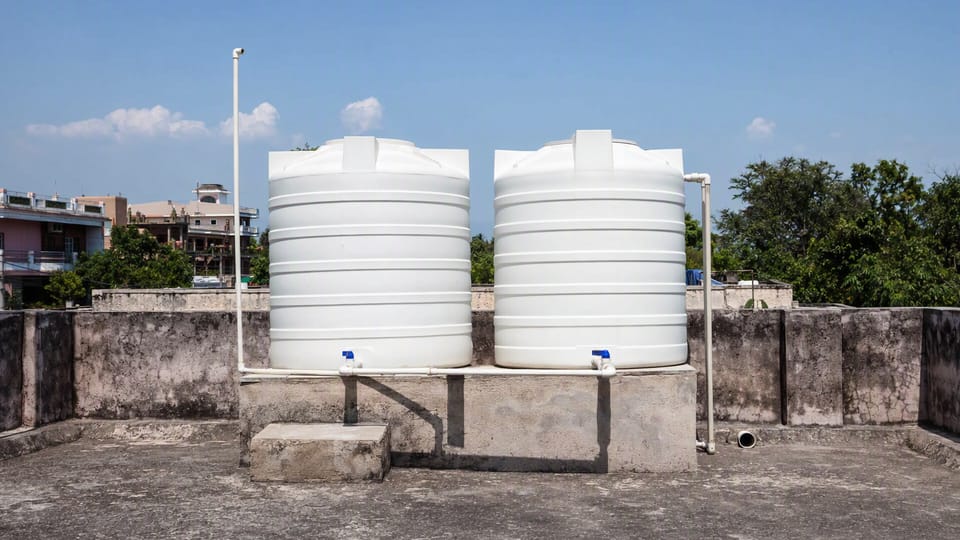
How big a water tank does a house need? Multiply the number of people by the water each uses in a day. The 2026 National Building Construction Standards suggest 135 litres per person per day for urban homes, so a family of 4 uses about 540 litres a day. How many days to store depends on how regular your supply is. Your engineer or plumber decides the split between sump and overhead tank.
On this page (9)
Need quantities? Water tank capacity calculator
“What size water tank do we need?” comes up as soon as the plumbing drawing is made. The answer has two parts: how much water the family uses in a day, and how many hours or days of that you want to keep in store. This page explains both from the Indian codes, shows how to work out the litres in any tank from its size, and lists what a good tank needs. It gives no prices, no brands and no structural details for tank supports. The water tank capacity calculator does the daily sum for you.
How much water does a family use in a day?
Daily need = number of people × litres per person per day.
The 2026 National Building Construction Standards (SP 7:2026), which replaced the National Building Code 2016, suggest 135 litres per person per day for urban communities, and 100 where the building uses water-efficient fixtures. Of the 135, they set aside 30 litres a day for flushing. These are design allowances. Your family may use more or less.
Older codes gave higher city figures. IS 1172:1993 gives 150 to 200 litres per person per day for cities of more than 100,000 people with full flushing, and allows 135 for lower-income houses. You may still see these figures in drawings and on websites.
Here is the calculator run for two family sizes. Treat it as an example, not a design.
| Family (example) | Litres per person per day | Water used per day | Smallest common tank that holds one day |
|---|---|---|---|
| 4 people | 135 | 540 litres | 1,000 litres |
| 4 people | 200 | 800 litres | 1,000 litres |
| 6 people | 135 | 810 litres | 1,000 litres |
| 6 people | 200 | 1,200 litres | 2,000 litres |
The tank sizes are common sizes sold in India, not a code requirement. One day’s store is the calculator’s simple starting point; the next section explains why your store may need to be larger or smaller.
How many days of water should I store?
No code gives a fixed number of days for an independent house. The codes list what decides it:
- how many hours a day the supply comes, with enough pressure to fill the tanks;
- how often the overhead tank is refilled in a day;
- how regular the supply is;
- what happens if the store runs out.
For intermittent supply, the 2026 standards say that “when the supply is from main OHT, such as in case of plotted development”, each house’s overhead tank (OHT) may hold half a day’s demand. The older IS 2065 said the same: a minimum of half a day’s supply in overhead tanks where supply is intermittent and irregular.
For a family of 4 at 135 litres, half a day is 270 litres. That is only the overhead tank. In common practice, houses with an underground sump keep more in the sump. The 2026 standards give minimum storage figures for a sump and overhead tank together, but they are written for buildings in general, so ask your engineer how they apply to your house.
If your area gets water only on some days, or you rely on tankers or a borewell, plan a larger store. That is a judgement for your engineer or plumber, based on how your supply actually behaves.
How do I work out the litres in a tank?
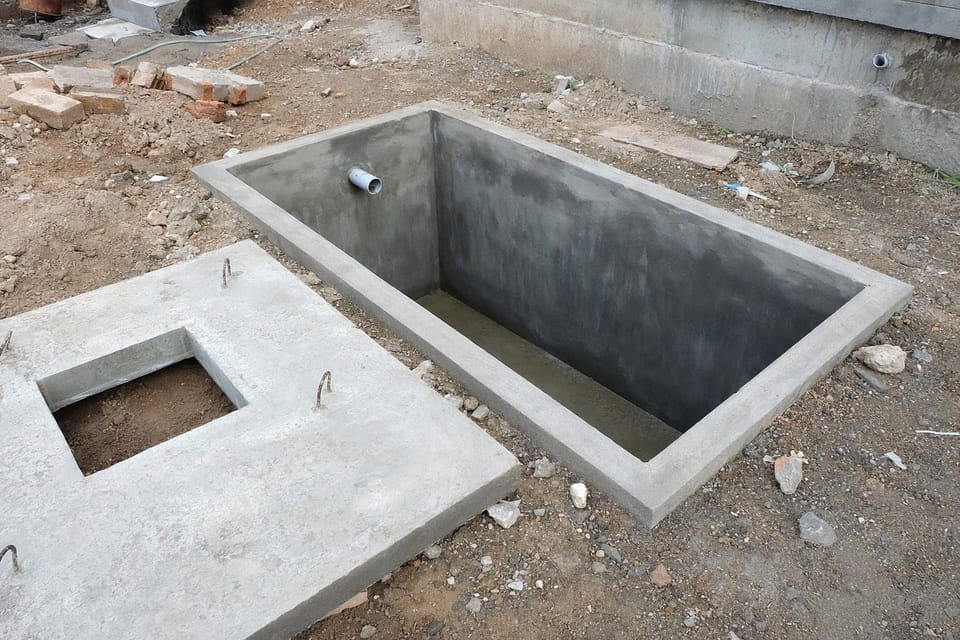
For a tank you are building or measuring, use the inside size and only the depth that can hold water, up to the overflow pipe.
- Rectangular tank: length × width × water depth, in metres, × 1,000 = litres. One cubic metre is exactly 1,000 litres.
- Round tank: 3.14 × radius × radius × water depth, in metres, × 1,000 = litres.
- In feet: cubic feet × 28.32 = litres (one cubic foot is 28.3168 litres, because one foot is exactly 0.3048 metre).
| Tank (example inside size, not a design) | Working | Litres |
|---|---|---|
| Rectangular, 2.0 m × 1.5 m, water 1.2 m deep | 2.0 × 1.5 × 1.2 = 3.6 m³ | 3,600 |
| Rectangular, 6 ft × 5 ft, water 4 ft deep | 120 cu ft × 28.32 | about 3,398 |
| Round, 1.2 m across, water 1.0 m deep | 3.14 × 0.6 × 0.6 × 1.0 = 1.13 m³ | about 1,130 |
| Water depth needed for 2,000 litres in a 1.5 m × 1.2 m tank | 2.0 ÷ (1.5 × 1.2) | about 1.11 m |
Two common errors give a bigger number than the tank really holds: measuring outside the walls, and counting the full height instead of the depth up to the overflow.
For plastic tanks, the litres moulded on the tank are its net capacity, the water it holds up to its working level. IS 12701, the standard for these tanks, says the total enclosed volume is larger than this, because some space cannot be filled.
What does a good tank need?
The 2026 standards and IS 2065 list these, in words:
- A lid that fits and locks, keeping out dust, light and mosquitoes.
- An overflow pipe you can see, ending above the ground or terrace so you notice when the tank overflows. It must never be connected to a drain, gully trap or manhole, and it needs a mosquito-proof grating.
- A drain-out (scour) pipe with a valve, so the tank can be emptied for cleaning.
- Easy access for inspection and cleaning. Two tanks joined together let you clean one while the other keeps supplying water.
- One tank, two outlets: where there is only one tank, the codes allow water to be drawn at two levels, with the flushing line at the lower outlet, so that part of the water is always kept for flushing.
For an underground sump, the 2026 standards add:
- Do not place it in low-lying ground, or near a sewer, septic tank, leaching pit or soak pit. The codes give no distance in metres, so keep it as far as your plot allows and ask your engineer.
- Stop surface water from flowing into it in a flood.
- Do not share a wall with a tank holding unsafe water.
For plastic tanks, IS 12701 asks for the maker’s name and net capacity to be moulded on the tank, a lid that fits securely and locks, carbon black in the plastic of tanks meant for outdoor use, and a flat base that supports the whole bottom. It also says these tanks are not meant for underground use. Our guide to water tank leakage covers testing and fitting them.
What mistakes should I avoid?
These come from the codes and from site practice:
- Sizing the tank only for one day when your supply comes every two or three days.
- Measuring a tank from outside the walls, or up to the brim, and expecting that many litres.
- Running the overflow into a drain, or leaving it without a mosquito mesh.
- Placing the sump close to the septic tank or soak pit.
- Using a plastic tank meant for above ground as an underground sump.
- Treating 135 litres per person as a legal limit. It is a design allowance.
- Forgetting that a tank full of water is heavy. Where it sits on the roof is a question for your structural engineer.
Frequently asked questions
What size water tank is needed for a family of 4?
At 135 litres per person per day, a family of 4 uses about 540 litres a day, so a 1,000-litre tank holds about one day. If your supply is irregular, your plumber may advise more storage, usually in an underground sump.
How many litres of water does one person use per day?
The 2026 National Building Construction Standards suggest 135 litres per person per day for urban homes, or 100 with water-efficient fixtures. Older codes gave 150 to 200 for large cities.
What should be the ratio of sump to overhead tank?
No code fixes one ratio for an independent house. The 2026 standards suggest the overhead tank hold about half a day’s demand where supply is intermittent, and give minimum figures for combined storage. Your engineer decides the split.
How do I calculate water tank capacity in litres?
Measure inside. Multiply length × width × water depth in metres and then by 1,000. For a round tank, use 3.14 × radius × radius × water depth × 1,000.
How many litres is 1 cubic foot?
About 28.32 litres. One foot is exactly 0.3048 metre, so one cubic foot is 28.3168 litres.
Is a black or a white plastic tank better?
IS 12701 asks for carbon black in tanks meant for outdoor use, and allows tanks with a white inner layer and a black outer layer. Tanks meant only for indoor use must be marked “For indoor use only”. Read the markings on the tank rather than judging by colour alone.
Related guides
- Water tank leakage: how to find the source and fix it
- CPVC vs UPVC pipes: which one to use for home plumbing
- Stages of house construction in India: checklist and inspection points
- Soak pit vs septic tank: what each does and when a soak pit works
- Septic tank size: how it is worked out, with a 10-user example
This guide is general information. Read the disclaimer. Your engineer or plumber decides the size, position and support of the tanks for your house, based on your supply and your local rules.
Work out your quantities
- Water tank capacity calculator: Estimate the daily water need of a house from the number of people, and the smallest standard tank that holds one day of it.
Sources
- SP 7:2026, National Building Construction Standards 2026, Part E Plumbing Services, Section 1 Water Supply: clauses 4.1.1, 4.4.4 to 4.4.7, 4.4.10, 4.4.12 (read from an unofficial copy; replaced the National Building Code 2016 on 30 April 2026).
- Gazette of India Extraordinary No. 299, Part III Section 4, 30 April 2026: SP 7:2026 established, SP 7:2016 withdrawn.
- IS 1172:1993, Code of Basic Requirements for Water Supply, Drainage and Sanitation (Fourth Revision). Clause 4.1.
- IS 2065:1983, Code of Practice for Water Supply in Buildings (Second Revision). Clauses 11.3, 11.7, 11.11.
- IS 12701:1996, Rotational Moulded Polyethylene Water Storage Tanks (First Revision, with amendments). Clauses 1.1.1, 1.2, 3.2, 3.3, 4.2.3, 5.6 (Amendment 1), 9.2, 10 and Annex E-2.
- NIST Special Publication 811, Appendix B.8 (litre and foot conversion factors).
General information only. It is not a structural design or professional advice. Ask a licensed structural engineer or architect to check your plans and site.