
Short answer
What is the difference between kW, kVA and kWh? kW is active power, the rate at which electricity does useful work. kVA is apparent power, volts multiplied by amps, divided by 1,000. The two differ by the power factor, so no single conversion fits every load. kWh is energy: 1 kW for 1 hour is 1 kWh, also called 1 unit. Your supply company, not a web table, decides your sanctioned load.
On this page (13)
- What do kW, kVA and kWh each measure?
- How are kW and kVA connected?
- How do I work out kWh?
- Worked examples: example, not a design
- What does the electricity meter count?
- Is my bill in kWh or kVAh?
- What do the numbers on an inverter or a geyser label mean?
- What are connected load, sanctioned load and maximum demand?
- How is house load in kW or kVA calculated?
- What mistakes should I avoid?
- Frequently asked questions
- Related guides
- Sources
A bill says kWh or units, an inverter box says VA, and a load letter may say kW or kVA. These look like one idea written three ways. They are not. This page explains what each unit measures, where you meet it at home, and how load words such as sanctioned load and connected load fit in. It gives no tariffs and no prices. It will not size an inverter, a wire or a connection for you.
What do kW, kVA and kWh each measure?
kW measures power, kVA measures apparent power, and kWh measures energy. A watt is one unit of power, and a kilowatt (kW) is 1,000 watts.
| Unit | What it is | Everyday picture | Where you meet it at home |
|---|---|---|---|
| kW or W | Active power: the part that does useful work | How fast work is being done now | Appliance labels, some load letters |
| kVA or VA | Apparent power: volts multiplied by amps | How much the wires and the source must carry | Inverter labels, some load letters |
| kWh | Energy: power used over time | How much work was done in total | Meter display, bills charged in units |
The “everyday picture” column is our own plain wording. The definitions come from BEE, the Bureau of Energy Efficiency, and IS 1885 (Part 1), the Indian vocabulary for electrical terms. The standard calls active power “the mean power in an alternating current circuit” and apparent power “the product of the rms current by the rms electromotive force or voltage”. Rms is a kind of average used for alternating current. The same standard defines load as “the true or apparent power given or absorbed by a machine or distribution network”. That is why a load can be stated in kW or in kVA.
How are kW and kVA connected?
Power factor connects them. IS 1885 defines power factor as “the ratio of the active power to the apparent power”. For a single-phase supply, BEE gives two formulas:
- kVA = volts × amps ÷ 1,000
- kW = volts × amps × power factor ÷ 1,000
So kW = kVA × power factor, and kVA = kW ÷ power factor. The two numbers match only when the power factor is 1. BEE adds: “Lower the power factor; electrical network is loaded with more current.” Two loads doing the same work can therefore draw different currents.
Web pages often say 1 kVA is 0.8 kW. Treat that as an assumption, not a fact about your house. The power factor belongs to the load or machine. No Indian text we read gives one factor that holds for every home. Where a figure appears, it serves one set purpose: Punjab’s supply code fixes factors for counting connected load under its own annexure, and IS 732 has a default for voltage-drop sums. Neither describes your house.
How do I work out kWh?
Multiply the power in kW by the hours it runs. BEE says that 1 kW run for 1 hour uses 1 kWh, which is “1 unit of electricity”. Power is the speed and energy is the distance: a 2 kW heater and a 1 kW heater can use the same kWh if the second runs twice as long.
Worked examples: example, not a design
These show the arithmetic only. The inputs are made up and are not values for your house.
| Question | Inputs (example only) | Arithmetic | Result |
|---|---|---|---|
| Energy used | 2,000 W for 1.5 hours | 2,000 ÷ 1,000 × 1.5 | 3 kWh, or 3 units |
| Apparent power | 230 V and 10 A | 230 × 10 ÷ 1,000 | 2.3 kVA |
| Active power | Same circuit, if the power factor were 1 | 2.3 × 1 | 2.3 kW |
| Active power | Same circuit, if the power factor were 0.9 | 2.3 × 0.9 | 2.07 kW |
| Battery energy | 12 V and 150 Ah | 12 × 150 | 1,800 Wh, or 1.8 kWh |
The 0.9 is an input we chose to show the sum. It is not a typical figure and not a test value. The battery figure is the rated energy, from the formula volts × Ah in an NPTEL lecture. It is not backup time.
What does the electricity meter count?
A standard home meter counts energy. IS 13779:2020 says a watthour meter “measures and registers active energy in watthours or in suitable multiples thereof, by integrating active power with respect to time”. Its principal unit is the kWh or MWh. The standard has no requirement for a kVA, kVAh or demand register. Our guide on how to read your electricity meter covers the display and the screens.
A smart meter can hold more data. IS 15959 (Part 2) lists kW, kVA, kWh, kVAh, power factor and maximum demand for a single-phase smart meter. That list is for sending data to the utility, so it does not prove all of them appear on the screen. The central metering rules say a consumer meter measures what the tariff needs, “depending upon the tariff requirement for various categories of consumers”.
Is my bill in kWh or kVAh?
Check your bill. Do not assume it is in kWh. Delhi’s supply code defines energy charges on energy consumed “in kWh or kVAh”, as the tariff order sets, and Punjab’s code defines consumption in either unit. Neither definition says which homes use which. Punjab’s FY 2024-25 tariff sheet charged its smaller domestic loads per kWh and its larger domestic loads per kVAh. kVAh is apparent energy, the kVA version of kWh. Your bill states the unit it uses.
What do the numbers on an inverter or a geyser label mean?
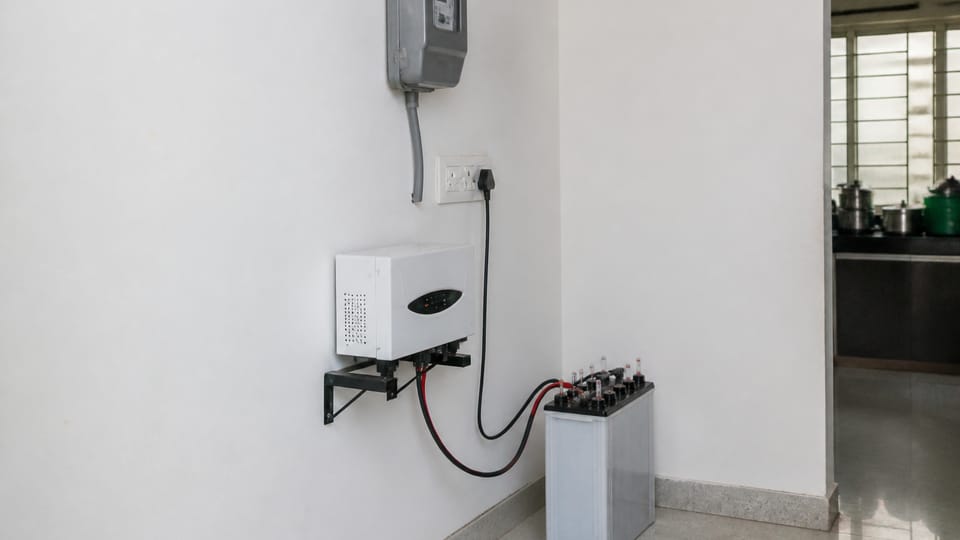
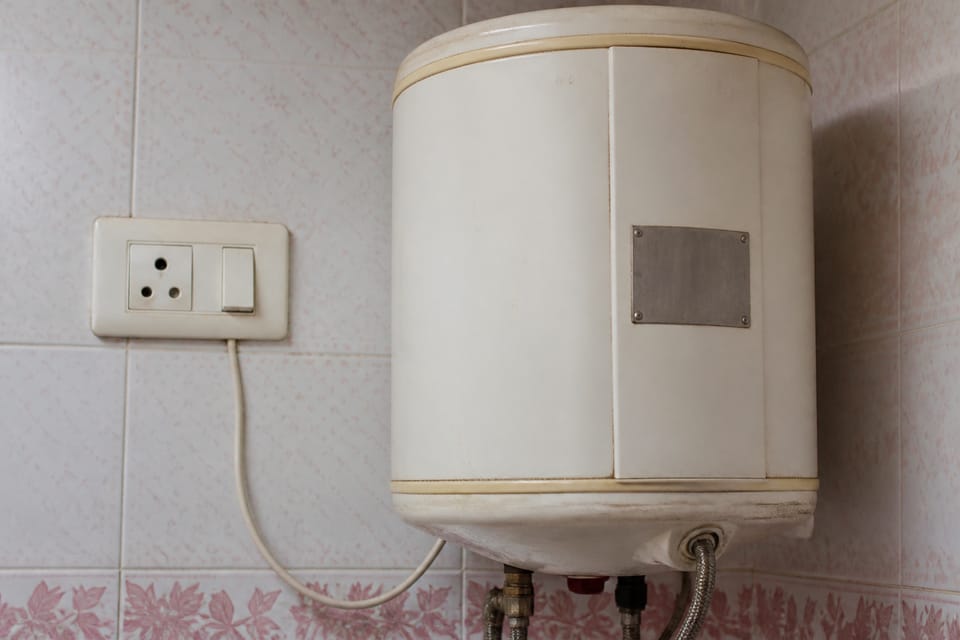
In practice an inverter label gives VA, and a heating appliance label gives watts. These printed figures show why VA and watts must be read separately:
| Product page | Printed VA | Printed watts (the Luminous pages call this maximum bulb load) |
|---|---|---|
| Luminous Optimus 1250+ | 1,100 VA | 924 W |
| Luminous Power sine 1100 | 900 VA | 756 W |
| A. O. Smith HAS-X water heater | Not given | 2,000 W at 230 V |
These are examples of how labels read, not recommendations. Two lessons follow. First, the number in a model name may not be the VA rating, as the first two rows show. Second, the Luminous pages we read state no power factor, and on the Optimus range page the watts-to-VA ratio changes across models, so read both figures on your own label. The geyser’s 2,000 W is its power. Its kWh depends on how long the heating element runs.
To choose an inverter, ask the maker’s sheet and your electrician. For how an inverter differs from a UPS and how it must be wired, see inverter vs UPS for a home.
What are connected load, sanctioned load and maximum demand?
These three words sound alike but mean different things:
| Word | What it means | Source |
|---|---|---|
| Connected load | The sum of the ratings, in kW or kVA, of apparatus “which may be connected simultaneously to the source” | CEA Safety Regulations 2023, reg 2(1)(n) |
| Sanctioned load | The load your supply company has agreed to supply | State supply codes |
| Maximum demand | The highest load measured in average kVA or kW over 30 minutes “or as specified by the Commission” in the billing period | Rights of Consumers Rules 2020 |
Sanctioned load is the agreed figure, and maximum demand is the measured one. The unit is set by your state. Delhi says kW or kVA. Maharashtra says kW, kVA or HP. Punjab says kW or BHP. Maximum demand is an average over a period, not a single moment.
As of the 2023 amendment to the central rules, if a smart meter records a maximum demand above the sanctioned load in a month, that cycle’s bill is worked out on the actual recorded demand, and you must be told. The same rule can also revise the sanctioned load upward if the limit is crossed repeatedly in a year. Your state code may hold further rules. Later changes to these rules were not confirmed for this page.
How is house load in kW or kVA calculated?
There is no single national house table that we can give you. The usual idea is to list the appliances, take each rating, add them up, and then allow for the fact that they do not all run together. That allowance is called diversity. IS 732, the wiring code, says a determination of maximum demand is essential and that “diversity may be taken into account”. This is engineering judgement.
A state’s supply code can set how your load is counted. Punjab, for example, for consumers not on its contract demand system, counts actual ratings and uses standard wattages from its own annexure if ratings are not given. So a figure from a web calculator or another state may not match. For a new house, take the load list to your electrical engineer and your supply company. It belongs on the electrical layout drawing before wiring starts.
What mistakes should I avoid?
These are practice points, not code rules.
- Reading VA as watts on an inverter label.
- Treating kW and kWh as the same. kW is the rate of use and kWh is the energy used over time.
- Trying to convert kWh into kVA. One is energy and the other is power, so you cannot convert without knowing the time and the power factor.
- Taking the sanctioned load as what you use. It is an agreed figure, not your consumption.
- Using a web power factor or a per-BHK load table as fact.
- Assuming the number in an inverter’s model name is its VA rating.
Frequently asked questions
Is 1 kVA the same as 1 kW?
Only when the power factor is 1. Otherwise kW is lower than kVA, by an amount that depends on the load.
Is 1 unit the same as 1 kWh?
Yes in BEE’s words: 1 kW for 1 hour is 1 kWh, “1 unit of electricity”. Punjab’s code also writes “kilowatt-hours (units)”. If your bill is in kVAh, read how it defines its unit.
Why is an inverter rated in VA and not in watts?
This is our plain explanation, not a rule from a standard or a maker. Apparent power, in VA, is volts multiplied by amps, and BEE says kVA “measures the electrical load on a circuit or system”. So VA shows the load the inverter must carry, whatever the load’s power factor. Many inverter pages print watts as well. Read both.
What does a 1 kW sanctioned load mean?
It means your supply company has agreed to supply a load of 1 kW. It says nothing about how many units you will use. What happens above it depends on your state code and the central rules.
Can I change my sanctioned load?
Ask your supply company. The application and the rules are set by your state’s supply code, and they differ between states.
Does a higher kVA mean a higher bill?
It can. On a kWh bill, the energy charge follows the kWh, but some tariffs also add a fixed or demand charge tied to kW or kVA. Punjab’s FY 2024-25 sheet did. Your own bill shows which charges apply to your connection. This page does not cover tariffs.
Related guides
- How to read your electricity meter: kWh, screens, blinking light
- Inverter vs UPS for a home and the safety rules for wiring
- Electrical layout drawing for a house: what it must show
This guide is general information. Read the disclaimer. Your supply company and your electrical engineer decide the load for your house.
Sources
- IS 1885 (Part 1):1961, Electrotechnical vocabulary, Part 1 Fundamental definitions: clauses 14.3, 14.4, 14.11 and 14.19 (archive.org text read).
- Bureau of Energy Efficiency (BEE), chapter 2, Basics of Energy and its Various Forms: single-phase formulas, kWh and unit, power factor.
- IS 13779:2020, a.c. Static Watthour Meters, Class 1 and 2, Specification (second revision): clauses 3.1.1 and 6.10.
- IS 15959 (Part 2):2016, Data Exchange for Electricity Meter Reading, Tariff and Load Control, Companion Specification, Part 2 Smart Meter: Table A1 and its Notes 1 and 2 (read with Amendments 1 and 2; later amendments not checked).
- Electricity (Rights of Consumers) Rules 2020, rule 2(1)(j), maximum demand (gazette copy on the MERC website).
- Electricity (Rights of Consumers) Amendment Rules 2023, G.S.R. 437(E) of 14 June 2023, rule 5(5B) (gazette scan on a third-party site). Later changes not confirmed.
- Central Electricity Authority (Measures relating to Safety and Electric Supply) Regulations 2023, regulation 2(1)(n), connected load (copy on the KSEB website).
- CEA (Installation and Operation of Meters) Regulations 2006, as amended: Schedule Part III(1) (read in a third-party consolidation, not the gazette).
- DERC (Supply Code and Performance Standards) Regulations 2017, Delhi: regulations 2(28) and 2(47) (licensee-hosted copy; later amendments not checked).
- Maharashtra Electricity Regulatory Commission (Electricity Supply Code and Standards of Performance of Distribution Licensees including Power Quality) Regulations, 2021: regulation 2.2(rr).
- PSERC (Electricity Supply Code, Standards of Performance and Related Matters) Regulations, 2024 (Supply Code, 2024), Punjab: definitions 16, 20 and 66, regulation 8 and Annexure-1.
- PSERC, Existing Tariff and the new Tariff for FY 2024-25: units of charge for domestic supply. Later sheets not read.
- IS 732:2019, Code of practice for electrical wiring installations: clause 4.1.5.6.1 and Annex Y.
- Luminous Optimus 1250+ product page: label figures only, not a recommendation.
- Luminous Power sine 1100 product page: label figures only, not a recommendation.
- A. O. Smith HAS-X product page: label figures only, not a recommendation.
- NPTEL, Module 9, Lecture 31, Batteries: energy in Wh is volts multiplied by Ah.
General information only. It is not a structural design or professional advice. Ask a licensed structural engineer or architect to check your plans and site.