
Short answer
What is the difference between an inverter and a UPS for a home? NBCS 2026 says a UPS keeps power on with virtually no time lag and is meant for sensitive electronic equipment like computers, while an inverter is used where a short break is acceptable, generally for house lighting. Both need protection, earthing and a ventilated battery, and their circuits should be marked. The wiring is a licensed electrician's job.
On this page (9)
People ask for “inverter vs UPS” and “how to do inverter wiring” and get shop pages that compare switch-over time and battery hours. This page takes the national code instead. It says what NBCS 2026 distinguishes, what its safety rules ask for, and what we could not find. It does not size a battery, name a brand, give a price or show a wiring diagram, and it describes no shortcut. Wiring a backup source into a house is the work of a licensed electrician.
What is the difference between an inverter and a UPS?
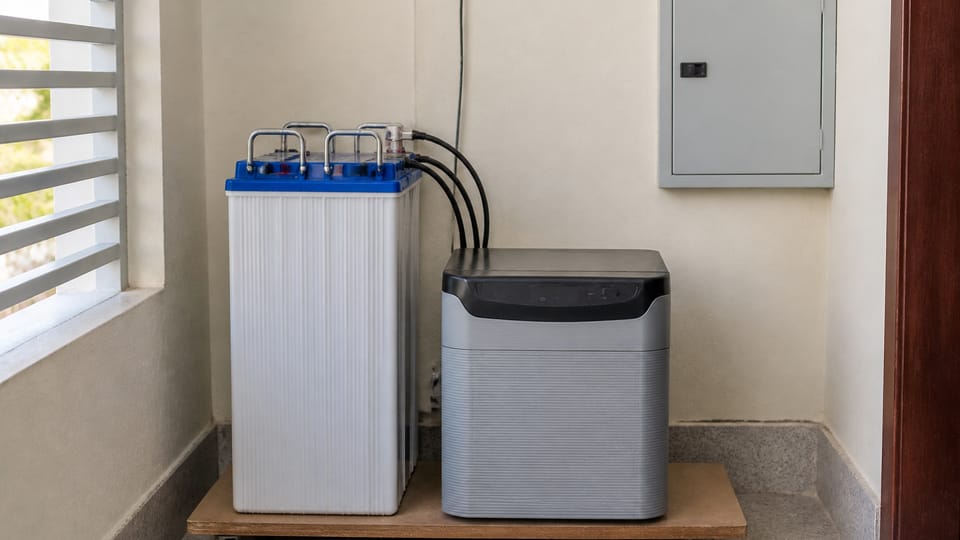
NBCS 2026 (Part D, Section 2) defines an inverter in clause 2.1.121 as an “electric energy converter that changes direct electric current to single-phase or polyphase alternating currents”. Clause 10.3.3 adds that an inverter system also has a battery bank to supply power during a failure of the mains, charged through a rectifier.
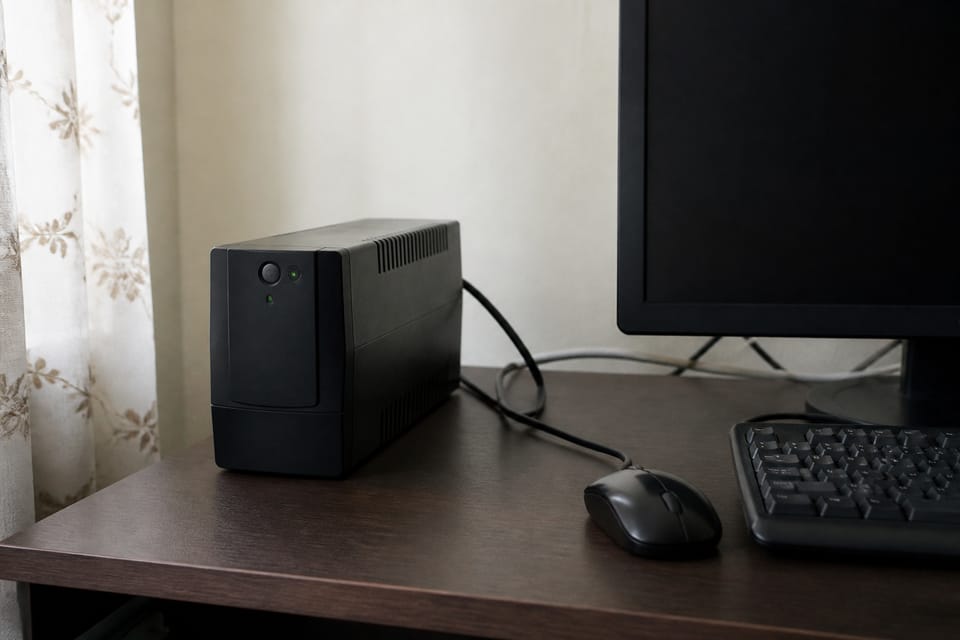
A UPS is described in clause 10.3.2 as “an electrical device providing an interface between the mains power supply and sensitive loads (computer systems, instrumentation, etc)”, generally made up of a rectifier or charger and an inverter together with a battery, for backup in a mains failure “with virtually no time lag”. The note under clause 10.3.3 draws the difference: “While a UPS system is provided to maintain power supply without any break even in the event of a failure of the incoming power supply, an inverter system is provided where a short break is acceptable.”
| UPS (NBCS 10.3.2) | Inverter (NBCS 10.3.3) | |
|---|---|---|
| What it does | Keeps supply on with virtually no time lag | Takes over after a short break |
| Meant for | Sensitive electronic equipment such as computers, printers, fire alarm panel, public address and access control equipment | House lighting, shop lighting, etc, in general |
| Contains | Rectifier or charger, inverter and battery | Inverter and battery bank, battery charged through a rectifier |
NBCS does not define online, offline or line-interactive UPS types, so this page does not either. Products sold as “inverter UPS” or “hybrid” blur the line, and the label does not tell you the switch-over behaviour or the runtime. Read the maker’s data sheet.
What are the safety rules in NBCS 2026?
Clause 10.3.1 starts from a hazard: a shock from a small inverter can be as dangerous as a shock from the grid, and even a low capacity inverter “poses the same level of shock hazard” as a large source, so earthing, earth-leakage and overload protection shall be provided as for a large system. It adds that batteries are “points of concentrated sources of energy”, whose improper release can cause fire, so care is needed in the location.
For an inverter (clause 10.3.3), the code says:
- Protective devices such as MCB, MCCB, fuses and RCD of adequate rating are to be provided at both incoming and outgoing sides.
- Earthing is to be done in accordance with good practice.
- Adequate ventilation space is to be provided around the battery section.
- The connected load is to be kept so that the demand at the time of mains failure is within the capability of the inverter. The code adds that if the inverter fails to take over the load, the purpose of the backup is defeated.
For both inverters and UPS (clause 10.3.4), the code says:
- Circuits fed by them “should have suitable marking to ensure that a worker does not assume that the power is off, once the mains have been switched off from the DB”.
- They should shut the output on overload or short circuit. Some may restore automatically after a delay, and “Warning should be displayed wherever the possibility of automatic restoration is possible”. Clause 13.7 adds that users should be told of this, so that nobody assumes a circuit is dead when it may restore itself.
- Batteries are “required to be placed in well-ventilated spaces as oxygen and hydrogen gasses are produced in the batteries, which unless ventilated, can cause explosive conditions”.
- The floor of a battery room should be acid- (or alkali-) resistant tile or coating.
Clause 13.7 also says that where switches are fed from more than one source it is desirable to mark them or use a colour code. Clause 13.3 says that with more than one source the shock hazard increases, and a drill and display of instructions are needed so that people are warned of the sources. Clause 13.7 uses “desirable” and “should”, and 13.3 says a drill and display “becomes necessary”; none of these uses “shall”.
What do the standards say about changeover and back-feed?
NBCS 10.3 gives no rule on paralleling. IS 732:2019 does. Clause 5.3.7.6.1.5 says changeover devices from alternative sources “shall affect all live conductors and shall not be capable of putting the sources in parallel, unless the installation is specifically designed for this condition”. Clause 4.5.4.4.7 says that in TN systems the transfer to an alternative supply is by a switching device which switches the line conductors and the neutral, if any. Clause 5.3.7.3.1.3 says that equipment with live parts connected to more than one supply needs a warning notice, unless an interlocking arrangement isolates all circuits.
The plain reason for these rules is that two sources should not feed the same wiring at the same time unless the arrangement is designed for it. None of these texts spells out why two sources must not feed the same wiring, so that reason is ours; NBCS 10.3.4 a, 13.3 and 13.7 and IS 732 5.3.7.3.1.3 do warn workers and users about circuits that can stay live. We describe no connection method here. The “specifically designed” exception in IS 732 is for engineered installations, not for a home workaround.
NBCS 12.11.2 says changeover switches “should be of 4 pole” so that earth-leakage protection works with each source, but that clause sits in the section for construction and demolition sites, so we do not present it as a house rule.
Who may do the wiring?
NBCS 3.9 says that, unless exempted under the CEA (Measures relating to Safety and Electric Supply) Regulations, 2023, electrical installation work “shall be carried out by a licensed electrical contractor” under the direct supervision of a person holding a certificate of competency. Adding a backup source changes the installation, so treat it as work for the licensed contractor (this reading is ours). See electrical work during house construction for the stages.
What should I plan?
This is practice, not a code rule, except where a clause is named.
- Decide before the conduit goes in which lights, fans and sockets will be on backup. NBCS says to keep the load within the inverter’s capability; the electrician sizes it.
- Ask for the backup circuits to be marked and labelled at the distribution board (NBCS 10.3.4 a).
- Choose a battery location that is open to air, away from sparks and from wet walls. Sealed or maintenance-free types are a product choice: NBCS clause 10.3.4 d speaks only of “oxygen and hydrogen gasses”, which fits lead-acid batteries, and does not mention lithium.
- Ask who will test the system after installation, and what happens on return of the mains.
- Keep the earthing in order. An inverter does not replace it: see earthing for a house and MCB vs RCCB vs RCBO.
What mistakes should I avoid?
These are practice, not code rules.
- Treating an inverter and a UPS as the same thing because both have a battery.
- Putting heavy loads on a small inverter, so it fails to take over (NBCS notes this defeats the purpose).
- Feeding house wiring from an inverter by any improvised connection. Do not; only a properly designed changeover arrangement fitted by a licensed electrician is acceptable.
- Skipping earthing or protection because the inverter is “small”.
- Keeping the battery in a closed cupboard, bedroom or damp corner.
- Not marking the backup circuits, so that a later worker assumes the power is off.
- Hiring an unlicensed person, and not testing after installation.
Frequently asked questions
Is a UPS better than an inverter for a home?
NBCS does not rank them. It says a UPS is for sensitive electronic equipment where no break is acceptable, and an inverter is generally for house lighting where a short break is acceptable.
Can I connect an inverter to the whole house?
NBCS says to keep the load within what the inverter can take at mains failure. How to arrange the circuits is for your licensed electrician. IS 732 says changeover devices shall not be capable of putting sources in parallel, unless the installation is specifically designed for it.
Does an inverter need earthing?
Yes. NBCS 10.3.3 b) says earthing shall be done in accordance with good practice, and 10.3.1 says protection is needed as for a large system.
Where should the inverter battery be kept?
NBCS says batteries for inverters and UPS are to be placed in well-ventilated spaces, because oxygen and hydrogen gases are produced. It gives no distances.
Is there an Indian Standard for inverters and UPS?
Yes. BIS lists IS 13314:1992 for solid state inverters run from storage batteries and IS 16242 (Part 1):2025 for UPS safety. We have not read their texts, and we do not know whether a BIS mark is compulsory for them.
Related guides
- Electrical work during house construction: stages and inspection
- Earthing for a house: earth vs neutral
- MCB vs RCCB vs RCBO
- kW vs kVA vs kWh: what each unit means on a meter, inverter and bill
This guide is general information. Read the disclaimer. A licensed electrician and your engineer decide the backup arrangement for your house.
Sources
- SP 7:2026, National Building Construction Standards (NBCS) 2026, Part D Sec 2 Electrical and Allied Installations: clauses 2.1.121, 3.9, 10.3.1 to 10.3.4, 12.11.2, 13.3 and 13.7. Quotes checked against page images of the NBCS PDF (an unofficial archive.org copy).
- IS 732:2019, Code of Practice for Electrical Wiring Installations (fourth revision): clauses 4.5.4.4.7, 5.3.7.3.1.3 and 5.3.7.6.1.5. BIS lists it as not withdrawn.
- BIS titles and status only, texts not read: IS 13314:1992 (solid state inverters run from storage batteries), IS 16242 (Part 1):2025 (uninterruptible power systems, safety requirements), IS 1651:2013 and IS 13369:2024 (stationary tubular-plate lead-acid batteries), IS 15549:2005 (stationary valve regulated lead-acid batteries).
Change log
- : Added Related guides link to newly published article(s): kw-vs-kva-vs-kwh-what-each-unit-means-on-a-meter-an-inverter-and-a-bill. No other text changed. Approved by the reviewing engineer.
General information only. It is not a structural design or professional advice. Ask a licensed structural engineer or architect to check your plans and site.