
Short answer
Which manhole or chamber cover grade is right for a house? IS 1726 (cast iron) and IS 12592 (precast concrete) use four grades. LD-2.5 is for residential areas with pedestrians and occasional light motor vehicles and for inspection chambers. MD-10 is for medium-duty traffic including car parking areas. Which one a chamber under your driveway needs is for your engineer to decide.
On this page (9)
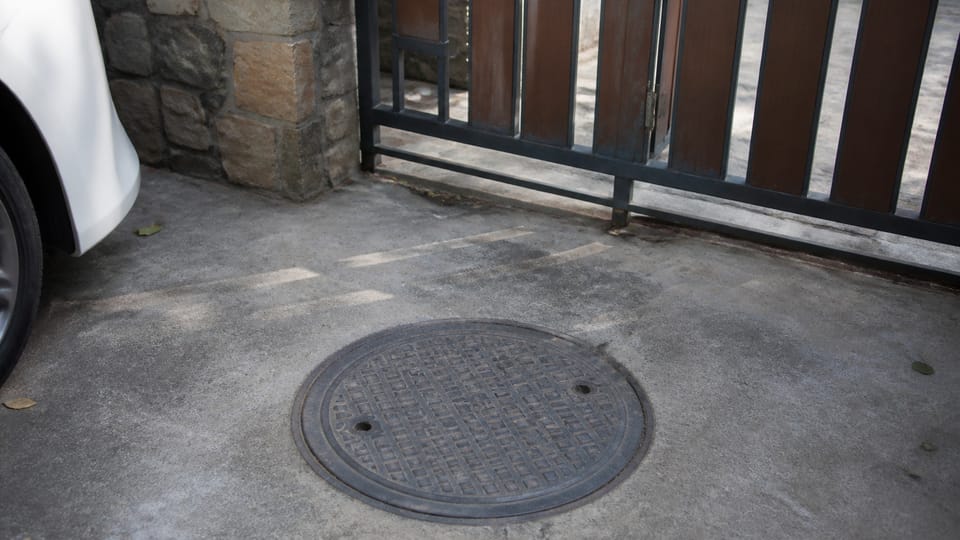
A cover over a chamber is easy to forget until a car wheel goes through it. The standards grade covers by the traffic they are meant to carry, and the grade is cast or marked on the cover, so an owner can check it. This page sets out what IS 1726 and IS 12592 say about the grades, what the standards say about bedding the frame, and why covers break. It gives no cover size, weight, thickness or price. For what a manhole and an inspection chamber are, see inspection chamber vs manhole: what IS 1742 says.
What are the grades?
IS 1726:1991 covers grey cast iron manhole covers and frames “for use in drainage and water works” (clause 1.1). IS 12592:2002 covers precast steel reinforced concrete covers and frames “for use in sewerage and storm water drainage”. Both use the same four grade designations, and IS 1726 clause 3.2 says what each is for:
| Grade | What the standard says it is suitable for |
|---|---|
| LD-2.5 (light duty) | “Within residential and institutional complexes/areas with pedestrian but occasional Light Motor Vehicle traffic. These covers are also used for inspection chambers.” |
| MD-10 (medium duty) | “In service lanes/roads, on pavements for use under medium-duty vehicular traffic including for car parking areas.” |
| HD-20 (heavy duty) | Institutional and commercial areas, carriageways, city trunk roads and bus terminals, with heavy-duty traffic like buses and trucks, and parking areas |
| EHD-35 (extra heavy duty) | Carriageways in commercial, industrial and port areas, where frequent loading and unloading of trucks and trailers are common |
IS 12592 repeats the LD and MD wording and gives its loads in kN. The number in each designation is the test load in tonnes in IS 1726 Table 1: a cover must withstand it “without fracture” for a minimum of 30 seconds (clause 10.2), applied through a 300 mm bearing block (clause 10.3 and Table 3). IS 12592 tests concrete covers to a test load in its own Table 2, and also limits the permanent set after the test, with a crack width limit on the underside, so a concrete cover is judged on more than a single load.
Which grade for a house?
The standards do not say “this grade for a house driveway”. LD is for areas with “occasional” light motor vehicles, and MD lists car parking areas. Which one a particular chamber needs depends on where it sits, what drives over it, and the engineer’s design. A chamber in a garden or a footpath, and one under a parked car, are different cases. The grade belongs in the plan before the paving goes down.
What are the covers made of?
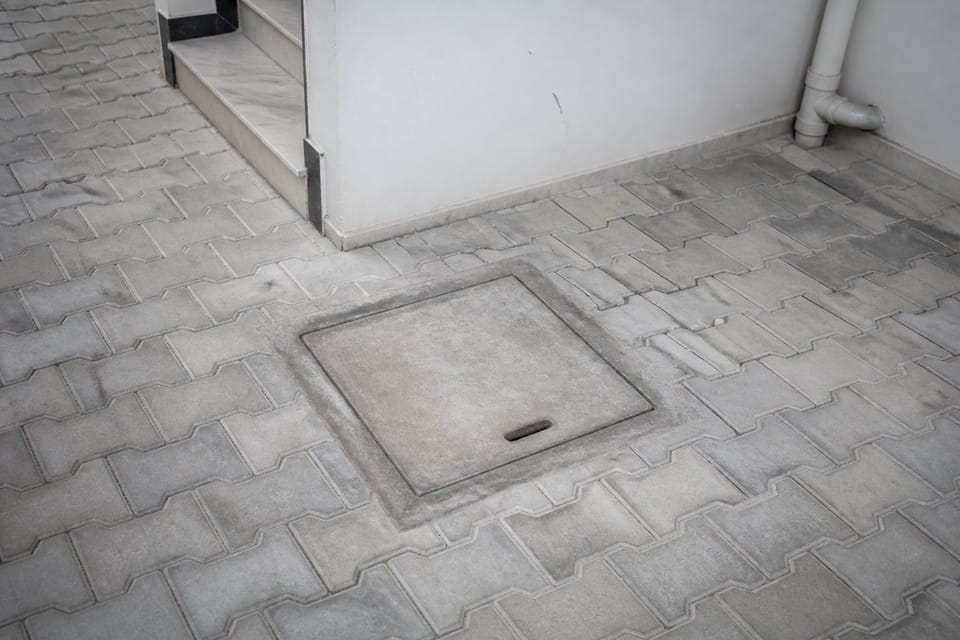
IS 1726 asks for grey cast iron “not inferior than FG 150 Grade of IS 210”. IS 12592’s foreword says cast iron covers “are prone to pilferage and misuse due to its high resale value”, and that precast concrete covers and frames have proved to be a good substitute. NBCS 2026 clause 4.5.10.6 says covers are traditionally and presently made of concrete, steel fibre reinforced concrete, cast iron, ductile iron or PVC, used according to load capacity. The only Indian standards listed in the NBCS for manhole covers are IS 1726 and IS 12592. We found no BIS standard for ductile iron, FRP or steel fibre only covers, so for those ask for the maker’s test report and the load grade they claim.
How is the cover bedded and opened?
NBCS clause 4.5.10.4.7 says “the frame of manhole shall be firmly embedded to concrete alignment and level in plain concrete on the top of masonry”, and clause 4.5.10.1 says a manhole or inspection chamber must carry the loads imposed on it, exclude subsoil water and be water tight, with “a removable cover of adequate strength”. It adds that no manhole or inspection chamber is permitted inside a building or in any passage therein, and that ventilating covers shall not be used for domestic drains. IS 1726 clause 5.2 asks for key holes, keys and lifting devices so the cover can be placed in the frame and opened for maintenance. IS 12592 clause 7.4.4 asks that the cover and frame seatings be compatible, and for the heavy grades, stable and quiet in use.
Why does a cover break under a car? (practice)
The standards give the tests and the bedding, not a list of failures, so this is practice, apart from the clauses named.
- A light-duty cover in a place a car drives or parks over.
- A frame that is not firmly bedded, or sits above or below the finished level, so the wheel hits an edge.
- A cover that rocks or clatters on its seat, so the load goes through a point and not the seat.
- Cracks in a concrete cover or a corroded cast iron cover left in use.
- A weak or cracked chamber top around the opening.
- A cover with no marking, so the grade cannot be confirmed.
What should I check and ask? (practice)
- Marking: IS 1726 clause 13.1 asks that the maker’s name or trade-mark, the grade designation and the date of manufacture be cast on each cover and frame; IS 12592 clause 14.1 asks for marking of the grade and the year and month on concrete covers. Ask to see them.
- Ask the plumber or vendor: which grade and which standard; whether the frame is included; how the cover is opened; and whether the cover is sealed where the chamber is on a sewer line.
- Plan the position: keep chambers out of the wheel path if you can, and not buried under paving, planters or tiles. For the paving, see paver blocks for a driveway: how they are laid and why they fail.
- Check after fixing: the cover sits flat and does not rock, the frame has no gap or crack around it, and one person can lift it with the key.
- Do not enter a chamber. It can hold harmful gases; call a trained person. IS 1742 (clause 9.2.1) describes gas tests before maintenance crews enter a deep manhole.
Frequently asked questions
Which manhole cover is for a car?
IS 1726 lists MD-10 for medium-duty traffic including car parking areas, and LD-2.5 for occasional light motor vehicles. The engineer decides for your chamber.
Is a 24 by 24 inch cover standard?
No standard we read gives that size for a house chamber. Clear opening sizes are listed in IS 1726 and IS 12592, and the cover must fit the chamber. NBCS asks for a clear opening of at least 500 mm diameter in manholes deeper than 0.90 m.
Can a concrete cover be used instead of cast iron?
IS 12592 covers precast concrete covers in the same four grades. Check the marking and the test report.
Do covers have to be airtight?
NBCS asks that the chamber be water tight and says ventilating covers shall not be used for domestic drains. It gives no airtightness rule for a house cover. The CPWD specifications (clause 19.3.1.1) ask cast iron covers to be gas tight and water tight; CPWD is a specification for its own works, not a BIS standard.
How do I open a cover?
IS 1726 asks for key holes, keys and lifting devices. Use the key, and do not enter the chamber.
Related guides
- Inspection chamber vs manhole: what IS 1742 says
- House drainage system explained: soil, waste and rainwater pipes
- Paver blocks for a driveway: how they are laid and why they fail
This guide is general information. Read the disclaimer. Your plumber and engineer decide the covers for your house.
Sources
- IS 1726:1991, Cast Iron Manhole Covers and Frames, Specification (third revision): clauses 1.1, 3.1, 3.2.1 to 3.2.4, 4.1, 5.2, 10.2, 10.3, 13.1, Table 1 and Table 3 (clause text and tables read in the archive text, the grade use clauses confirmed on page images). BIS lists it as in force, valid to 2027-10-31.
- IS 12592:2002, Precast Concrete Manhole Covers and Frames, Specification, with Amendments 1 and 2: clauses 1, 3.1, 3.2.1, 3.2.2, 7.4.4, 9.3, 14.1, Table 2 and Annex C (page images read for the amendments; other clauses archive text). BIS lists it as in force, valid to 2028-01-31.
- SP 7:2026, National Building Construction Standards (NBCS) 2026, Part E Section 2, Drainage and Sanitation: clauses 4.5.10.1, 4.5.10.4.7 and 4.5.10.6 and the list of standards item E-2(16) (page images read). From an unofficial archive.org copy.
- IS 1742:1983, Code of Practice for Building Drainage, clause 9.2.1 (text layer read). BIS lists it as in force. CPWD Specifications 2019, Volume 2, clause 19.3.1.1 (text layer read; CPWD is a specification for its own works, not a BIS standard).
General information only. It is not a structural design or professional advice. Ask a licensed structural engineer or architect to check your plans and site.