
Short answer
How do I recharge a borewell with rainwater? For a house, only clean roof water should be used: keep out the first rain, pass the rest through a filter, then lead it to a recharge pit or, after local advice, a bore. Yard, drain and waste water must stay out. Avoid recharge where the water level is shallower than 3 m below ground after the monsoon. Official texts differ on a bore you drink from, so ask your state groundwater office first.
On this page (12)
- How does rooftop recharge work?
- Is a recharge pit the same as sending water into the bore?
- Which bores can be used for recharge?
- Can roof water go into a bore I drink from?
- When should recharge not be done?
- What must never go into a recharge pit?
- How is it maintained?
- Do I need permission?
- What mistakes should I avoid?
- Frequently asked questions
- Related guides
- Sources
Borewell levels fall, and many owners hear that a pit in the yard will bring the water back. Roof rain can be sent into the ground, but no one can promise that your own bore will gain from it. This page explains how recharge works, what the Indian standards and the Central Ground Water Board (CGWB) ask for, when it should not be done, and where the official texts disagree. It gives no pit sizes, no prices and no yield figures, because they depend on your site. For the general methods and bye-laws, see rainwater harvesting for a house.
How does rooftop recharge work?
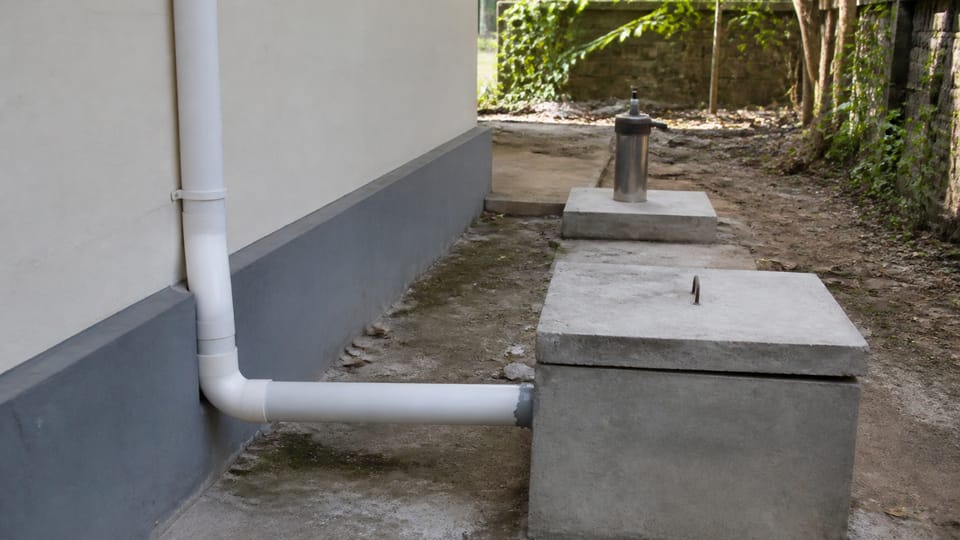
Rain from a clean roof is led down a pipe, the first rain is kept out, the rest passes through a filter, and the water soaks into the ground or enters a well. IS 15792, the Indian guideline on artificial recharge, says such projects are “site-specific”. So a design that worked next door may not suit you. The CGWB booklet of January 2025, written for the public, says rooftop rainwater harvesting suits individual houses.
The steps are the same in most systems:
- Clean roof. The CGWB booklet says an asbestos roof is not suitable.
- First rain kept out. The booklet and a 2023 Ministry of Jal Shakti letter to the States both ask for this, because the first spell washes dust off the roof.
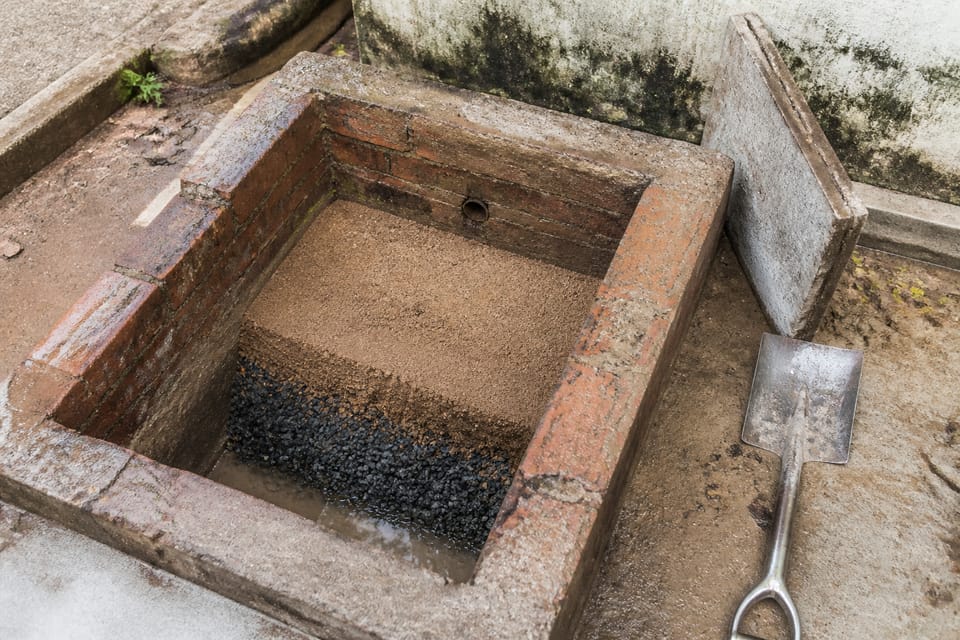
- Filter. IS 15797, the roof rainwater guideline, describes a graded filter with coarse sand on top, gravel below and boulders at the bottom. IS 15792 says a “major requirement” is that recharge water “should be silt-free”.
- Recharge point. A pit, or a bore after local advice.
- Overflow. Heavy rain needs a planned exit. CGWB’s Delhi designs send it to a storm water drain. Your local rule may differ.
Is a recharge pit the same as sending water into the bore?
No. They are different, and they do different jobs.
| Option | Where the water goes | What the texts say | Main caution |
|---|---|---|---|
| Recharge pit | Soaks down through the soil | IS 15797 says pits recharge “the shallow aquifers” | Benefit to a deep bore is not assured |
| Failed or unused bore | Straight into the ground through the bore | IS 15797 allows abandoned or existing tube wells; NBCS lets excess roof water go to them in limited-rainfall areas; CGWB sets conditions; the 2023 letter says no direct recharging below water level | Must not be left open; clean filtered water only |
| Working bore you pump from | Straight into the water you use | Official texts disagree (see below) | No soil layer between the water and your supply |
The CGWB Manual of 2007 says pits “do not necessarily penetrate or reach the unconfined aquifers” and that the water must pass through the soil above. An aquifer is the water-bearing layer. Whether a shallow layer feeds a deeper one depends on how they connect, which a homeowner cannot see. So a pit may help the ground under your plot and still do little for a bore that draws from deep rock. It may also help. No text we read can tell you which, and no one should promise it.
Which bores can be used for recharge?
The CGWB booklet sets out these points:
- A bore that once gave water and went dry because levels fell is “the most suitable”.
- A bore abandoned because of poor water quality “should be avoided”.
- A bore that does not tap a potential aquifer “cannot act as a recharge structure”.
- For an abandoned bore too, the water “should be clean and filtered”.
IS 15797 adds that an abandoned tube well “should be properly developed before use”. It does not define this. Elsewhere it describes clearing a tube well with an air compressor or bailer, which in practice is a job for a driller.
An unused bore must never stay open. A Supreme Court order of 6 August 2010, made to stop children falling into bores, directs that a well be capped with a strong cap fixed to the casing, that abandoned bores be filled to ground level, and that a certificate of proper filling be obtained. The order does not discuss bores used for recharge. CGWB and IS 15797 allow reuse, and no text we read settles how the two fit together. In practice, ask your local groundwater office before keeping an old bore, and keep it capped either way.
Can roof water go into a bore I drink from?
Official texts disagree, so do not decide this on a plumber’s word alone.
- For: the CGWB booklet says both functional and abandoned bores can be used. For wells in use, “only rooftop rainwater should be used after filtration and overland flow should not be used”. IS 15797 also allows existing tube wells.
- Against: the 2023 Ministry letter, written for urban systems and addressed to the States, says “Direct recharging below water level should not be done.” This line is not limited to bores in use, so it can also reach an unused bore that holds water. NBCS 2026, the national building standard, says “No recharge structure or a well shall be used for drawing water for any purpose”. It also says “Direct recharge is recommended when the well has gone dry” and “Indirect recharge is adopted for functioning borewells”.
- The opposite on depth: the 2007 Manual and IS 15792 cl 5.2.2 both say water is piped to the bottom of the well, below the water level.
- Treatment: the CGWB booklet says filtered. The 2007 Manual says “adequately filtered and disinfected” when existing wells are used. The texts we read give disinfection steps for stored tank water and periodic chlorination for an operational dug well, but none for roof water entering a bore.
A filter stops silt and dirt. Do not treat it as proof that the water is safe to drink. If the bore is your drinking supply, get the view of your state groundwater department or a hydrogeologist first, and test the bore water as they advise. That advice is ours, not a code rule.
When should recharge not be done?
The texts list these situations:
| Situation | What the source says | Source |
|---|---|---|
| Water shallower than 3 m below ground after the monsoon | Avoid: it may cause waterlogging and can damage foundations. Store the rain in tanks instead | CGWB booklet; IS 15792 cl 2.2 also leaves out the upper 3 m |
| Water shallower than about 5 m | “better to avoid”, for urban systems | 2023 Ministry letter |
| Flood-prone area | Structures “should not be constructed” | 2023 Ministry letter |
| Limestone area, or industrial, chemical or hazardous waste nearby | Avoid methods other than surface spreading. A pit is not surface spreading | CGWB booklet; IS 15792 cl 4.1.2 lists pits as sub-surface |
| Farm fields | No recharge pits, shafts or bores: water may carry fertiliser and pesticide | CGWB booklet |
| Hilly site with steep slope | May not work; storage may be the better choice | CGWB booklet |
| Near a septic tank, soak pit or contaminated ground | Keep “away from” them. No distance is given | CGWB booklet |
| Tight ground for a pit | Pits suit alluvial areas with permeable rock at shallow depth. Permeability “should be ascertained through infiltration tests” before building | IS 15797 cl 7.2.1; IS 15792 cl 5.2.3.1 |
The 3 m, 5 m and 8 m figures you may see are not one rule. IS 15797 calls areas with water deeper than 8 m and permeable ground “suitable”. That does not ban shallower sites. The 3 m line is about waterlogging, and the 5 m line sits in a letter on contamination. Between 3 m and 8 m, ask locally. Always ask for the level after the monsoon, not the summer level. Do not treat any of these as a safe depth.
What must never go into a recharge pit?
For a house, only clean roof rain goes in. The CGWB booklet says yes when asked whether recharge can contaminate groundwater, “if proper precautions are not taken”. These stay out:
- Kitchen and toilet waste water. NBCS says “No sewage or waste water should be admitted into the system”. See sewage, sullage and storm water.
- Washing machine water with heavy detergent (IS 15797).
- Water from drains. The 2023 letter says “There should be no mixing of drain water with rooftop run off.”
- Water from parking and other paved areas with vehicles. The 2023 letter says it should not be diverted to the system, and NBCS bars waste water from areas likely to have oil or grease. The CGWB booklet allows overland flow only with a desilting chamber and filter, in larger premises, and never into a well in use. For a house, keep it out.
A Delhi case shows why this matters. A Joint Committee on housing societies in Dwarka was told that the designs were satisfactory, but that recharge pipes went deep into the static groundwater, so “contamination was bound to occur”. It said contamination may also come from waste water and paved-area runoff mixing with rain water. Its own test of 38 samples showed “very partial contamination” (2 to 3 of 27 parameters). Later Delhi reports to the National Green Tribunal recorded contamination in 180 societies, and F-coliform in pit samples from 115 of 176 surveyed. These are reports filed by Delhi agencies, on large societies, not a finding on single houses.
A recharge pit is not a soak pit. A soak pit takes septic tank effluent, as our soak pit guide explains, and the two must be kept apart.
How is it maintained?
- Filter. Clean the filter media once or twice a year, and remove the top sand layer before every monsoon (CGWB booklet).
- Roof and drains. Clean them before the monsoon (IS 15797).
- Cover. “Never leave the covers of RWH chamber/ AR structures open” (2023 letter). An open pit is a danger to children.
- Waste. Do not dump pollutants or waste near the structure (2023 letter).
- Bore. IS 15797 says recharge tube wells should be developed periodically to avoid clogged slots.
Do I need permission?
Ask your state groundwater department and your local body. The CGWA guidelines of 2020 exempt individual domestic users from a certificate for extraction, but that clause is about taking water out, not putting it in. We found no clause on recharge by a single house, and that is not the same as permission not being needed. NBCS says the type and number of pits follow local or state bye-laws. IS 15797 suggests getting the scheme vetted by authorities and experts.
What mistakes should I avoid?
These are practice points, not code rules.
- Copying a pit size from the web. Published sizes differ, even within the codes. The CGWB booklet says accurate design depends on local rainfall and ground conditions.
- Connecting a downpipe straight into a bore with no filter and no first-rain bypass.
- Building the pit close to the foundation without asking the engineer. The texts we read give no distance.
- Asking the water level in summer, not after the monsoon.
- Blaming the aquifer before checking the pump, the pipes and new bores nearby.
- Forgetting the filter after the first year.
- Leaving a pit or an old bore uncovered during the work.
Frequently asked questions
Will recharge increase my borewell’s water?
No one can promise that. It depends on the ground, the depth of your bore and how your neighbours draw water. The sources we read give no result you can expect and no time for it. How much rain your roof collects is a separate question: see rainwater tank size.
Can rainwater go directly into a borewell?
Only filtered roof rain, and only after local advice. For a bore that has failed, CGWB allows it on conditions. For a bore you drink from, official texts disagree.
Can a dry borewell be used for recharge?
CGWB calls such a bore “the most suitable”, if it dried because levels fell and it taps an aquifer. IS 15797 says it must be developed first. The Supreme Court order says abandoned bores should be filled, so ask your groundwater office before reusing one, and keep it capped meanwhile. A bore abandoned for bad water should be avoided.
How far should the pit be from the septic tank?
The texts we read say “away from” and give no distance. Your engineer and local rules decide. Do not take a figure from the web.
Will a recharge pit damage my foundation?
It can if the water table is shallow. The CGWB booklet warns of waterlogging that may damage foundations where the post-monsoon level is shallower than 3 m. Ask your engineer before siting a pit near the house.
Can bath or kitchen water go into the pit?
No. Waste water must stay out of the system.
Related guides
- Rainwater harvesting for a house: methods and when it is compulsory
- Rainwater tank size: how the roof and the rain set it
- Soak pit vs septic tank: what each does and when a soak pit works
This guide is general information. Read the disclaimer. Your state groundwater department, a hydrogeologist and your engineer decide what suits your site.
Sources
- CGWB and National Water Mission, Simple and Practical Methods of Artificial Recharge for Groundwater Augmentation, January 2025: pp. 6, 7, 8, 9, 13, 14, 19, 26, 32, 33, 37 (web archive copy of the CGWB file).
- Department of Water Resources, RD and GR, Ministry of Jal Shakti, letter F.No. T-81011/77/2021 - GW Section-MOWR of 31 March 2023 to the States, Prevention of potential contamination of ground water from Rain Water Harvesting systems in Urban Areas: Annexures I and II. Read as reproduced in the GNCTD report to the National Green Tribunal.
- Delhi Jal Board, Action Taken Report in EA 4/2023 in OA 147/2021 before the National Green Tribunal, quoting the Joint Committee report of 06.10.2021. A party filing. The 180-society figure is from the GNCTD report above.
- IS 15797:2008, Roof top rainwater harvesting, Guidelines: clauses 7.0, 7.1, 7.2.1, 7.2.3, 7.2.4, 7.2.5.1, 7.3 and 7.4.
- IS 15792:2008, Artificial recharge to ground water, Guidelines: clauses 2.2, 3.1, 3.2.8, 4.1.2, 5.2.2 and 5.2.3.1. BIS lists one amendment, which was not read.
- CGWB, Manual on Artificial Recharge of Ground Water, September 2007: clauses 5.1.5.2, 6.2.3.2.1(v), 6.2.3.3 and 7.8 (copy on the CWAS site).
- SP 7:2026, National Building Construction Standards 2026, Part E Section 2: clauses 4.5.12.1 note, 4.5.12.3, 4.5.12.4 and 4.5.13.5. From an unofficial archive.org copy.
- Supreme Court of India, W.P.(C) 36 of 2009, order of 6 August 2010, directions (vi), (ix) and (xiii) (third-party copy, not the court's own file).
- CGWA Guidelines to regulate and control ground water extraction, S.O. 3289(E) of 24 September 2020: paragraph 1.0 (copy on the MPCB site).
- CGWB, Standard Designs for Adoption of Roof Top Rainwater Harvesting in Delhi, undated: overflow and cover conditions (web archive copy). Delhi only.
General information only. It is not a structural design or professional advice. Ask a licensed structural engineer or architect to check your plans and site.