
Short answer
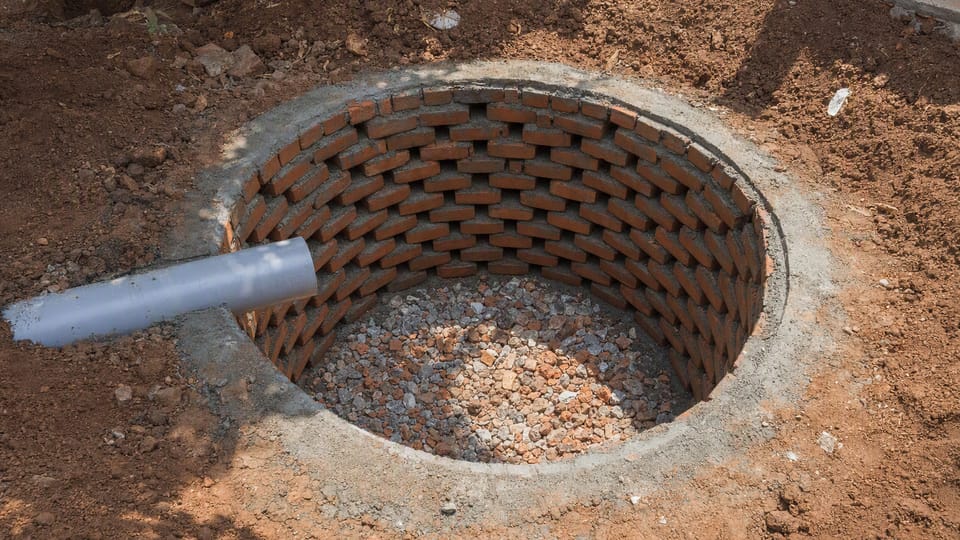
What is the difference between a soak pit and a septic tank? A septic tank is a sealed tank where toilet waste settles and partly breaks down. A soak pit is a pit with open-jointed walls that takes only the liquid flowing out of the septic tank and lets it soak into the soil. The two work as a pair. Whether a soak pit can be used at all depends on your soil and groundwater, which a test on your plot decides.
On this page (12)
- What does each one do?
- Can toilet waste go straight into a soak pit?
- Can bath and kitchen water go to a soak pit?
- When does a soak pit work, and when not?
- How is a soak pit built?
- How is a twin-pit toilet different?
- Does a soak pit need maintenance?
- What mistakes should I avoid?
- Frequently asked questions
- Related guides
- Work out your quantities
- Sources
Need quantities? Septic tank size calculator
Most houses outside sewer areas have a septic tank, and many owners are told they also need a soak pit. Some think they are the same thing; some build one without the other. This page explains what each one does, why toilet waste must not go straight into a soak pit, when your soil rules a soak pit out, what the alternatives are, and how a twin-pit toilet differs. It gives no sizes, depths or distances, because those come from tests on your plot and your engineer’s design. For the tank itself, use the septic tank size calculator.
What does each one do?
The CPHEEO sewerage manual of the Ministry of Housing and Urban Affairs describes a septic tank system as “a septic tank and a soak pit”, using two technologies: treatment inside the tank without air, and then letting the treated liquid soak into the ground.
| Septic tank | Soak pit | |
|---|---|---|
| What goes in | Toilet waste | Only the liquid that flows out of the septic tank (and, separately, bath and kitchen water where allowed) |
| What it does | Solids settle and partly break down | The liquid seeps out through the walls and floor into the soil |
| How it is built | Watertight, with sealed covers and a vent | Open-jointed walls, or filled with stones, so water can escape |
| Indian Standard | IS 2470 (Part 1) | IS 2470 (Part 2), which calls it a seepage pit, soakaway or soak pit |
IS 2470 (Part 2) explains why the second step is needed: even a well-designed septic tank lets only part of the solids settle, and the liquid that leaves still carries dissolved and suspended matter that is a health hazard if it is not disposed of properly. The CPHEEO manual adds that this liquid still contains pathogens and needs treatment before its final disposal.
So the tank does not finish the job, and the soak pit does not replace the tank.
Can toilet waste go straight into a soak pit?
No. IS 2470 (Part 2) defines the soak pit as a pit for septic tank effluent, the liquid from the tank. A pit that takes raw toilet waste is a different design, a leach pit, which is sized and placed in its own way.
The 2020 MoHUA and CPHEEO advisory warns about the reverse problem too: “Often, septic tanks are constructed in such a way that they are not septic tanks at all, but are instead seepage pits or cesspools”, which can act as direct routes for sewage into groundwater. A septic tank must be watertight; only the soak pit is meant to let water out.
Can bath and kitchen water go to a soak pit?
It can. IS 2470 (Part 1) says water from baths, kitchens and washing (sullage) may be drained to a seepage pit or dispersion trench, located so that it does not contaminate watercourses or groundwater. Its household septic tank sizes assume toilet waste only.
When does a soak pit work, and when not?
It depends on the soil and the groundwater, not on habit. IS 2470 (Part 2) chooses the disposal method from how fast the soil absorbs water and how close the groundwater comes to the surface:
| Site condition | What IS 2470 (Part 2) recommends |
|---|---|
| Porous soil that drains quickly, groundwater well below the surface | A soak pit or a dispersion trench can be used |
| Porous soil, high groundwater | A dispersion trench raised partly or fully above ground in a mound, not a pit |
| Dense or clayey soil that drains slowly | A biological filter or an upflow anaerobic filter instead of soaking into the ground |
| Limestone or fissured rock | Soil absorption is not recommended, because cracks can carry contamination a long way |
The standard’s notes add that soil which drains too slowly is unsuitable for a soak pit, and still slower soil is unsuitable for any soak-away system. It asks for a percolation test, which times how fast water soaks away from a small test hole, at more than one place on the plot, and for the groundwater level and its seasonal change to be found. It warns that a casual or visual inspection may fail to reveal unsuitable conditions. The CPHEEO manual adds that rocky ground, very permeable soil and high groundwater can all rule out a soak pit. Our guide to the soil test before building a house explains how the ground is investigated.
The soak pit must also be kept away from wells and other drinking-water sources, and from the foundations of buildings. IS 2470 (Part 2) and the CPHEEO manual give different minimum distances, and IS 2470 says the actual distance depends on the soil. Your engineer and your local body’s rules decide it for your plot. IS 2470 (Part 2) also asks for approval from the local authority before the work starts.
A note on the future: the CPHEEO manual says soak pits are cheap and widely used, but recommends that soak pits (and dispersion trenches) be “phased out in due course of time”.
How is a soak pit built?
In words, from IS 2470 (Part 2):
- The pit is lined with stone, brick or concrete blocks laid with open (dry) joints, backed by coarse aggregate, so the liquid can pass through. Above the inlet pipe, the lining is finished with mortar.
- An unlined pit, especially near trees, is filled with loose stones.
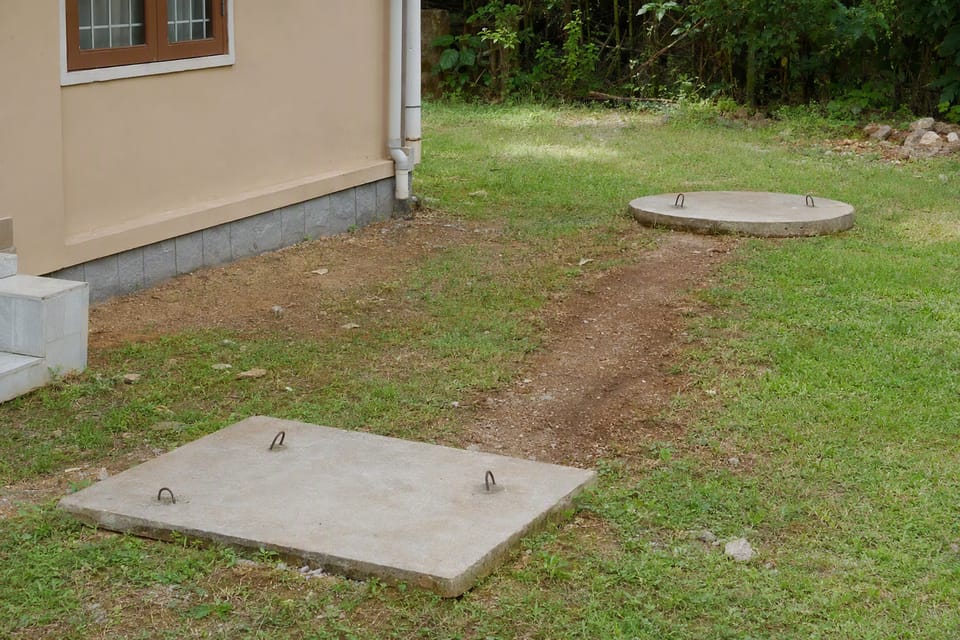
- The pit is covered, and a masonry ring at the top keeps surface rainwater from flooding it. The CPHEEO manual also says the top should be raised above the surrounding ground.
Sizes come from the percolation test and the design. This page gives none.
How is a twin-pit toilet different?
A twin-pit toilet, promoted under Swachh Bharat Mission, has no septic tank. The CPHEEO manual describes leach pits that both store and digest the solids and let the liquid soak away. Two pits are used in turn: when one is full, the flow is switched to the other, and the full pit is left to rest before it is emptied. The manual says a single pit is appropriate only if it is emptied by a vacuum tanker.
The Swachh Bharat guidelines list both twin pits and a septic tank with a soak pit among safe options, with the choice depending on topography, groundwater level and soil, and say safe distances from water sources should be followed.
Does a soak pit need maintenance?
Yes, in practice, though IS 2470 (Part 2) gives no cleaning procedure. The MoHUA and CPHEEO advisory says the property owner is responsible for operating and maintaining the septic tank and soak pit, and notes that many soak pits are found silted up. The CPHEEO manual notes that leach pits absorb less over time as the soil around them clogs (the same applies to soak pits, our reading). A septic tank that is not emptied on time also lets more solids out, which can clog the soak pit (our reading). The Department of Drinking Water and Sanitation’s manual points out that a soak pit only helps dispose of the liquid; the sludge in the tank still has to be emptied and managed.
What mistakes should I avoid?
These come from the standards, the government guidance and site practice:
- Building a septic tank with no soak pit or other disposal step, or running its untreated outflow into a drain. IS 2470 (Part 1) says the effluent should never go into an open channel drain or a water body without adequate treatment.
- Sending toilet waste straight into a soak pit.
- Building a soak pit in clay, in fissured rock or where groundwater is high.
- Placing it close to a well, borewell or sump, or near the house foundation.
- Letting rainwater run into the soak pit.
- Building a “septic tank” with an open, unlined floor.
- Never emptying the septic tank, so solids reach and clog the soak pit.
Frequently asked questions
Is a soak pit necessary with a septic tank?
The liquid from a septic tank needs a further step. Where the soil allows, that is usually a soak pit or a dispersion trench. Where it does not, IS 2470 (Part 2) lists other options such as filters, and the 2020 MoHUA advisory suggests that local bodies encourage connecting septic tanks to small sewer networks where a soak pit is not feasible. Your engineer decides which suits your plot.
Why is my soak pit overflowing?
In practice, common reasons are a septic tank that has not been emptied (so solids clog the pit), rainwater getting in, a high groundwater level, or soil that drains too slowly. Ask an engineer to check before rebuilding it.
How far should a soak pit be from a borewell or well?
IS 2470 (Part 2) and the CPHEEO manual each set a minimum distance from drinking-water sources, and they differ. IS 2470 says the actual distance depends on the soil. Your engineer and local body’s rules decide it for your plot.
Is a twin-pit toilet better than a septic tank?
They suit different places. A twin pit stores and treats toilet waste in place and needs no septic tank. A septic tank needs a soak pit or other disposal step and regular emptying. Swachh Bharat guidance lists both as safe, depending on soil, groundwater and topography.
Can rainwater go into a soak pit?
No. IS 2470 (Part 2) suggests a masonry ring at the top of the pit to keep surface run-off from flooding it, and the CPHEEO manual says the top should be raised above the adjacent ground.
Related guides
- Soil test before building a house: what it is and why it matters
- Pre-monsoon checklist for your house and your building site
- Stages of house construction in India: checklist and inspection points
- Septic tank size: how it is worked out, with a 10-user example
This guide is general information. Read the disclaimer. Your engineer decides the type, size and position of the septic tank and soak pit for your plot, following your local body’s rules.
Work out your quantities
- Septic tank size calculator: Look up the septic tank size for toilet waste from the number of users and the cleaning interval, using the dimensions in IS 2470 (Part 1).
Sources
- IS 2470 (Part 2):1985, Code of Practice for Installation of Septic Tanks, Part 2: Secondary Treatment and Disposal of Septic Tank Effluent (with Amendments 1 and 2). Foreword and clauses 1, 2, 3, 4, 5 and Tables 1 and 2.
- IS 2470 (Part 1):1985, Code of Practice for Installation of Septic Tanks, Part 1: Design Criteria and Construction. Clauses 2.4, 3.1.2, 3.1.3, 3.4.9 and 3.4.10.
- CPHEEO Manual on Sewerage and Sewage Treatment Systems, Part A, Chapter 9: On-site Sanitation (MoHUA; copy hosted by NIUA). Sections 9.1.2, 9.3.3 and 9.3.4 to 9.3.6.
- CPHEEO and MoHUA, Advisory on On-Site and Off-Site Sewage Management Practices, May 2020 (copy hosted by NIUA).
- Department of Drinking Water and Sanitation, Manual on Faecal Sludge Management, July 2021, Chapter 2.
- Swachh Bharat Mission (Grameen) Phase II Operational Guidelines, 2020, section 5.
General information only. It is not a structural design or professional advice. Ask a licensed structural engineer or architect to check your plans and site.