
Short answer
How big a rainwater tank does my roof need? The Indian guideline for roof-top rainwater harvesting, IS 15797, works from the roof's catchment area and the local rainfall. The roof collects only part of the rain, because some is lost. The tank volume depends on how long the dry season lasts and how much water the house needs. Ask your engineer or plumber to work out the figures from local rainfall data.
On this page (7)
Rain that falls on a roof can be led into a tank and kept for use. How big the tank should be depends on the roof and the rain, not only on the family. This guide explains how the Indian guideline for roof-top rainwater harvesting, IS 15797, works out the water a roof can collect. It gives no fixed tank size, no price and no rainfall figure. Those depend on the place, the roof and the house, and your engineer or plumber works them out.
What decides how much a roof collects?
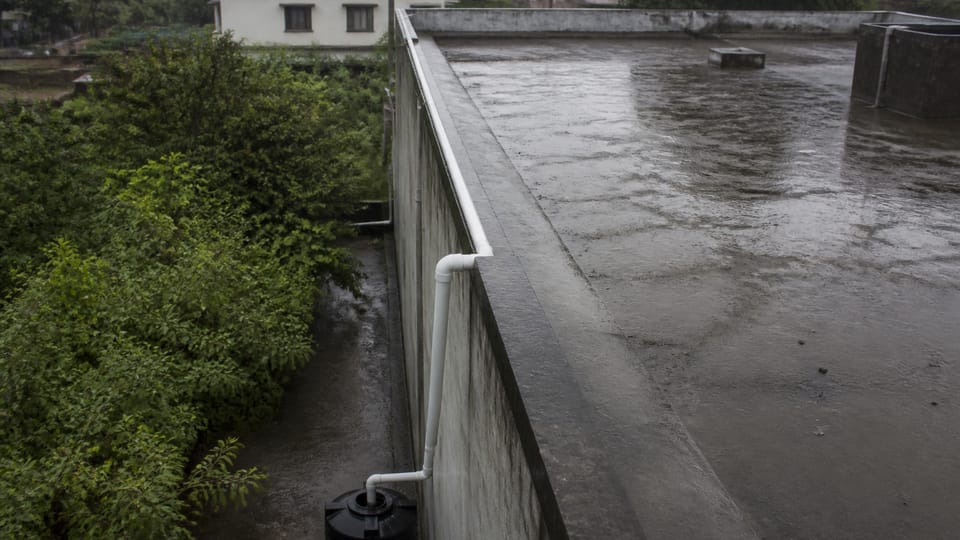
IS 15797 says that “The total volume of rainwater available from any roof top surface is a product of total rainfall and the surface area of collection” (clause 5.1). Two things set the amount: how much rain falls, and how large the roof is.
The standard adds a loss. It says that “A runoff coefficient is usually applied to account for infiltration, evaporation and other losses and it varies from 0.8 to 0.95” (clause 5.1). So a roof does not catch all the rain. The coefficient depends on the type of roof (clause 6.3).
To estimate the water in a given place, the standard says that the average annual or monsoon rainfall data for the location is used. The rainfall figures come from the local weather record, and the standard’s tables then give the water available from a flat or a sloping roof (clause 5.1). Ask the plumber or engineer for the local rainfall figures, and say which source they used.
How is the tank volume worked out?
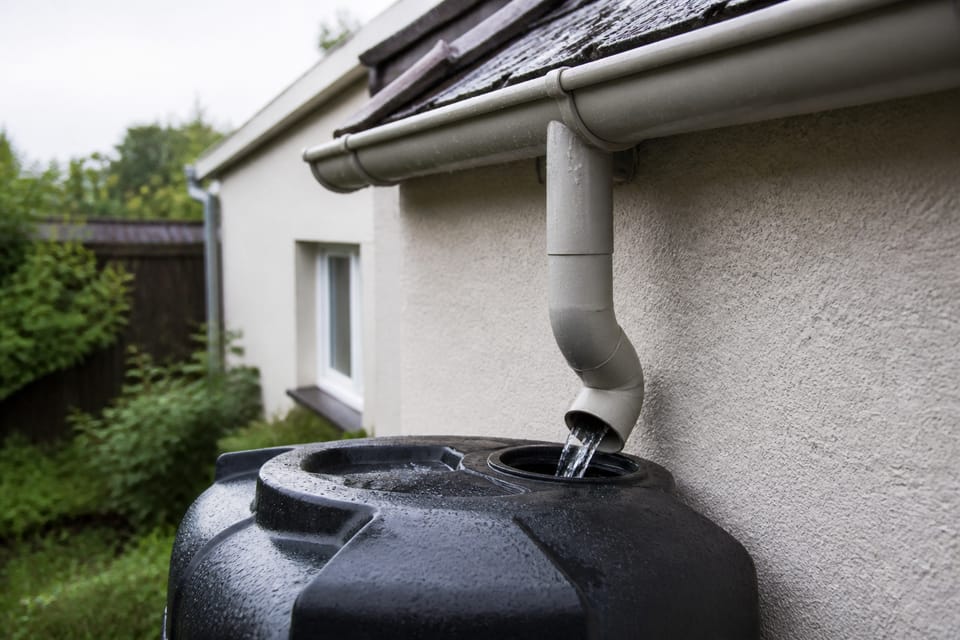
The standard works in the other direction as well. It says that the required catchment area “can be determined by dividing the volume of the tank by the accumulated average rainfall volume (in litres) per unit area (in m2) over the preceding wet months and multiplying this with the runoff coefficient” (clause 6.3). Put simply: the roof must be big enough to fill the tank in the wet months, after losses.
The volume of the tank depends on the dry season the water must cover, the number of people using the water, and the amount each uses. The standard gives a formula with those three factors (clause 6.3). The numbers in its example are the standard’s own example, and they are not a recommended size for your house.
What should I ask for?
This section is practice, not a code rule.
- The local rainfall figures used for the calculation, and their source.
- The roof area used, and the roof type, since the loss depends on the roof.
- The length of the dry season and the water need of the house that the tank must cover.
- The tank volume the calculation gives, and where the tank sits relative to the roof and the downpipes.
- The first-flush or screen arrangement, so that leaves and dirt do not go into the tank. Ask the plumber what is fitted.
What mistakes should I avoid?
This section is practice.
- Sizing the tank by the number of people alone, without the roof area and the rain.
- Using a rainfall figure from a web page rather than the local record.
- Forgetting the loss in the runoff coefficient, so the roof is expected to give more water than it can.
- Leaving a tank with no screen or first-flush arrangement, so that dirt goes straight in.
- Placing the tank where the downpipes cannot reach it without a pump or a long pipe.
Frequently asked questions
Is rainwater harvesting compulsory?
This guide does not cover that. Some towns and cities make it compulsory through their own bye-laws. IS 15797 itself does not. Check with your local authority and see rainwater harvesting for a house.
How does the tank size relate to the water need of the house?
The tank must hold enough water for the dry season, so the water need of the house matters. See water tank size for a house for how the household need is worked out.
Related guides
- Rainwater harvesting for a house: methods and when it is compulsory
- Water tank size for a house: litres per person and tank capacity
- Pre-monsoon checklist for your house and your building site
- Recharge pit for a borewell: how it works and when not to do it
This guide is general information. Read the disclaimer. Your engineer or plumber works out the tank for your house.
Sources
Change log
- : Added Related guides link to newly published article(s): recharge-pit-for-a-borewell-how-rooftop-rainwater-recharge-works-and-when-not-to-do-it. No other text changed. Approved by the reviewing engineer.
General information only. It is not a structural design or professional advice. Ask a licensed structural engineer or architect to check your plans and site.