
Short answer
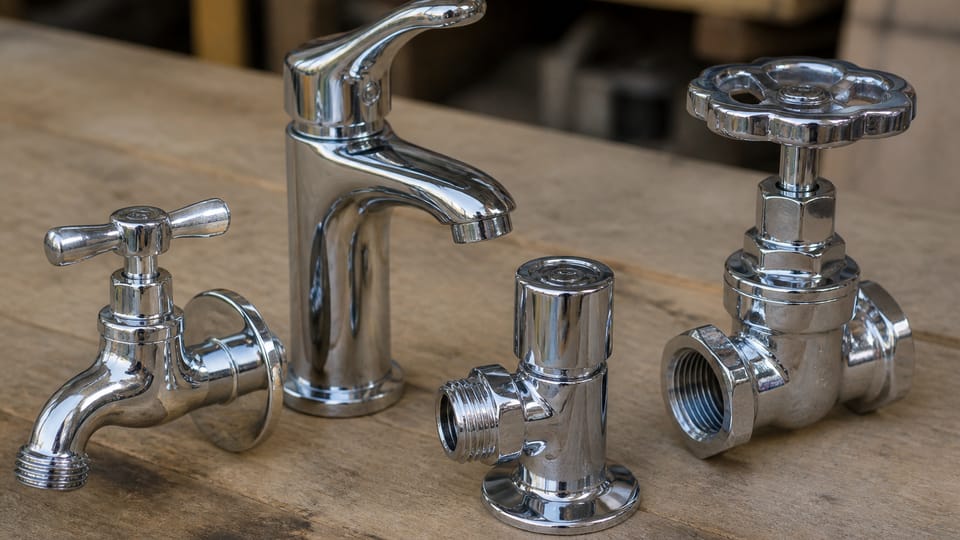
What is the difference between a tap, a stop cock, a gate valve and an angle valve? A tap delivers water at a draw-off point: IS 10446 defines a bib tap as having a horizontal inlet and a pillar tap as having a vertical inlet. A stop cock or stop valve controls the flow in a pipe. A gate valve and an angle valve are valve types in IS 778. The standards do not define wall mixer or diverter.
On this page (10)
A house has a dozen kinds of taps and valves, and the words for them are used loosely: stop cock and gate valve, angle valve and angle cock, wall mixer and diverter. The Indian standards define some of these words and say nothing about others. This page sets out what the standards say, which common names they leave undefined, where the codes ask for a shut-off valve, and what to check with the plumber. It gives no flow rate, size, brand or price. For the stages of the plumbing work, see plumbing work during house construction: stages and inspection points.
Which is a tap and which is a valve?
IS 10446 is the glossary the other standards use. It defines a tap as “a valve with a free outlet used as a draw-off or delivery point” (entry 2.635 b). So a tap delivers water, and a valve in general controls its flow. The definitions below are from IS 10446, with the clause in brackets:
| Word | Definition |
|---|---|
| Bib tap (2.58) | “A tap with a horizontal inlet and a nozzle arranged to discharge in a downward direction” |
| Pillar tap (2.401) | “A tap, suitable for mounting on a horizontal surface, having a vertical inlet and a nozzle arranged to discharge in a downward direction” |
| Stop-cock (2.599) | “A cock fitted in a pipe line for controlling the flow of water” |
| Stop-valve or stop tap (2.603) | “A valve, other than a servicing valve, fitted in a pipeline for controlling the flow of water. Contrast with stop cock.” |
| Isolating valve (2.303) | “Any valve fitted for the purpose of shutting off part of a water installation from the remainder” |
| Gate valve (2.252) | “A valve which affords a straight-through flow and in which a sliding gate is moved in its own plane at right angles to the flow” |
| Globe valve (2.256) | “A screwdown valve having a partially spherical body with a horizontal inlet and horizontal or vertical outlet” |
| Mixing valve (2.364) | “A valve in which separate supplies of hot water and cold water mix together …” |
NBCS 2026 Part E Section 1 defines a stop-cock in the same words as IS 10446 and a stop tap as one that “includes stop-cock, stop valve or any other device for stopping the flow of water in a line or system of pipes at will” (clauses 2.1.64 and 2.1.65). It defines a direct tap as one connected to a supply pipe and subject to the pressure of the water main (2.1.24), and a down take tap as one taken off from a storage tank at a higher elevation in the building (2.1.28). In NBCS, the terms bib tap and pillar tap appear only in the list of fittings (2.1.31).
The standards word a few of these differently. IS 781 defines a bib tap as “a draw-off tap with horizontal inlet and free outlet”, and IS 1795 defines a pillar tap with “an uptilted or a horizontal free outlet”, which is not the downward nozzle of IS 10446. IS 8931:2021 follows the IS 10446 words for pillar and wall mounted tap assemblies, and IS 10446 also defines a combination tap assembly.
What is an angle valve?
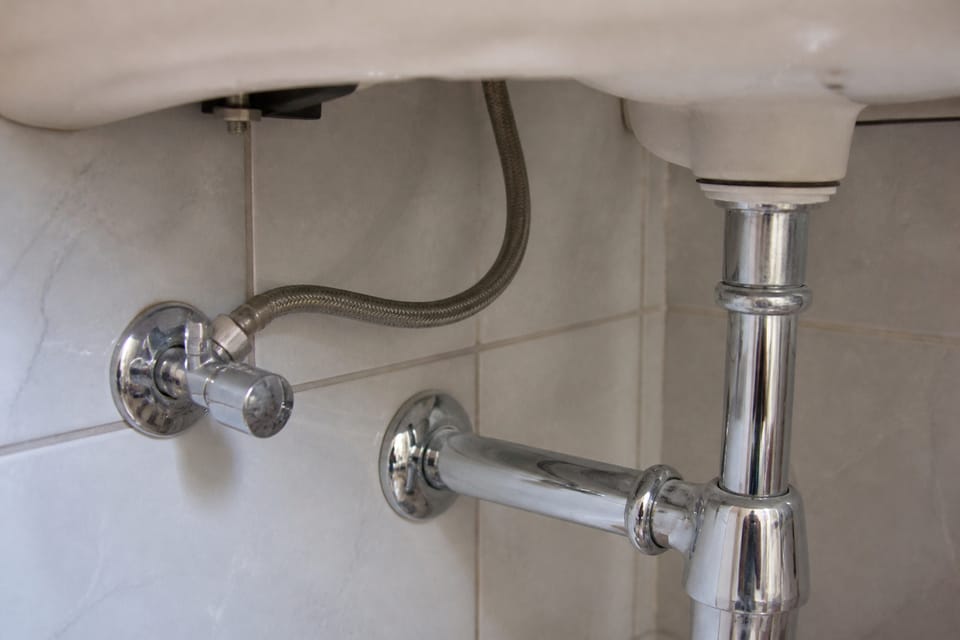
Two standards define it, in slightly different words. IS 778:1984 clause 2.3 defines an angle valve as “a valve having generally a spherical body in which the body ends are at right angles to each other”, a globe-type valve. IS 8931:2021 clause 3.2 defines an angle stop valve as “a valve with the inlet and outlet at right angles to each other and is intended to facilitate servicing of water fittings or appliances”. The small valve under a basin or at a cistern is the second kind. Neither IS 10446 nor NBCS defines it. IS 778 clause 2.1 describes a gate valve as one where the flow is controlled by a gate in the form of a wedge or disc, “there is no change in the direction of flow”.
What do the standards not define?
IS 10446, IS 8931 and NBCS 2026 define neighbouring terms, such as a wall mounted combination tap assembly and a single lever mixer, but have no definition of “wall mixer” or “diverter”. IS 8931 lists, among its types, the “single lever concealed bath and shower mixer with diverter”, the “single lever pillar mounted basin mixer”, the “single lever pillar mounted sink mixer with swivel spout” and the “single lever wall mounted sink mixer with swivel spout”, and it defines a single lever mixer as a mixing valve that lets the user adjust between all cold and all hot water. NBCS uses “mixers/diverters/faucets” together only in the rules for public use. So the question “wall mixer or diverter” cannot be answered from the standards: a mixer blends hot and cold, and a diverter, in everyday use, sends the water to one of two outlets, and a shower set usually has both. That is usage, not a standard definition. We also found no standard definition of a health faucet.
Which valves and taps do the codes ask for?
- At the entry: every communication pipe has a stop-cock (and a meter) inserted in it (NBCS 4.9.2(e)); IS 2065 clause 8.1.2 adds that it is in an accessible position. That stop-cock is on the supply authority’s side, and the authority has control over it. The owner needs a separate isolating valve after it, which is practice.
- For each part of a building: where a common service pipe supplies several separately occupied parts, such as flats, a stop valve is fixed on the branch to each, “to minimize the interruption of the supply during repairs”, in accessible positions and properly protected (NBCS 4.9.3(c); IS 2065 clause 8.1.4, which also asks, in large buildings, for enough stop valves on branch pipes to control groups of ball valves and draw-off taps).
- On tank outlets: IS 2065 clause 11.5 asks for a stop valve or stop tap at every outlet of a storage tank except the overflow, “preferably full-way gate valves”.
- Draining taps at the lowest points of the piping (NBCS 4.9.3(f)).
- WC and urinal: no service pipe is connected directly to a water-closet or urinal; they are supplied from flushing cisterns or flush valves fed from a storage tank (NBCS 4.9.4(d)), and IS 2065 clause 12.4 asks for a stop cock on the upstream side of every flush valve.
- Records and upkeep: record drawings show the pipe layout and valve positions, and all valves are operated periodically to keep them moving (NBCS 4.18.2 and 4.18.4).
We found no clause that asks for a valve under every basin or in every bathroom. A shut-off per bathroom or per fixture is good practice, not a code requirement as far as we read.
What about mixing hot and cold?
NBCS 4.14.12.2.4 says that where hot and cold water are mixed by a mixing fitting, the pressures in the hot and cold systems must be equal, and that otherwise hot and cold water should be supplied to the fixture by separate taps. IS 8931 clause 13.1 asks the manufacturer to mark taps for hot or cold use, with the hot side on the left and the cold on the right for combination tap assemblies and single lever mixers.
What should I ask the plumber? (practice)
This is practice, apart from the clauses named.
- Where is the main stop valve, and can I reach it?
- Is there a shut-off for each bathroom, the kitchen and the geyser, so that one repair does not stop the house? Where is it, and is it behind a panel I can open?
- Which valve is on each line: a gate valve to be fully open or shut, a stop valve, or an angle valve under the fixture?
- Which pipe is hot and which is cold, and is it marked? Is the hot supply on the left at each mixer?
- Will I get a valve map in the as-built drawing?
- Has every valve been turned open and shut at handover, without leaks?
- Is there a spare handle or key?
Use a gate valve fully open or fully shut, and not to regulate the flow. That is practice, not an IS statement.
What mistakes should I avoid? (practice)
- No isolating valve per room, so the whole house goes dry for a basin repair.
- Valves buried in the wall or behind tiles with no access.
- Hot and cold lines swapped at a mixer or geyser.
- Forcing a stuck valve until the spindle breaks.
- Valves with no labels and no handles.
- Not testing every valve at handover.
- Skipping the pressure test before the chases are closed.
- Calling every tap a “stop cock”. The standards separate the stop-cock, a cock, from the stop valve.
Frequently asked questions
What is the difference between a bib tap and a pillar tap?
IS 10446: a bib tap has a horizontal inlet, usually on a wall, and a pillar tap has a vertical inlet for mounting on a horizontal surface such as a basin.
Is a stop cock the same as a gate valve?
No. IS 10446 defines a stop-cock as a cock fitted to control the flow in a pipeline, and a gate valve as a straight-through valve with a sliding gate. It says to contrast a stop-valve with a stop cock.
What is an angle valve?
A valve with its inlet and outlet at right angles. IS 8931 calls the small one under a fixture an angle stop valve, intended to facilitate servicing.
What is the difference between a wall mixer and a diverter?
The standards do not define either. In everyday use a mixer blends hot and cold and a diverter chooses between outlets.
Does every basin need a valve under it?
No standard we read asks for one. It is good practice, so that a repair does not stop the supply to the rest of the bathroom.
Related guides
- Plumbing work during house construction: stages and inspection points
- Water tank leakage: how to find the source and fix it
- Solar water heater vs geyser: flat plate, evacuated tube and the roof
This guide is general information. Read the disclaimer. Your plumber and engineer decide the valves and fittings for your house.
Sources
- IS 10446:1983, Glossary of Terms Relating to Water Supply and Sanitation: entries 2.58, 2.252, 2.256, 2.303, 2.364, 2.401, 2.599, 2.603 and 2.635 (page images read). BIS lists it as in force, valid to 2027-02-28.
- IS 8931:2021, Copper Alloy Single Taps, Combination Tap Assemblies, Stop Valves and Single Lever Mixers for Water Services (second revision): clauses 1, 3, 3.1, 3.2, 3.3, 4 and 13.1 (page images read). BIS lists it as in force, valid to 2026-12-30: check the status again before relying on it.
- IS 778:1984, Copper Alloy Gate, Globe and Check Valves for Waterworks Purposes: clauses 2.1 and 2.3 (page images read). BIS lists it as in force, valid to 2031-02-27. IS 781:1984, Copper Alloy Screw Down Bib Taps and Stop Valves, clause 2.1, and IS 1795:1982, Pillar Taps, clause 2.1 (page images read). BIS lists both as in force, valid to 2031-02-27.
- IS 2065:1983, Water Supply in Buildings, Code of Practice: clauses 8.1.2, 8.1.4, 11.5 and 12.4 (page images read). BIS lists it as in force, valid to 2027-02-28.
- SP 7:2026, National Building Construction Standards (NBCS) 2026, Part E Section 1, Water Supply: clauses 2.1.24, 2.1.28, 2.1.31, 2.1.64, 2.1.65, 4.9.2, 4.9.3, 4.9.4, 4.14.12.2.4, 4.18.2 and 4.18.4 (page images read). From an unofficial archive.org copy.
General information only. It is not a structural design or professional advice. Ask a licensed structural engineer or architect to check your plans and site.