
Short answer
Is a solar water heater better than an electric geyser for an Indian house? A solar water heater uses the sun, and in cold or cloudy weather it may need a back-up heater. The Indian code IS 12976 leaves the collector type to the temperature and climate, and recommends a closed loop where water is too hard or acidic, or the climate is very cold. The roof has to carry the system and its wind loads, so an engineer should check it. Ask the installer for the design, the manual and the back-up details in writing.
On this page (13)
- Two decisions, not one
- Flat plate or evacuated tube?
- Water that is hard, or very cold
- Roof, wind and sun
- Where should the tank go?
- The plumbing
- Do I still need an electric back-up?
- Overheating and freezing
- What should I ask before I buy?
- What mistakes should I avoid?
- Frequently asked questions
- Related guides
- Sources
A geyser heats water with electricity in the tank, and it works the same way on any day. A solar water heater uses the sun to heat the water, and on a cloudy or cold day it may need a back-up. The choice is less about which is “better” and more about your roof, your water, your climate and how the system is put together. This guide sets out the choices, what the Indian code IS 12976 says, and what to check before you buy. It gives no prices, savings or brand names. Those depend on your house and your installer.
Two decisions, not one
Most people compare two things at once, and they are separate choices:
- The energy source: the sun with a back-up heater, or electricity or gas alone.
- The collector: the panel on the roof that catches the sun. The two common types are the flat plate and the evacuated tube.
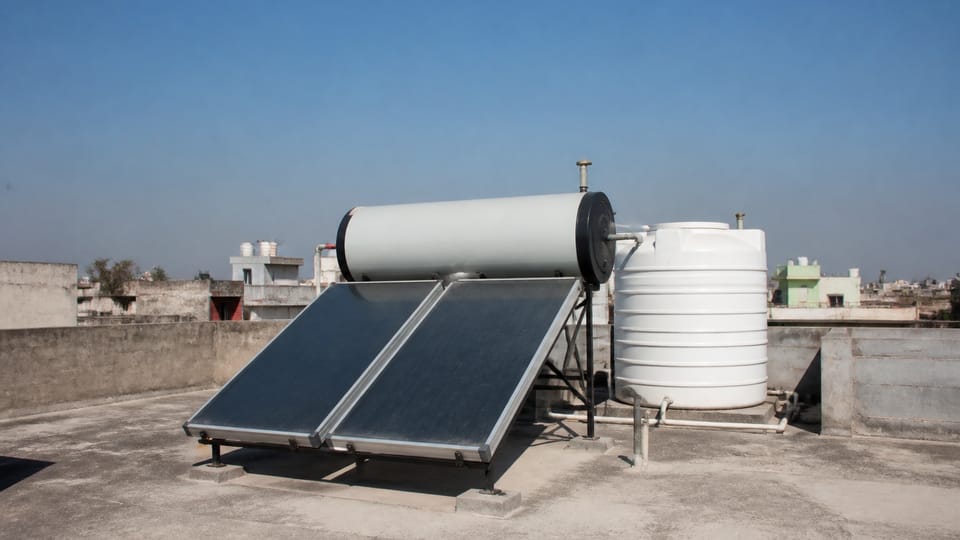
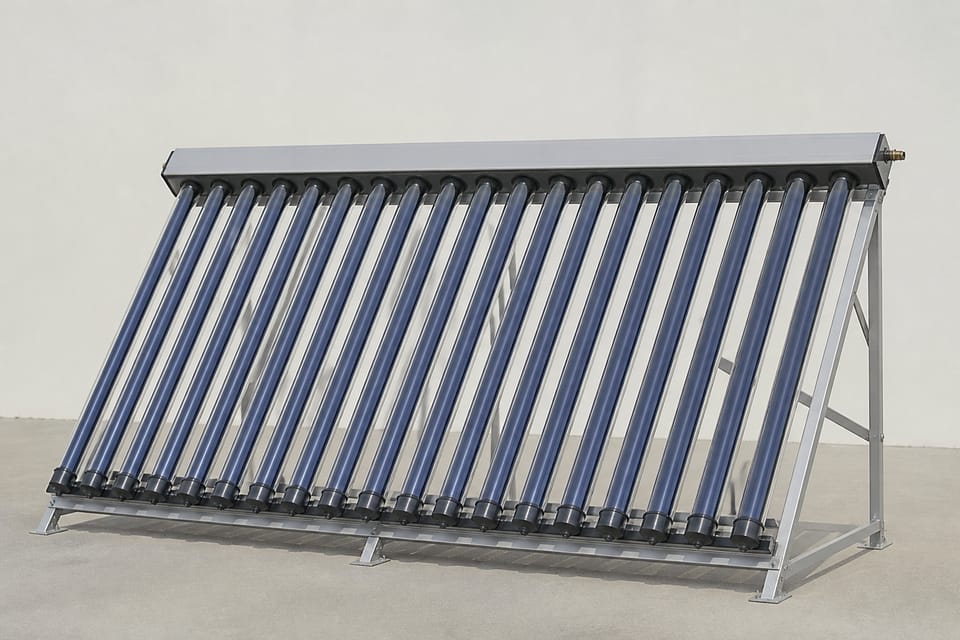
IS 12976 says the collector type depends on the temperature the water needs and the climate. It says the most widely used collector is the flat plate (clause 4.1). It also names evacuated tube, concentrating and flat plate types as possible.
Flat plate or evacuated tube?
| Point | Flat plate | Evacuated tube |
|---|---|---|
| What it is | A flat panel with a sun-absorbing plate and pipes | Glass tubes, each with a vacuum layer, joined to a tank |
| What IS 12976 says | The most widely used type (clause 4.1) | One of the types the standard names (clause 4.1) |
| Hard water | The standard recommends a heat exchanger where water is very hard (thermosyphon system, clause 3.2.1(e)) | A closed loop is used where water is too hard or acidic (clause 3.3.1) |
| Cold climate | A closed loop is recommended in very cold climates (clause 3.3.1), with antifreeze added to the loop (clause 8.1.1) | Same advice for the closed loop (clause 3.3.1) |
| Glass | Usually a glass cover over the plate (practice) | The glass tubes need care in handling and installation (practice) |
The standard does not rank the two. Choose with the installer by your water hardness, your winter temperature and your roof space. Practice: ask which collector suits your city, and why.
Water that is hard, or very cold
Hard water leaves scale, which blocks pipes and can clog the collector. IS 12976 says to avoid scaling, the water should be de-ionised or neutral in pH, or inhibitors should be added (clause 9.1.5). It also says a closed loop, with a heat exchanger, is used where water is too hard or acidic (clause 3.3.1).
In a very cold climate, the standard recommends a closed loop to protect the system from freezing (clause 3.3.1), with antifreeze added to the loop (clause 8.1.1). Freezing in winter may damage the whole system, so freeze protection is important (clause 8.1). One method is to drain the collector when freezing is sensed, with an automatic air vent at the highest point (clause 8.1.2 and Fig. 7).
Roof, wind and sun
A solar water heater on a roof means fixings through the roof. IS 12976 says a roof location needs the building envelope to be penetrated for the mounting hardware, the piping and the wiring (clause 10.1). Wind can lift the collectors from underneath, and the wind load, with the roof area involved, should be determined according to accepted engineering procedures (clause 10.1).
The standard does not give a roof load figure or name who must sign the check. Practice: get a structural engineer to check the roof for the filled tank, the collector and the frame, and the fixings. Practice: keep the roof waterproof around every fixing. The architect and engineer guide explains who does what, and the pre-monsoon checklist lists the roof checks before the rains.
The standard says the collector should always be kept facing due south (clause 4.1.2). Shading from nearby buildings or trees can reduce the output, so check the shadow on the roof before you buy (practice).
Where should the tank go?
IS 12976 says the storage tank should be placed as near to the collector as possible, to reduce the piping length and the heat loss. The tank should be properly insulated (clause 10.2). In an active system, the tank may be placed inside the building (clause 10.2). Practice: the tank position decides the pipe run, so ask the installer and the plumber to agree it before the roof work starts.
The plumbing
IS 12976 asks for a short pipe run with as few joints and elbows as possible, and leak-proof joints. The pipes must be insulated and weatherproof. The pipes must slope so the collector drains, with no inverted U loops that trap air. The valves must be easy to reach for an emergency shut-off. The sensor wiring must be moisture-proof and kept away from power lines (clauses 10.3, 10.3.1 and 10.3.2).
Three other Indian standards bear on the plumbing:
- IS 2065 says no supply pipe may connect directly to a hot-water system except through a feed cistern (clause 8.2.4).
- IS 2065 says polythene and PVC pipes should not be laid on hot surfaces or close to hot-water pipes (clause 6.2.6).
- IS 15778 covers CPVC pipes for hot and cold water. Its guidance says to hang or strap CPVC loosely, to allow for expansion (Annex E, clause E-2.9). See the CPVC guide for the pipe choice.
Do I still need an electric back-up?
It depends on the climate. IS 12976 says an auxiliary heater is not needed in hot or tropical weather. In cold regions with low sunshine, an auxiliary heater run by electricity, fuel or gas is needed (clause 5). The standard does not require an electric heater; the back-up can be fuel or gas.
Check the back-up with care. The evacuated-tube standard, IS 16544, does not cover a system with a back-up heater built in as an integral part, because the heater can change the performance (clause 1.2). So a tank with an electric heater inside may be outside that standard. Ask the installer which standard the system is built to.
Practice: if there is an electric back-up, it needs its own protected circuit, and the earthing must be done properly. The MCB, RCCB and RCBO guide and the earthing guide explain the protection.
Overheating and freezing
IS 12976 warns that liquid expansion or excess pressure can burst the pipes or the tanks, and that steam or gas in the system can stop the flow (clause 8.2). The evacuated-tube standard says the system must not need special action from the user to return to normal after long high sun with no hot-water draw (IS 16544 clause 5.2.1.1). If the overheat protection depends on electricity or cold-water supply, the instructions and the system must say so clearly (clause 5.2.1.3).
Ask the installer how the system protects itself from overheating and from freezing, and whether that protection needs power or water.
What should I ask before I buy?
These are practice questions, based on the standards above:
- Which collector suits my water and my winter, and why?
- Who has checked the roof for the filled tank, the collector, the wind load and the fixings?
- Where will the tank go, and what is the pipe run?
- Is there a back-up heater? Is it fuel, gas or electric, and which standard is the system built to?
- How does the system protect itself from overheating and freezing?
- Will you give me the manual, the design, the warranty and the maintenance schedule in writing?
What mistakes should I avoid?
- Buying on price alone, without a roof check.
- Fixing the collector through the roof without sealing the penetrations.
- Choosing a collector without checking the local water hardness.
- Laying PVC or polythene pipes on hot surfaces or close to hot-water pipes (IS 2065 clause 6.2.6), or running a hot-water loop that traps air (IS 12976 clause 10.3.1).
- Assuming a back-up heater is not needed in a cold region.
Frequently asked questions
Is a solar water heater better than a geyser?
The standard does not rank them. It depends on your climate, your roof and how much you rely on sunshine. Many systems keep a back-up, and the back-up decides how the system behaves on a cloudy day.
Flat plate or evacuated tube for my city?
IS 12976 says the choice depends on the temperature the water needs and the climate. Ask the installer, who should know your local water and winter.
Can my roof take it?
An engineer should check. The standard says the wind and roof loads must be determined by accepted engineering procedures. It does not give a number for a house roof.
Do I need an electric geyser as well?
Not in a hot or tropical climate. In a cold region with low sunshine, the standard says a back-up is needed, and it can be electric, fuel or gas.
Related guides
- Water tank size for a house
- CPVC vs UPVC pipes for home plumbing
- Architect, engineer and contractor for a house
This guide is general information. Read the disclaimer. Your engineer decides the roof check, and your installer and plumber decide the layout for your house.
Sources
- IS 12976:2023, Solar Water Heating Systems: Code of Practice (first revision). Clauses 1.1, 3.2.1, 3.3, 4.1, 4.1.2, 5, 8.1, 8.2, 9.1.5, 10.1 to 10.3 and Fig. 7 read.
- IS 16544:2016, All Glass Evacuated Tubes Solar Water Heating System. Clauses 1.1, 1.2, 5.1.2, 5.2.1.1 and 5.2.1.3 read.
- IS 13129 (Part 4):2023, Solar heating: domestic water heating systems, determination of durability and reliability. Purpose clauses 4.1 and 5.1 read. IS 13129 (Part 1):2023, clause 1.4 read.
- IS 2065:1983, Code of Practice for Water Supply in Buildings. Clauses 6.2.6 and 8.2.4 read. The cover reads reaffirmed 2001.
- IS 15778:2007, CPVC pipes for potable hot and cold water distribution supplies. Clause 1 and Annex E (E-2.9) read.
General information only. It is not a structural design or professional advice. Ask a licensed structural engineer or architect to check your plans and site.