
Short answer
What is the difference between a wash basin and a sink? NBCS 2026 treats both as waste appliances with a waste hole and a trap. A wash basin is a vitreous china fixture with a soap recess, covered by IS 2556 Part 4. A sink is used in the kitchen or laboratory for cleaning utensils, and the domestic stainless steel sink is covered by IS 13983. The minimum waste outlet and trap are 32 mm for a basin and 40 mm for a domestic sink.
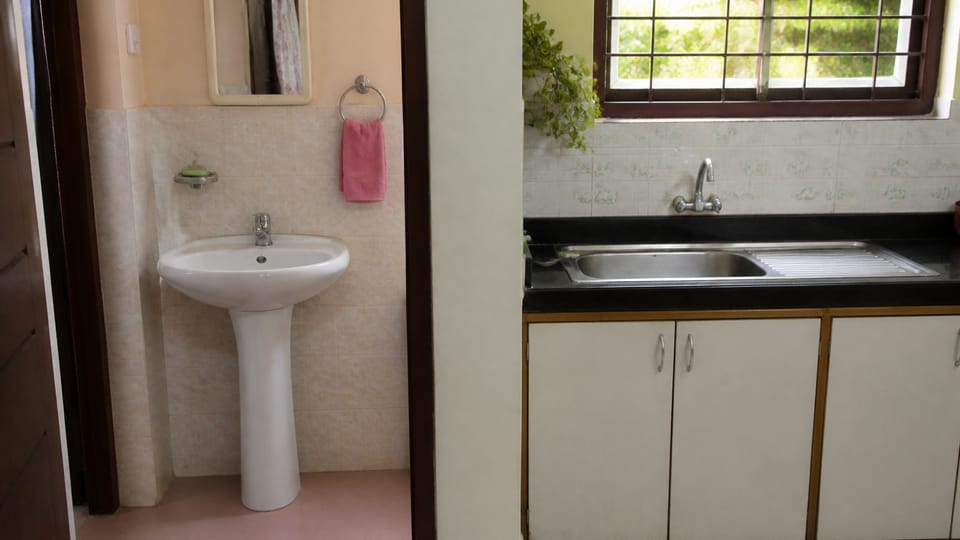
On this page (9)
People use “wash basin” and “sink” for the same thing, and then argue with the plumber about the waste point. The standards do separate them, by what each is for, what it is made of, and the trap and outlet each needs. This page sets out that difference, the standard basin sizes and sink types, and what to fix on the plan before the platform and tiles go in. It names no brand and gives no price, cabinet size or platform height. For the pipe, trap and grease of a kitchen sink, see kitchen sink drain plumbing: pipe, trap and grease.
What is the difference?
| Wash basin | Sink | |
|---|---|---|
| NBCS 2026 class | Waste appliance (clause 4.1.2) | Waste appliance (clause 4.1.2) |
| What the clause says | One-piece construction with a combined overflow, “preferably” soap holding recesses, and a circular waste hole (4.1.2.1); the clause does not state a use | “used in kitchen and laboratory for the purpose of cleaning utensils/apparatus” and for general water (4.1.2.3) |
| Overflow | Usually a combined overflow; IS 2556 Part 4 allows with or without (6.1) | May be made with or without an overflow |
| Standard | IS 2556 (Part 4):2004, vitreous china | IS 13983:1994, stainless steel sinks for domestic purposes (laboratory sinks of vitreous china are IS 2556 Part 5) |
| Smallest waste outlet (NBCS 4.5.3.6.1.5); minimum trap size (Table 20) | 32 mm | 40 mm for a domestic or kitchen sink (50 mm for hotel and canteen sinks) |
| Drainage fixture units (Table 20) | 1 | 2 for a kitchen sink |
NBCS 2026 clause 2.102 defines a waste appliance as one “for the collection and discharge of water after use for ablutionary, culinary and other domestic purpose”, and clause 2.104 calls the discharge from wash basins and sinks sullage. Both go into a trap: clause 4.5.3.3 asks that the waste pipe of every bath, wash basin or sink be trapped immediately beneath by an efficient siphon trap, a P trap, with adequate means for inspection and cleaning, and vented into the external air where necessary.
What sizes are standard for a wash basin?
IS 2556 (Part 4):2004, Table 1, lists these patterns and sizes (length by breadth, in mm):
| Pattern | Sizes (mm) |
|---|---|
| Flat back | 660 x 460 (surgeon’s basin), 630 x 450, 550 x 400, 450 x 300 |
| Angle back | 600 x 480, 400 x 400 |
Clause 4.2 allows other patterns and sizes “where so agreed to between the manufacturer and the purchaser”. So a basin in a shop may not match a table size; read the maker’s data sheet for the one you buy. The standard asks that a basin be of one-piece construction with all internal angles easy to clean (clause 6.1), with a circular waste hole fitted for a waste fitting (clause 6.3), and an overflow slot, if provided, not larger than 64 mm horizontally (clause 6.5). For the other dimensions of a basin, such as tap holes and wall fixing, see the standard itself; this page does not give them.
What types of sink does the standard describe?
IS 13983 clause 3 describes two ways a stainless steel sink fits: a sit-on sink that lines up with a base unit, and an inset sink that fits into an aperture in a work top. Clause 4 lists the types by the number of bowls and drainers: single bowl without a drainer, double bowl without a drainer, single bowl with a single or double drainer, and double bowl with a single or double drainer. The standard adds that other types may be made as the manufacturer and buyer agree. It says the sheet is austenitic stainless steel to IS 5522 (clause 5), and that if an overflow hole is provided, it must lie below the spillover level (clause 7.6). It does not specify how sinks are supported or fixed and sealed (clause 1).
IS 13983 covers stainless steel. The standard IS 771 for fire-clay kitchen sinks and IS 8718 for enamelled steel sinks are named in its foreword, and BIS lists both as withdrawn. We found no BIS standard titled for granite or quartz composite sinks. For those, ask for the maker’s data sheet.
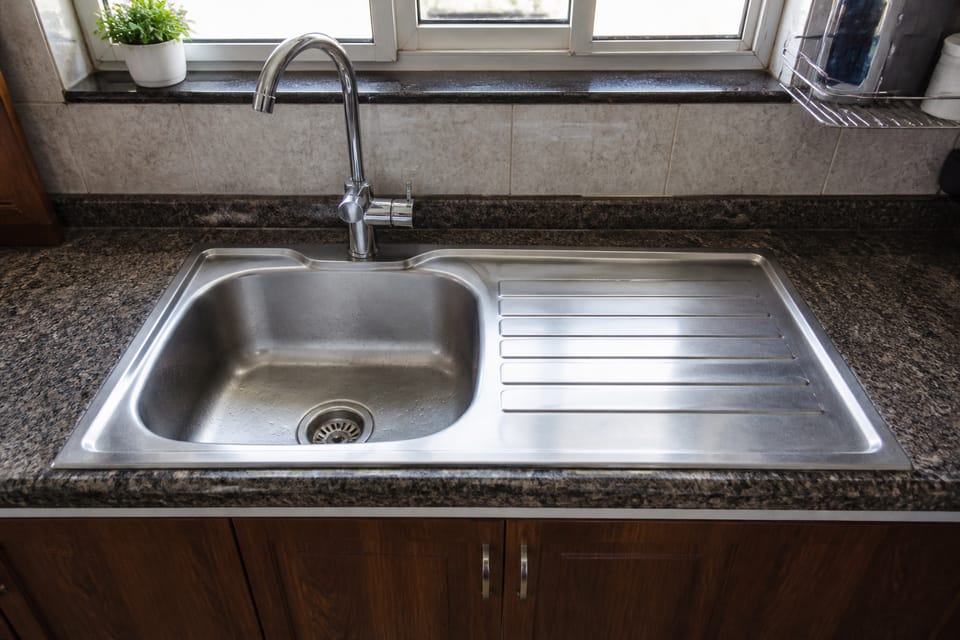
Where does each go? (practice)
This is practice, apart from the clauses named.
- Wash basin: in a bathroom, a wash area, or near the dining space. A dining-area basin usually needs its own water and waste point and a tiled splash area on the plan.
- Sink: in the kitchen, and in a utility or wash area if you plan one. Choose it before the platform is cast or the stone is cut, because the cut-out, the waste point and the tap reach all follow from it.
- Both: water and waste points marked on the plan before tiling, with the trap reachable for cleaning. NBCS Annex D shows typical mounting drawings for both; they are drawings, not rules.
What mistakes should I avoid? (practice)
- Waste point at the wrong height or place for the fixture you finally buy.
- A trap boxed in with no way to reach it.
- A sink chosen after the platform is laid.
- A blocked or missing overflow where the fixture has one.
- A basin too close to a wall or in a door swing.
- A tap spout that does not reach the bowl.
- A wall-hung basin on a weak wall.
- A kitchen sink in a bathroom, or a basin used for utensils.
What should I ask the plumber? (practice)
- Where will the waste point be, and at what height?
- How will I reach the trap?
- Does the fixture have an overflow, and where does it drain?
- Does the tap reach the bowl, and does the platform cut-out match the sink?
- Who fixes the wall-hung basin, and into what wall?
Frequently asked questions
Can I use a kitchen sink as a wash basin?
NBCS treats both as waste appliances. It describes a sink for cleaning utensils and apparatus and does not state a use for a basin. In practice, use a basin for hands and face and a sink for utensils.
What is the standard size of a wash basin?
IS 2556 Part 4 Table 1 lists six sizes, from 450 x 300 mm to 660 x 460 mm. Other sizes may be agreed with the maker.
What is the standard size of a kitchen sink?
IS 13983 gives types by bowls and drainers. This page does not give its size table; use the maker’s data sheet and the cut-out template.
Does a double bowl sink need two traps?
The clauses we read do not say. NBCS Annex D shows two basins on one common waste, as an illustration only. Ask your plumber where the waste outlets join before the trap.
Do both need a trap?
Yes. NBCS 4.5.3.3 asks that the waste pipe of every bath, wash basin or sink be trapped immediately beneath it.
Related guides
- Kitchen sink drain plumbing: pipe, trap and grease
- House drainage system explained: soil, waste and rainwater pipes
- Plumbing work during house construction: stages and inspection points
This guide is general information. Read the disclaimer. Your plumber and engineer decide the fixtures for your house.
Sources
- SP 7:2026, National Building Construction Standards (NBCS) 2026, Part E Section 2, Drainage and Sanitation: clauses 2.102, 2.104, 4.1.2.1, 4.1.2.3, 4.5.3.3, 4.5.3.6.1.5, Table 20 and Annex D Figures 20 to 23 (page images read). From an unofficial archive.org copy.
- IS 2556 (Part 4):2004, Vitreous Sanitary Appliances (Vitreous China), Specific Requirements of Wash Basins, with Amendments 1 and 2: clauses 1, 4.1, 4.2, 6.1, 6.3, 6.5 and Table 1 (page images read). BIS lists it as in force, valid to 2031-02-27.
- IS 13983:1994, Stainless Steel Sinks for Domestic Purposes, Specification, with Amendment 1 (2005): clauses 1, 3, 4, 5 and 7.6 (page images read; Amendment 1 text layer only). BIS lists it as in force, valid to 2031-01-31.
General information only. It is not a structural design or professional advice. Ask a licensed structural engineer or architect to check your plans and site.